
6 Dec 2025
- 15 Comments
Medication Food Interaction Checker
Check Your Medications
Enter any medication name to see if it needs to be taken with food or on an empty stomach
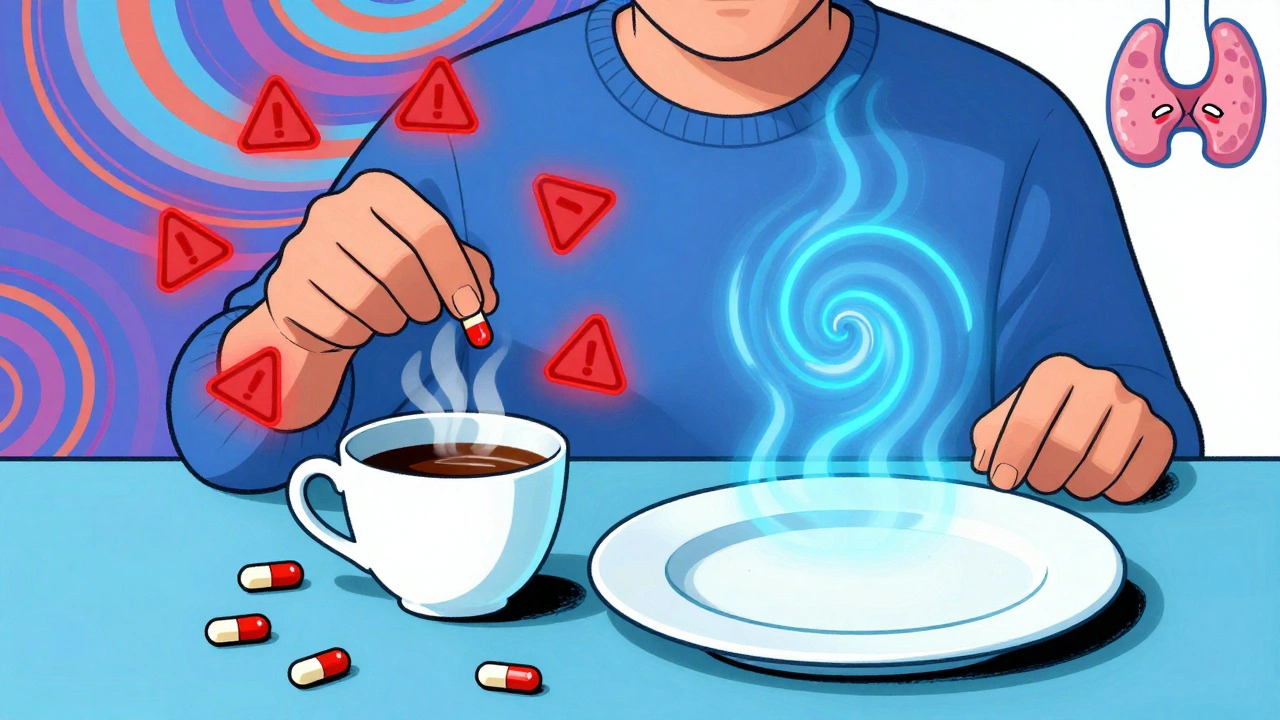
Ever taken a pill with your morning coffee and wondered why it didn’t seem to work? You’re not alone. Millions of people take medications without realizing that what they eat-or don’t eat-can make the difference between a drug working properly and it doing almost nothing. In fact, food interactions can cut the effectiveness of some medications by half or spike side effects to dangerous levels. This isn’t guesswork. It’s science-and it’s critical.
Why Food Changes How Medicines Work
Your stomach isn’t just a passive container. It’s a chemical factory. When you eat, your body shifts gears: acid levels rise and fall, bile flows, digestion slows or speeds up, and blood flow to your gut changes. All of this affects how a pill dissolves, gets absorbed, and enters your bloodstream. Take levothyroxine, the most common thyroid medication. If you take it with breakfast-especially if that breakfast includes coffee, milk, or calcium-fortified cereal-your body absorbs 20% to 50% less of the drug. That might sound small, but for someone with hypothyroidism, it means your TSH levels stay high, you feel tired, gain weight, and your doctor keeps increasing your dose. All because of timing, not dosage. On the flip side, some drugs need food to work at all. Statins like Lipitor and Zocor are better absorbed when taken with a meal. But here’s the catch: grapefruit juice? It can make those same statins 300% to 500% more potent in your blood. That’s not better-it’s risky. It can lead to muscle breakdown, kidney damage, even death. The FDA requires drug makers to test their products with both high-fat meals (800-1,000 calories) and low-fat meals. Why? Because food isn’t one thing. A bowl of oatmeal behaves nothing like a cheeseburger when it comes to drug absorption.Medications That Must Be Taken on an Empty Stomach
Some drugs are like delicate instruments. They break down in the wrong environment. Here’s who needs to stay away from food:- Levothyroxine (Synthroid): Take it 30 to 60 minutes before breakfast. Even a sip of coffee or a bite of toast can cut absorption. Many patients report feeling better only after switching to taking it at 4 a.m. and waiting 90 minutes.
- Alendronate (Fosamax): This osteoporosis drug needs an empty stomach and a full glass of water. If you eat before or after, absorption drops by 60%. That means your bones don’t get the protection they need.
- Sucralfate (Carafate): Used for ulcers, it needs to coat the stomach lining. Food gets in the way. Take it 1 hour before meals.
- Ampicillin: A common antibiotic. Food reduces its peak concentration by 35%. That’s not just less effective-it can let bacteria survive and grow resistant.
- Zafirlukast (Accolate): For asthma. Food cuts absorption by 40%. Take it 1 hour before or 2 hours after eating.
- Omeprazole (Prilosec) and Esomeprazole (Nexium): These proton pump inhibitors block acid production triggered by food. Take them 30 to 60 minutes before your first meal. If you take them after, they’re fighting yesterday’s acid, not today’s.
Medications That Need Food to Work Right
Other drugs are like fire starters-they need fuel. Food doesn’t just help them absorb-it protects you.- NSAIDs (Ibuprofen, Naproxen): These painkillers irritate your stomach lining. Taking them on an empty stomach increases your risk of ulcers by 50% to 70%. Food acts like a shield. Always take them with a meal or snack.
- Aspirin (high-dose): For pain, not heart protection. Food cuts stomach irritation from 25% down to 8%. That’s a huge difference in comfort and safety.
- Duloxetine (Cymbalta): This antidepressant causes nausea in about half of users. Taking it with food lowers that risk by 30%. If you’re struggling with side effects, try eating a small cracker before your pill.
- Statins (Atorvastatin, Simvastatin): As mentioned, food helps absorption. But avoid grapefruit juice completely. It’s not just a warning-it’s a red flag. One glass can overload your system.
- Metformin: Often prescribed for diabetes. Taking it with food reduces nausea and diarrhea. Many patients stop taking it because they didn’t know this simple trick.
The Science Behind the Rules
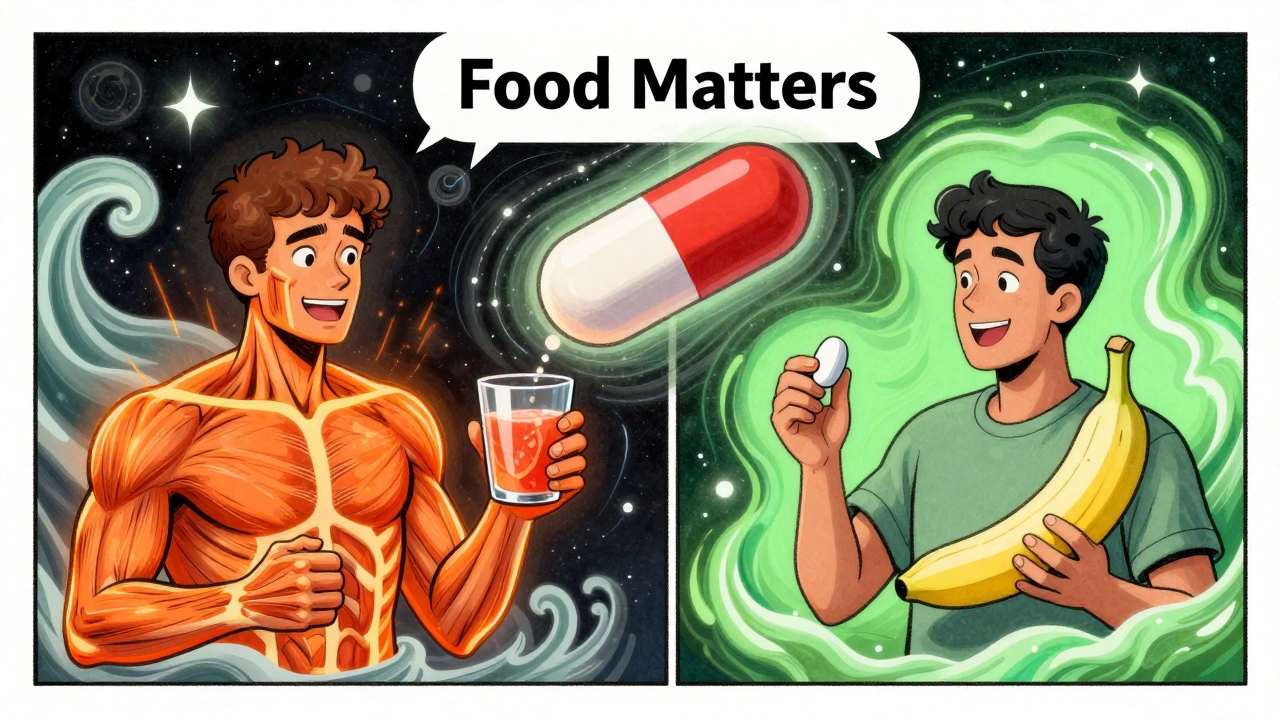
It’s not magic. It’s chemistry and biology. - Stomach acid: Food raises pH from 1-2 to 3-5. That’s enough to destroy acid-sensitive drugs like penicillin V, which degrades 40% faster in higher pH. - Gastric emptying: A fatty meal can delay stomach emptying by 90 to 120 minutes. That delays absorption of time-sensitive drugs like levothyroxine, reducing TSH suppression by 22%. - Bile release: Fat triggers bile, which helps dissolve fat-soluble drugs like griseofulvin. Without food, absorption drops by 50%. - Chelation: Calcium in dairy or iron in supplements can bind to tetracycline antibiotics, blocking absorption by 50% to 75%. That’s why you’re told to wait 2 hours before or after dairy. The FDA now requires food-effect studies for nearly all new drugs. In 2022, 68% of newly approved drugs came with specific food instructions. That number was only 45% in 2010. This isn’t a trend-it’s a standard.What Happens When You Ignore the Rules
You think it’s harmless. But the numbers say otherwise. - A 2021 JAMA study found that 30% of medication non-adherence is due to confusion over food timing. That costs the U.S. healthcare system $290 billion a year. - The Institute for Safe Medication Practices tracks 12,000 to 15,000 medication errors each year tied to food timing. Levothyroxine errors alone make up 22% of those cases. - One Drugs.com analysis of 12,450 patient reviews showed that 37% of complaints about PPIs not working were because people took them after meals. - In a 2022 survey of 10,000 patients, 65% admitted they ignored food instructions. Of those, 41% saw reduced effectiveness and 29% had worse side effects. The most common mistake? Taking NSAIDs without food. It leads to stomach pain in 73% of cases. That’s not just discomfort-it’s ER visits, hospitalizations, and long-term damage.How to Get It Right Every Time
You don’t need to memorize a list. Just use these simple rules:- The 2-1-2 Rule: For empty stomach meds, take them 2 hours after eating, or 1 hour before. If you’re unsure, go with 2 hours after.
- With food: Take it during or within 30 minutes of a meal. It doesn’t have to be a big meal-just enough to coat your stomach.
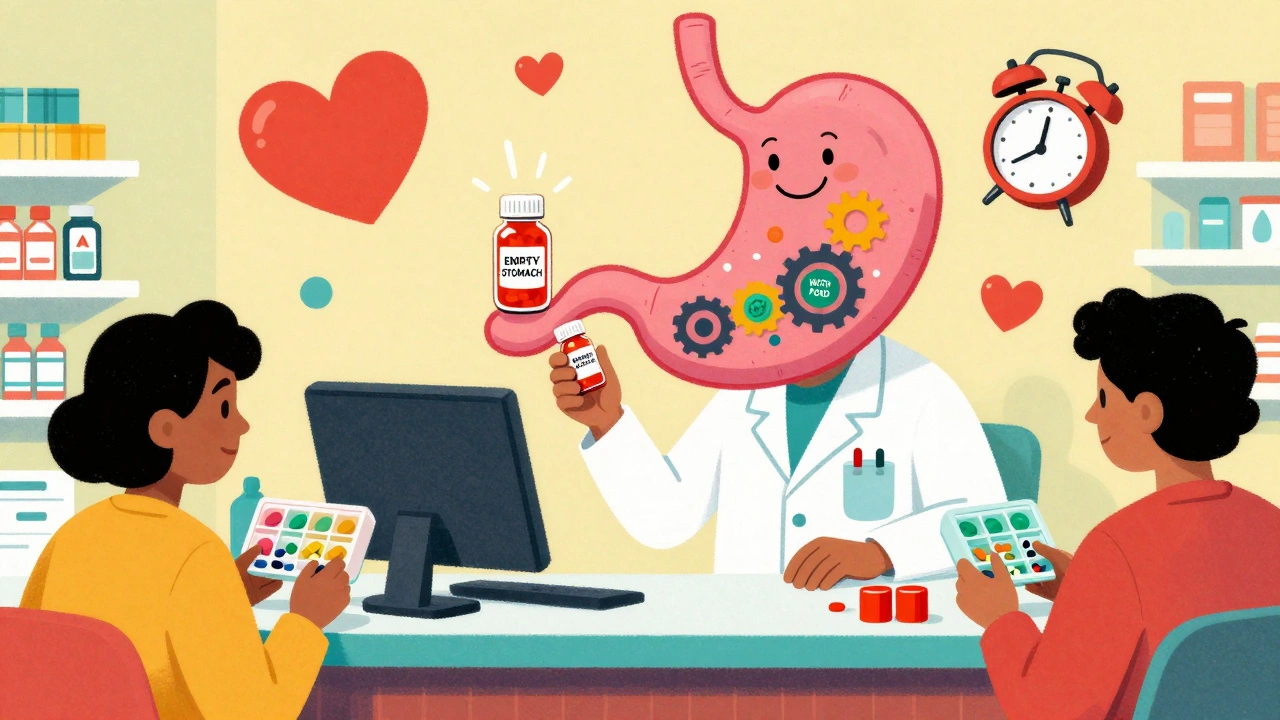
- Use color-coded stickers: Pharmacies like CVS and Walgreens now put red stickers on bottles for “empty stomach” and green for “with food.” In one pilot, this raised correct use from 52% to 89%.
- Use a pill organizer: Label compartments “AM: empty stomach” and “AM: with food.” A 2022 study showed this improved adherence by 35%.
- Try a reminder app: Apps like Medisafe and GoodRx send alerts: “Take your pill 30 minutes before breakfast.” Users reduce errors by 28%.
- Stagger your meds: If you take 5 pills a day, space them out. Empty stomach meds at 7 a.m., breakfast at 8 a.m., food-required meds at 8:15 a.m. It works.
What’s Changing in the Future
The good news? Science is catching up. - Johnson & Johnson’s new Xarelto Advanced uses a pH-resistant coating that works the same whether you eat or not. It cuts variability from 35% to just 8%. - Researchers at the University of Michigan are testing nanoparticle levothyroxine that bypasses stomach acid entirely. Early results show 92% consistent absorption, even with food. - The FDA is considering dropping food-effect testing for 37% of generic drugs where data shows no real impact. That could speed up cheaper drug availability. But here’s the truth: even with these advances, 75% of medications you’re taking today still need careful timing. The future is coming-but not fast enough to make you lazy now.When in Doubt, Ask Your Pharmacist
Doctors often don’t have time to explain food timing. But pharmacists do. A 2021 study found that 92% of pharmacists give clear food instructions, compared to just 45% of physicians. Don’t assume. Don’t guess. Ask. Bring your list of meds to the pharmacy. Say: “Can you tell me which ones need to be taken with food and which ones need an empty stomach?” It’s the single most effective thing you can do to make sure your meds actually work.Can I take my medication with just a sip of water?
Yes, water is fine for most medications, whether taken with or without food. But avoid juice, milk, or coffee unless your pharmacist says it’s okay. Grapefruit juice, for example, can dangerously boost levels of statins and some blood pressure drugs.
What if I forget and take my pill with food?
If you took a medication that should be on an empty stomach with food, don’t double up. Wait until your next scheduled dose and go back to the correct timing. Taking extra can be dangerous. For food-required meds, if you forgot to eat, take it with a small snack like a cracker or banana-don’t skip it entirely.
Do supplements count as food?
Yes. Calcium, iron, magnesium, and even multivitamins can interfere with antibiotics like tetracycline or thyroid meds. Take supplements at least 2 hours apart from these medications. Don’t assume they’re harmless just because they’re “natural.”
Why do some meds say “take with food” but don’t specify what kind?
Most of the time, it just means any meal-even a light one. But for fat-soluble drugs (like some antifungals or statins), a high-fat meal helps absorption. If you’re unsure, ask your pharmacist. They can tell you if a snack is enough or if you need something heavier.
Is it okay to take all my pills at once?
No, unless your doctor or pharmacist says so. Mixing meds can cause interactions. Also, some need empty stomachs, others need food. Taking them all together means some won’t work right. Space them out. Use a pill organizer with labeled times.
Can I take my thyroid pill at night instead of in the morning?
Yes, if you can take it at least 3-4 hours after your last meal. Some people find nighttime dosing easier to remember and avoid morning food interference. Just be consistent-same time every day. Studies show it works just as well as morning dosing if timing is controlled.
Desmond Khoo
December 7, 2025I used to take my levothyroxine with my coffee like a champ... until I started feeling like a zombie. Switched to 4 a.m. and now I actually have energy. 🙌 Life-changing. Don't sleep on this stuff.
Louis Llaine
December 8, 2025So... we're supposed to be pharmacists now? I just want my pill to not make me puke. Why does everything have to be so complicated?
Jane Quitain
December 8, 2025OMG I JUST REALIZED I’VE BEEN TAKING MY Cymbalta ON AN EMPTY STOMACH FOR 2 YEARS 😭 I’M SO SORRY MY STOMACH. I’M SWITCHING TO A CRACKER NOW. THANK YOU FOR THIS POST!!!
Ernie Blevins
December 10, 2025This is just pharmaceutical fearmongering. Your body knows what to do. They just want you to buy more pills and follow more rules. Wake up.
Nancy Carlsen
December 10, 2025I love how this post breaks it down like a friend explaining it over coffee ☕️ Seriously, if you’re taking meds, please don’t guess. Talk to your pharmacist. They’re the real MVPs. 🤗💖
Ted Rosenwasser
December 11, 2025The FDA’s 800-1,000 calorie high-fat meal testing protocol is scientifically dubious. Most humans don’t consume that much fat in a single sitting. The data is skewed toward extreme conditions that rarely reflect real-world pharmacokinetics. Also, grapefruit juice interactions are overblown - it’s only a problem with specific CYP3A4 substrates. Not all statins. Not all people.
Kyle Oksten
December 11, 2025There’s a quiet dignity in following the science, even when it’s inconvenient. We don’t need to romanticize it. We just need to respect it. Your body isn’t a machine you can hack - it’s a system that evolved over millions of years. Treat it like one.
Sam Mathew Cheriyan
December 11, 2025Wait… so the government is telling us what to eat with our pills? Sounds like a big pharma plot to sell more color-coded stickers and apps. I bet they’re tracking us through our pill organizers too. 😏
Olivia Hand
December 13, 2025I never thought about how bile release affects absorption… but now I’m wondering if my morning avocado toast is secretly sabotaging my antifungal. Should I be eating oatmeal instead? Or is this overthinking?
Ashley Farmer
December 14, 2025This post made me cry a little. I’ve been skipping my metformin because it made me sick. I had no idea eating a banana first would help. Thank you for making me feel less alone.
Jennifer Anderson
December 15, 2025i just started taking my omeprazole after dinner and now i feel like a new person 😅 why didnt anyone tell me this sooner??
Sadie Nastor
December 16, 2025I use the color-coded stickers now and it’s such a small thing but it makes me feel so in control. Like I’m not just a patient, I’m someone who shows up for myself. 💚
Sangram Lavte
December 16, 2025In India, we don't have these stickers or apps. Most people just take pills with tea or milk. I told my uncle about the calcium-levothyroxine thing and he said, 'But we've been doing this for 30 years.' I didn't argue. But I still take mine alone.
Oliver Damon
December 18, 2025The pharmacokinetic variability introduced by food interactions is a significant confounder in therapeutic drug monitoring. The 2-1-2 rule is a pragmatic heuristic, but it lacks granularity for polymorphic CYP enzymes and gastric pH heterogeneity across populations. A more robust approach would involve population pharmacokinetic modeling calibrated with real-world adherence data.
Kurt Russell
December 20, 2025I used to be a mess with my meds - missed doses, took them wrong, felt awful. Then I got a pill organizer with AM/PM labels, set 3 alarms, and started asking my pharmacist questions. Now I’m running marathons. This isn’t just about pills - it’s about reclaiming your life. DO IT.