
2 Jan 2026
- 15 Comments
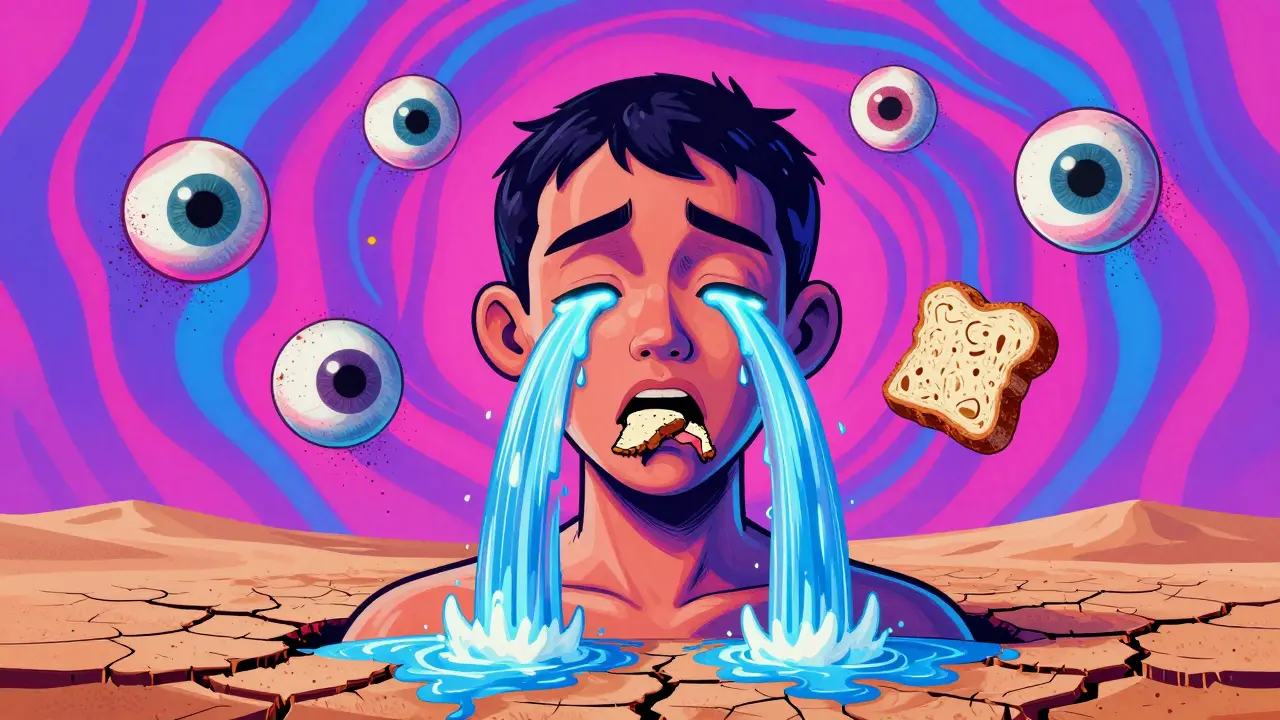
Sjögren’s Syndrome isn’t just about being thirsty or having gritty eyes. It’s when your immune system turns on the very glands that keep you moist-your tear ducts, saliva glands, and more. Imagine waking up every day with cotton in your mouth, eyes that burn like sandpaper, and a throat so dry you can’t swallow a cracker without water. For 4 million Americans, this isn’t imagination-it’s reality. And most of them spent years being told it’s just stress, aging, or not drinking enough water.
What Happens When Your Body Stops Making Moisture
Sjögren’s Syndrome attacks exocrine glands, the ones that produce fluids like tears, saliva, sweat, and vaginal lubrication. These aren’t minor inconveniences. Saliva protects your teeth, helps you taste food, and prevents infections. Tears keep your eyes clear and comfortable. When these stop working, life changes fast.People with Sjögren’s often describe dry eyes as a constant gritty feeling, like there’s dust under the eyelids. Some can’t wear contact lenses. Others blink so hard their eyes water-only to feel worse minutes later. Dry mouth isn’t just discomfort. It turns meals into tasks. Bread, chips, meat-all become impossible without gulping down water. Taste fades. Cavities explode. Dentists see patients in their 40s with 20 missing teeth, not from poor hygiene, but from zero saliva protection.
And it’s not just the mouth and eyes. About half of women with Sjögren’s experience vaginal dryness, leading to pain during intimacy and emotional strain. Skin gets itchy, flaky, and cracked. Lungs can dry out, triggering a persistent cough. Nerves in hands and feet tingle or go numb. Joints ache like arthritis. Fatigue hits so deep that even after a full night’s sleep, you feel like you’ve run a marathon.
Why It’s So Hard to Diagnose
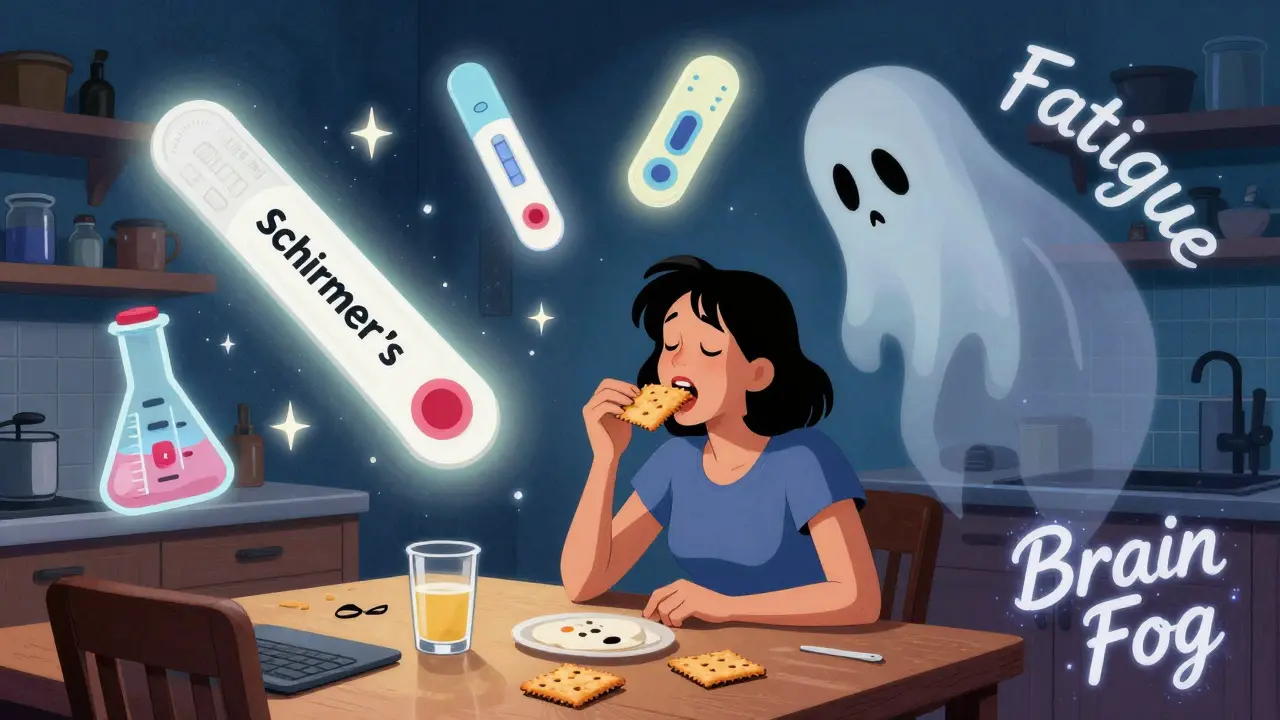
Most doctors aren’t trained to think of Sjögren’s when someone walks in with dry eyes. They assume allergies, screen time, or dehydration. Even dentists might blame poor hydration. The average time to diagnosis? 2.8 years. Sixty-eight percent of patients see three or more doctors before getting the right answer.Why? Because symptoms creep in slowly. No fever. No rash. No sudden crash. It’s a whisper, not a shout. And the tests aren’t simple. Doctors need to confirm two things: objective signs of dryness and autoimmune markers. The Schirmer’s test measures how many millimeters of tears your eye produces in five minutes. Below 5mm? That’s abnormal. A salivary flow test checks if you make less than 1.5mL of saliva in 15 minutes. That’s less than a teaspoon.
Then there’s blood work. About 60-70% of patients have anti-SSA/Ro and anti-SSB/La antibodies. But even then, some people test negative and still have the disease. A lip biopsy-the only definitive test-looks for clusters of immune cells invading the salivary glands. It’s invasive, but it’s the gold standard.
And here’s the kicker: Sjögren’s often hides behind other autoimmune diseases. About 30-50% of cases are secondary, meaning they show up with lupus, rheumatoid arthritis, or scleroderma. That’s why rheumatologists are usually the ones who catch it. But if you’re seeing a dermatologist for dry skin or a gynecologist for vaginal pain, they might miss the bigger picture.
It’s Not Just Dryness-It’s Systemic
Many think Sjögren’s is a “dryness disease.” That’s wrong. It’s a systemic autoimmune disorder. The immune system doesn’t stop at glands. It can attack the kidneys, lungs, liver, nerves, and even blood vessels.Up to 25% of patients develop lung issues-dry cough, shortness of breath, or even scarring in the lungs. About 10-15% get neuropathy: burning, tingling, or loss of sensation in their limbs. Brain fog is common. Patients report forgetting words mid-sentence, struggling to focus in meetings, or feeling mentally drained after simple tasks. One Reddit user called it “the invisible disability that makes you look lazy.”
And then there’s lymphoma. People with Sjögren’s have a 4-5% lifetime risk of developing non-Hodgkin lymphoma-ten times higher than the general population. That’s why long-term monitoring matters. Regular check-ups, blood tests, and awareness of new lumps or night sweats can catch it early.
What Treatments Actually Work
There’s no cure. But there are ways to manage it-and some new ones are finally coming.For dry eyes, preservative-free artificial tears are the first line. You might need them 8-10 times a day. Prescription eye drops like cyclosporine (Restasis) or lifitegrast (Xiidra) reduce inflammation and help your eyes make more tears over time. For dry mouth, pilocarpine (5mg three times daily) and cevimeline (30mg three times daily) stimulate saliva production. About 60-70% of patients report real improvement.
Dental care is non-negotiable. You need check-ups every 3-4 months, not 6. Fluoride treatments, xylitol gum, and alcohol-free mouthwash are essential. Cavities don’t wait.
For joint pain and fatigue, hydroxychloroquine (Plaquenil) is often prescribed. It helps about 30-40% of patients. It’s not a miracle drug, but it’s better than nothing. Newer options are emerging. In June 2023, the FDA approved Efgartigimod (Vyvgart Hytrulo), the first new Sjögren’s treatment in 20 years. In trials, it improved dry mouth symptoms by 35% compared to placebo.
Complementary therapies are everywhere. Fifty-two percent of patients take omega-3 supplements. Twenty-three percent try acupuncture. Eighty-nine percent use specialized oral care products. Some swear by humidifiers, drinking water constantly, or avoiding caffeine and alcohol.
Living With Sjögren’s: The Real Daily Struggles
It’s not the diagnosis that breaks people-it’s the daily grind.You learn to carry water everywhere. You avoid dry foods. You wear sunglasses indoors because the AC makes your eyes sting. You cancel plans because you’re too tired to speak. You feel guilty for needing help. You get told, “It’s all in your head,” or “Just drink more water.”
One patient on MySjogrensTeam wrote: “I had to explain to my partner that my vaginal dryness wasn’t about attraction-it was my immune system attacking my body. It took 18 months to find a doctor who understood.”
Another shared: “I used to love eating sandwiches. Now I can’t. I need to soak every bite in water. I feel like I’ve lost a part of my life.”
Depression affects 42% of patients-five times higher than the general population. The loneliness, the fatigue, the constant medical battles-it adds up.
The Future: New Hope on the Horizon
Research is accelerating. In 2023, the NIH launched the Sjögren’s Precision Medicine Network, enrolling 5,000 patients to match treatments to individual biomarkers. A new blood test, identifying a specific T-cell signature found in 78% of patients, could make diagnosis faster and more accurate.Twelve new drugs are in clinical trials. Three target B-cells-the immune cells that drive the attack on glands. One, a biosimilar of rituximab, is showing promise for severe systemic cases.
The TARGET initiative, a $15 million research project, aims to find genetic markers that predict who will develop serious complications. That means personalized care instead of trial-and-error.
And awareness is growing. Medical schools are adding Sjögren’s to curricula. More rheumatologists are screening for it. But patients still wait too long. Too many still feel dismissed.
What You Can Do Now
If you’ve had dry eyes and mouth for more than three months, and nothing helps:- See a rheumatologist-not just an optometrist or dentist.
- Ask for anti-SSA/SSB blood tests.
- Request a Schirmer’s test and salivary flow test.
- Keep a symptom journal: when your mouth dries, when your eyes burn, how tired you feel.
- Find a support group. The Sjögren’s Syndrome Foundation has resources, forums, and patient guides.
- Don’t accept “it’s just aging.” You deserve better.
Sjögren’s Syndrome doesn’t have to define you. But you need to understand it. You need to advocate for yourself. And you need to know-you’re not alone.
Is Sjögren’s Syndrome the same as dry eye syndrome?
No. Dry eye syndrome can happen from screen use, aging, or environmental factors, but it doesn’t involve the immune system attacking glands. Sjögren’s causes dry eyes as part of a systemic autoimmune disease. People with Sjögren’s also have dry mouth, fatigue, joint pain, and positive autoantibodies-signs absent in simple dry eye.
Can Sjögren’s Syndrome be cured?
There’s no cure yet. But treatments can manage symptoms effectively. New drugs like Efgartigimod and ongoing clinical trials targeting the immune system offer real hope for slowing or stopping disease progression in the future.
Why do so many women get Sjögren’s Syndrome?
About 90% of cases occur in women, especially between ages 45 and 55. Researchers believe hormones, genetics, and immune system differences play a role. Estrogen may influence how the immune system reacts, but the exact reason isn’t fully understood. It’s one of the biggest unanswered questions in autoimmune research.
Does Sjögren’s Syndrome shorten life expectancy?
Most people with Sjögren’s-about 90%-have a normal life expectancy. The biggest risk is lymphoma, which occurs in 4-5% of patients over their lifetime. Regular monitoring, early detection, and managing systemic symptoms can reduce this risk significantly.
What’s the difference between primary and secondary Sjögren’s?
Primary Sjögren’s occurs on its own, without another autoimmune disease. Secondary Sjögren’s develops alongside conditions like lupus or rheumatoid arthritis. Both types cause the same symptoms, but secondary cases are often more complex because they involve multiple autoimmune systems. Diagnosis and treatment are similar, but managing overlapping conditions adds layers.
Can children get Sjögren’s Syndrome?
Yes, though it’s rare. About 3-5% of cases occur in children as young as 8. Pediatric cases often present with dry eyes, joint pain, and fatigue, but dry mouth is less common. Diagnosis is harder because symptoms mimic other childhood illnesses. Pediatric rheumatologists are best equipped to evaluate these cases.
Tru Vista
January 4, 2026SSA/SSB? Schirmer’s test? Ugh, another autoimmune buzzword salad. I got dry eyes from my laptop, not my immune system. Stop overmedicalizing everything.
Also, why are all the pics in these posts of middle-aged white women? 🤔
Vincent Sunio
January 6, 2026One must observe with clinical precision: the conflation of symptomatic relief with disease modification is a persistent fallacy in patient advocacy literature. Efgartigimod, while statistically significant in phase III trials, does not alter disease trajectory-merely palliates. The reliance on anecdotal testimony from Reddit forums undermines the epistemic rigor required for clinical discourse.
JUNE OHM
January 7, 2026THEY DON’T WANT YOU TO KNOW THIS BUT…
Big Pharma is hiding the REAL cure: coconut oil + red light therapy + drinking distilled water from a copper cup at 4:20am 🌙💧
They made Efgartigimod so you keep buying drops. Also, Sjögren’s is just Lyme disease in disguise. 😷🩸
Shanahan Crowell
January 7, 2026I’ve been living with this for 12 years, and honestly? This post nailed it. The fatigue? The brain fog? The way your tongue sticks to the roof of your mouth at 3pm? Yeah. That’s real.
Don’t let anyone tell you it’s ‘just stress.’ You’re not lazy. You’re fighting an invisible war. Keep going. You’re not alone.
Also, try xylitol gum. It’s a game-changer.
Kerry Howarth
January 8, 2026Saliva flow test < 1.5mL? That’s less than a teaspoon. That’s not dry mouth-that’s a desert.
And yes, dentists need to stop blaming hydration. I had 14 cavities by 38. No sugar. No neglect. Just zero saliva. This isn’t a lifestyle issue. It’s immunology.
Tiffany Channell
January 9, 202690% women? Of course. Hormonal imbalance. Feminine biology is inherently fragile. Men don’t get this because their immune systems are better regulated. Also, why are all the patients in these stories white? Where are the Black and Latino patients? This feels like a rich person’s disease.
Angela Fisher
January 9, 2026They’re lying. The government knows this is caused by 5G towers and fluoride in the water. I’ve had Sjögren’s since 2017, and I stopped drinking tap water after I read about the microchips in vaccines. Now I only drink filtered rainwater from my rooftop collection system. My eyes haven’t burned in 18 months. Also, my neighbor’s smart fridge is spying on me. They’re tracking my tear production. They want to sell you more drops. Don’t buy it. The real cure is a Faraday cage around your bed and eating only organic kale. And stop using screens. Ever. 🌿🔒👁️
Neela Sharma
January 9, 2026My grandmother called it ‘the silent fire’-when your body forgets how to weep, how to taste, how to feel softness.
It is not dryness. It is erosion. The soul dries before the mouth.
We do not need more drugs. We need to be seen. To be held. To be believed.
And yes, the chai with cardamom helps. Not because of science-but because someone made it for you.
That is medicine too.
❤️
Shruti Badhwar
January 10, 2026While the article presents a comprehensive overview, it neglects to address the socioeconomic disparities in access to rheumatological care. Many patients, particularly in rural communities, cannot afford the Schirmer’s test, let alone cyclosporine or Efgartigimod. The focus on pharmaceutical innovation obscures the structural failure of healthcare delivery. Policy reform must precede drug approval.
Brittany Wallace
January 12, 2026I’m from India, and my mom had this. We called it ‘jala roga’-the water disease. No one knew what it was. She used to gargle with warm salt water and put rosewater drops in her eyes. She never saw a rheumatologist. But she survived. Because she had tea with her sisters every afternoon. And they listened.
Maybe the cure isn’t just in the lab. Maybe it’s in the kitchen.
And yes, I cried reading this. Not because I’m sad. Because I finally felt understood.
Thank you.
Michael Burgess
January 12, 2026Biggest myth? That Sjögren’s is just ‘dryness.’ Nah. It’s the exhaustion that sneaks up on you. Like your bones are full of wet sand. You smile at work. You nod along. You say ‘I’m fine.’
Then you collapse on the couch at 7pm and stare at the ceiling for an hour because you don’t have the energy to turn off the light.
And no, you don’t need more sleep. You need your immune system to stop being a traitor.
Also, I use the AYR saline nasal spray for my lungs. Works like magic. 🙌
Liam Tanner
January 13, 2026Interesting piece. I’m a med student. We barely covered this in immunology. Maybe we should add a module on ‘invisible autoimmune diseases.’ Patients shouldn’t have to become experts just to be heard.
veronica guillen giles
January 14, 2026Oh wow. Another ‘you’re not alone’ post. How original. Did you also post this on your 3rd Instagram story with a candle and a quote from Rumi? 🙄
Meanwhile, my insurance denied my cevimeline prescription. Again. Because ‘dry mouth isn’t medically necessary.’
So yeah. We’re not alone. We’re just ignored.
And your empathy is performative.
Ian Ring
January 15, 2026While I appreciate the thoroughness of this post, I must respectfully note that the assertion regarding lymphoma risk-‘ten times higher than the general population’-requires contextual qualification. The baseline incidence of non-Hodgkin’s lymphoma in the U.S. is approximately 20 per 100,000; thus, a 4–5% lifetime risk equates to roughly 80–100 per 100,000, which is indeed elevated, but not astronomically so. Precision in language avoids unnecessary alarmism.
Philip Leth
January 16, 2026My aunt had this. She’d carry a water bottle like a security blanket. Once, at a BBQ, she asked for a glass of water… and then cried because she couldn’t swallow the ice.
She didn’t want pity. She just wanted someone to say, ‘Yeah, that sucks.’
So I’m saying it now.
That sucks.
And you’re still here. That’s badass.