
2 Mar 2026
- 8 Comments
REMS Eligibility Calculator
Drug Safety Risk Assessment
Enter details about the drug's risks to determine if REMS is required according to FDA criteria
REMS Recommendation
REMS Component:
Estimated Implementation Cost:
Expected Patient Benefit:
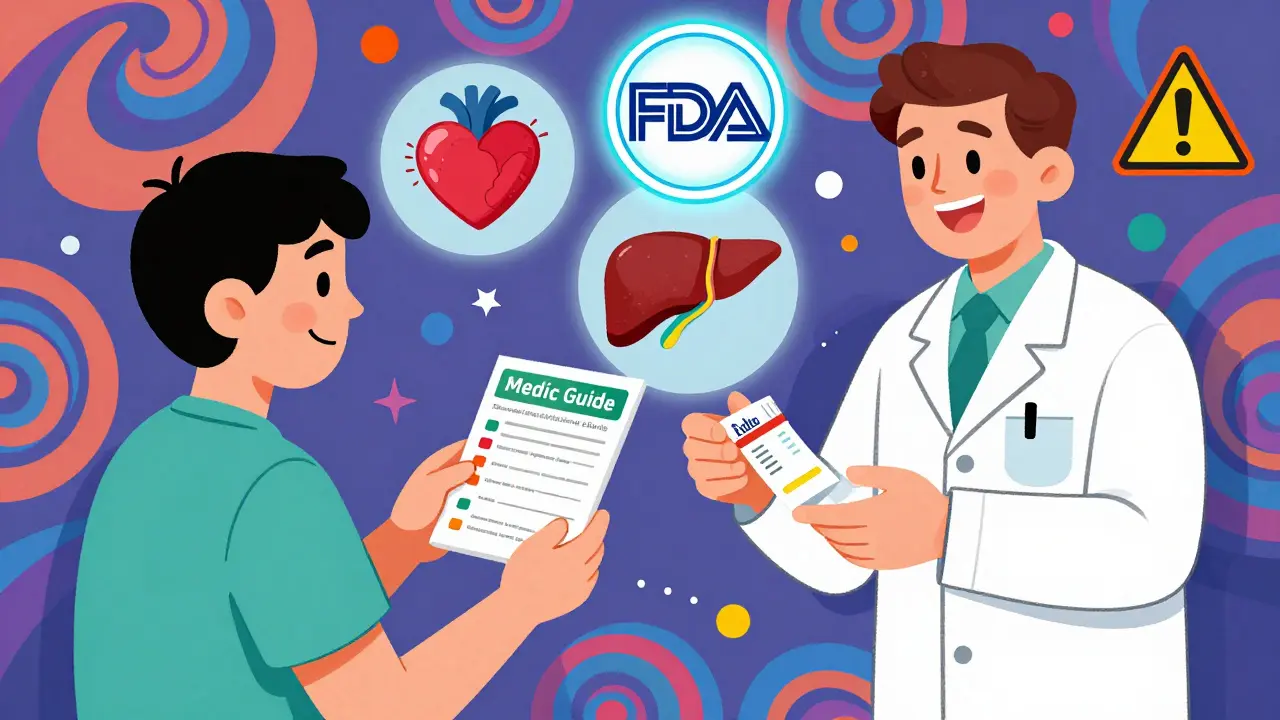
The U.S. Food and Drug Administration (FDA) introduced REMS in 2007 to stop serious drug risks from outweighing their benefits. It wasn’t just another guideline-it was a legal requirement. Before REMS, the FDA relied on voluntary RiskMAPs, which barely worked. Only about 40% of providers followed them. REMS changed that. Now, if a drug has a high risk of death, birth defects, or organ failure, manufacturers must build a plan to manage it. And they have to prove it works.
What Exactly Is a REMS?
REMS stands for Risk Evaluation and Mitigation Strategy. It’s not one-size-fits-all. There are three main parts: Medication Guides, Communication Plans, and Elements to Assure Safe Use (ETASU). Medication Guides are the simplest-they’re printed handouts patients get with their prescription. About 45 of the 72 active REMS programs require them. These aren’t just brochures. They’re FDA-approved, legally required documents that explain risks like liver damage, suicidal thoughts, or life-threatening infections. They must be handed out 100% of the time. Manufacturers report compliance annually.
Communication Plans are more targeted. They’re used when doctors need to know specific safety steps. Think ‘Dear Doctor’ letters or mandatory online training. About 38 REMS programs use these. The FDA doesn’t just trust that the letter was sent. They require proof-surveys show at least 80% of prescribers understand the risks and procedures. If not, the manufacturer has to fix it.
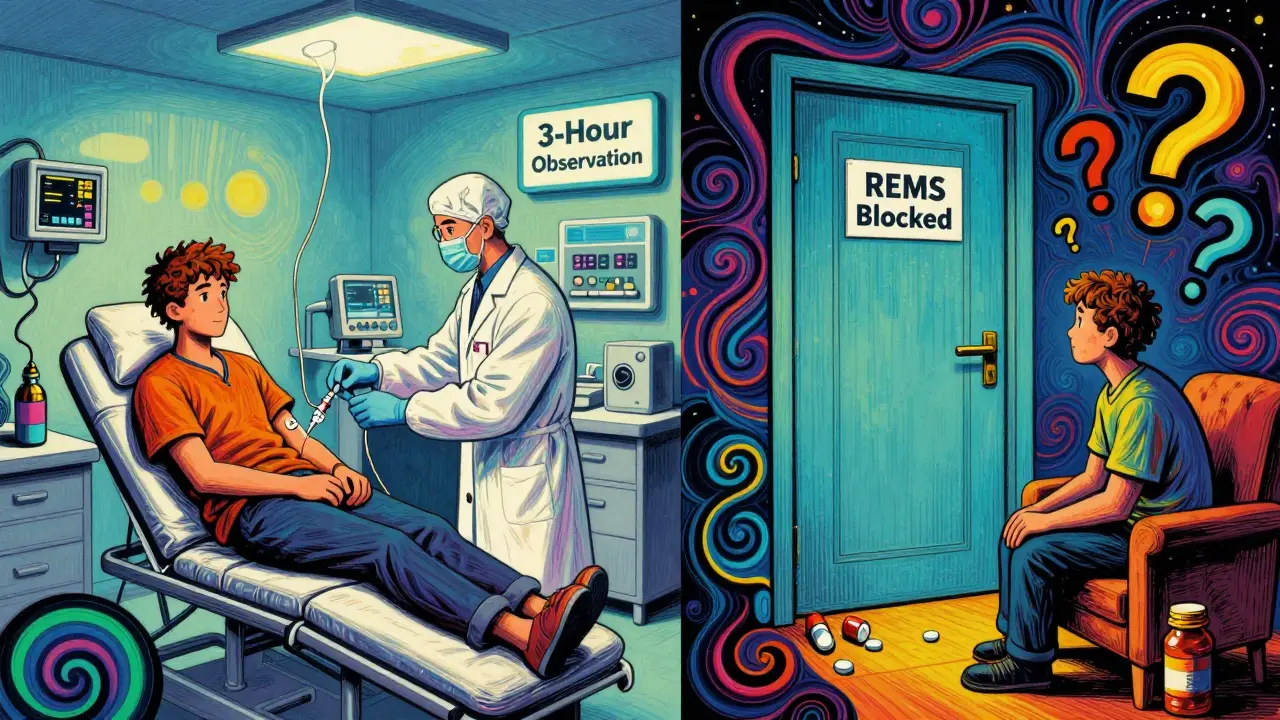
ETASU is the toughest. It’s only used in 22 REMS programs, but it’s the most restrictive. It can force prescribers to get certified, pharmacies to have emergency equipment on-site, or patients to be monitored for hours after treatment. Take Zyprexa Relprevv, a schizophrenia injection. It carries a 0.8% risk of sudden dizziness and confusion after injection. So, the REMS says: you can only give it in a certified facility. The patient must be watched for three full hours. Staff must document every minute. No exceptions.
Do These Tools Actually Change What Happens to Patients?
This is the big question. Are REMS just paperwork-or do they save lives?
The FDA says yes. Since 2018, 12 new drugs were approved only because REMS made them safe enough to use. These include treatments for rare cancers and autoimmune diseases that would’ve been pulled from the market otherwise. For example, Tysabri, used for multiple sclerosis, had a deadly brain infection risk. The REMS added mandatory JC virus testing before every infusion. A clinic in Ohio reported a 30% drop in serious side effects after implementing the protocol.
But here’s the problem: most REMS programs still measure the wrong things. In 2020, the FDA admitted only 30% of REMS had enough data to judge if they actually improved patient outcomes. The rest? They just track how many guides were handed out, how many doctors completed training, or how many pharmacies registered. These are process metrics-not real-world results.
Dr. Peter Lurie, a former FDA official, puts it bluntly: “We’re counting steps, not lives.” A 2021 JAMA study found that in most cases, there’s no clear link between REMS compliance and fewer hospitalizations, ER visits, or deaths. That’s not because REMS doesn’t work. It’s because we’re not measuring what matters.
The Hidden Cost: Delays, Frustration, and Abandoned Treatments
While REMS helps some patients, it hurts others.
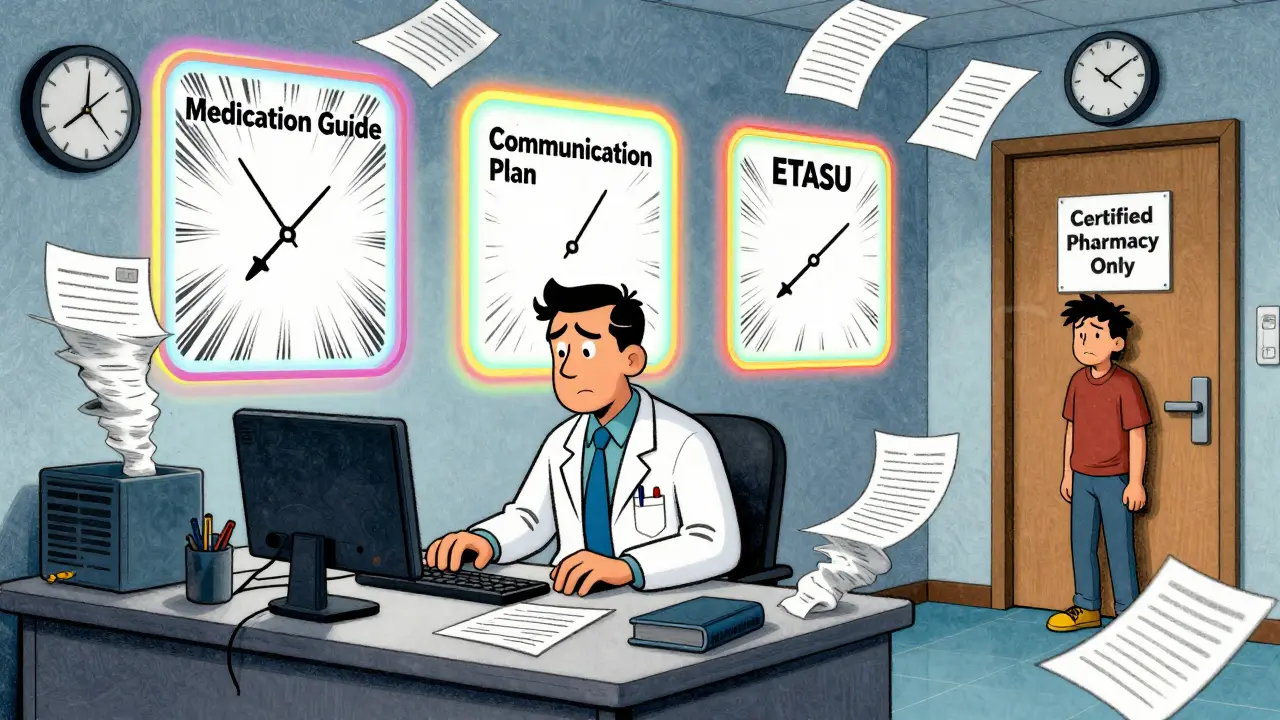
A 2022 AMA survey of 1,200 doctors found 68% said REMS caused delays in treatment. Oncologists were hit hardest-82% reported patients waiting weeks because their pharmacy wasn’t certified. One patient with lung cancer had to switch drugs because her oncologist couldn’t navigate five different REMS portals. She lost three months of treatment.
Specialty pharmacies are drowning in paperwork. On average, a REMS-required drug needs patients to register on 3.2 separate systems. Each setup takes 4.2 hours. That’s not just annoying-it’s dangerous. A 2023 Cancer Support Community survey found 28% of cancer patients had treatment interrupted because of REMS rules. Many of these were oral drugs that patients could take at home. But the pharmacy had to be certified. And the prescriber had to complete training. And the insurance had to approve it. All before the first pill was dispensed.
Some doctors just give up. Nearly half of surveyed physicians said they’d stopped prescribing a drug because the REMS was too complicated. That’s not patient safety-it’s access denial.
Who’s Paying the Price?
Manufacturers spend an average of $18.7 million in the first year to set up a REMS. After that, it’s $5.3 million per year. That’s not just a cost to them-it’s a cost to patients. Higher prices, fewer drug options, and delayed access all stem from these programs.
But it’s not all bad. The REMS@FDA portal, launched in 2020, cut prescriber setup time from 45 minutes to 22. That’s progress. And by 2026, the FDA plans to integrate 90% of REMS into electronic health records. At Mayo Clinic and Kaiser Permanente, pilots cut admin time by 40%. That’s the future.
Now, the FDA is shifting. Their 2023 draft guidance says: stop counting forms. Start counting outcomes. By 2025, new REMS programs must show real-world results: fewer deaths, fewer hospital stays, fewer ER visits. They’re even testing ‘REMS Lite’-simplified versions for lower-risk drugs. That could expand REMS to 50-75 more medications without the heavy burden.
The Bottom Line: REMS Is Necessary, But Broken
REMS didn’t create risk. It responded to it. Drugs like thalidomide, fen-phen, and Vioxx showed what happens when we don’t act. REMS was meant to prevent those disasters. And in some cases, it has.
But today, REMS is a system built for compliance, not care. It’s easier to check a box than to prove a patient lived longer because of it. The FDA knows this. So do doctors, pharmacists, and patients.
The next five years will decide if REMS becomes a true safety tool-or just another bureaucratic wall between patients and life-saving drugs.
Are Medication Guides the same as REMS?
No. Medication Guides are one part of REMS. They’re printed handouts given to patients with certain prescriptions. But REMS is the full regulatory framework that can include guides, provider training, and strict safety steps like certified pharmacies or patient monitoring. Not all drugs with medication guides have a REMS. Only drugs with serious, preventable risks do.
Do all high-risk drugs have a REMS?
No. The FDA only requires REMS for drugs with serious, specific, and preventable risks that can’t be managed with standard warnings. Out of over 10,000 approved drugs, only about 150 have REMS. That’s less than 1%. Many high-risk drugs still rely on regular labeling. The FDA picks the most dangerous cases where extra steps make a measurable difference.
Can patients refuse to follow REMS requirements?
It depends. For Medication Guides and provider training, patients can’t opt out-they’re given the info, but no consent is needed. But for ETASU requirements, like mandatory monitoring or certified pharmacies, patients can’t get the drug unless they comply. If a patient refuses to be observed for three hours after an injection, they won’t receive the dose. The system is designed to protect, not punish-but sometimes, protection means saying no.
Why do some REMS programs take so long to set up?
Because each one is different. Some require prescribers to complete 16 hours of training. Others need pharmacies to install emergency oxygen tanks and have staff trained in CPR. Each system has its own portal, login, and documentation rules. Before REMS@FDA, a doctor might need to register on 5 different websites just to prescribe one drug. Even now, 4.7 portals are the average. Integration with electronic health records is slowly fixing this-but it’s a slow process.
Is REMS getting better or worse?
It’s evolving. REMS is getting smarter. The FDA now requires manufacturers to prove their programs reduce hospitalizations or deaths-not just distribute handouts. By 2025, new REMS must show real outcomes. Pilots with EHR integration are cutting admin time by 40%. And ‘REMS Lite’ could bring safety tools to more drugs without the heavy burden. The system is still flawed, but the direction is clear: from paperwork to patient results.
tatiana verdesoto
March 3, 2026I've seen too many patients just give up on life-saving meds because the paperwork was too much. One lady with MS cried because she had to wait 6 weeks just to get her Tysabri refilled. She didn't need a brochure. She needed her treatment.
REMS isn't the problem. The way we're doing it is.
Tildi Fletes
March 5, 2026The FDA's shift toward outcome-based metrics is long overdue. Tracking compliance via forms and portal logins is performative, not protective. Real-world data from EHR integration-like reduced ER visits or mortality rates-is the only valid metric. The 2021 JAMA study confirmed this: process ≠ outcome. Until we measure survival, not signatures, REMS remains a bureaucratic mirage.
Megan Nayak
March 6, 2026So we're now admitting that the entire system is a tax on patients disguised as safety?
Let me get this straight: we force 28% of cancer patients to delay treatment because a pharmacy somewhere didn't update their portal login… and we call that ‘risk mitigation’?
It’s not a strategy. It’s a performance art piece for regulators who’ve never met a patient. The only thing REMS minimizes is access.
Jane Ryan Ryder
March 8, 2026Americans pay more for drugs and then get treated like criminals just to fill a prescription. The system is broken because we trust paperwork more than people.
Matt Alexander
March 8, 2026My clinic just got certified for 3 REMS drugs last month. Took 11 hours of training across 4 different websites. One of them asked for a photo of my license. I’m not a cop. I’m a doctor.
But yeah, I got my badge. Now I can prescribe. And my patient? Still waiting 3 weeks for her meds. This isn’t safety. It’s a delay machine.
Justin Rodriguez
March 8, 2026I work in oncology. REMS isn’t evil. It’s just misapplied. Take Zyprexa Relprevv-yes, the 3-hour observation is extreme. But we’ve had zero deaths since implementing it. That’s real. The problem? We apply the same rules to oral drugs that have no acute risk. A pill you take at home doesn’t need a certified pharmacy. It needs a clear guide.
REMS Lite is the right idea. Scale the heavy stuff. Simplify the rest.
Callum Duffy
March 10, 2026There is a subtle but critical distinction between safety and administrative burden. The intention behind REMS is laudable-preventing tragedies like thalidomide is non-negotiable. However, the current implementation appears to conflate procedural rigor with clinical efficacy. Evidence-based refinement, not expansion, is required. The pilots at Mayo and Kaiser demonstrate that integration with EHRs reduces friction without compromising safety. This is not a rejection of REMS; it is an evolution toward intelligent regulation.
Jessica Chaloux
March 11, 2026I just want to say… I hate this so much. 😭
My mom had to cancel her chemo because the pharmacy said ‘REMS not approved.’ She cried on the phone. I cried in the car. We drove 45 minutes to a different pharmacy. They said ‘oh we don’t do that drug.’
Why does the system hate people so much? 💔