

9 Mar 2026
- 9 Comments
ICH Country Adoption Checker
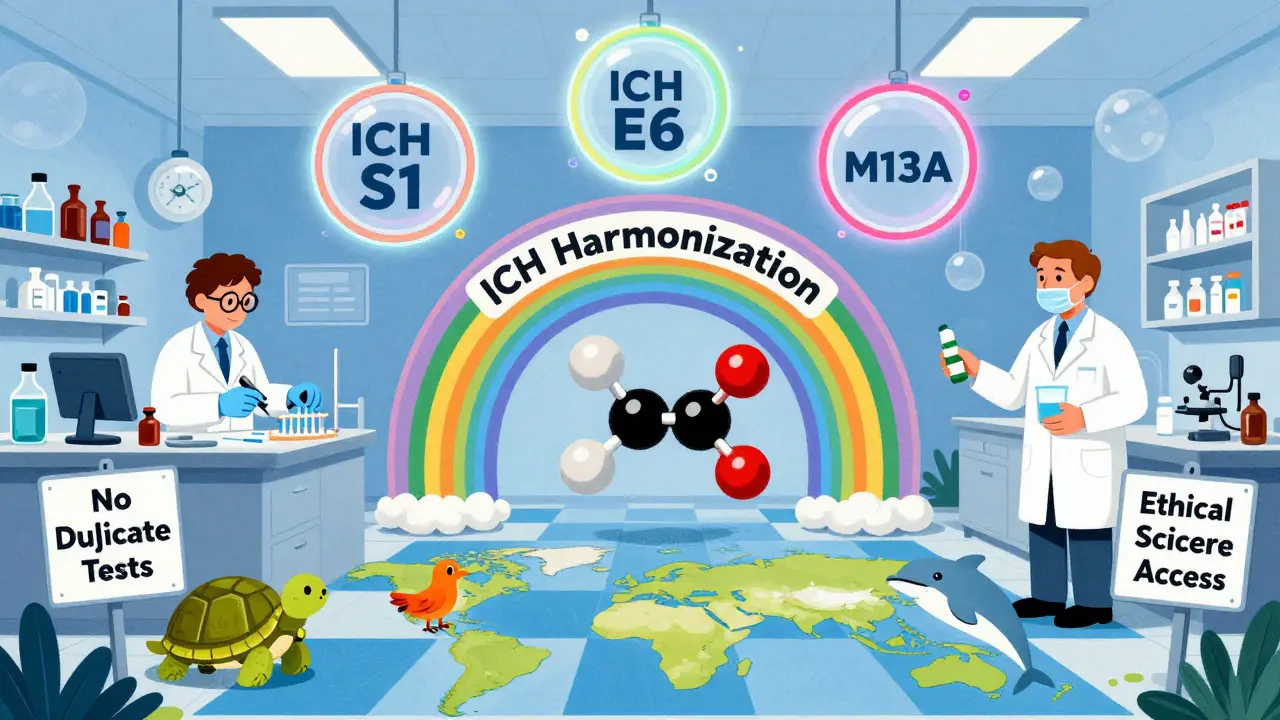
When a new drug crosses borders - from a lab in Boston to a pharmacy in Sydney - it doesn’t just travel physically. It must also pass through a maze of regulatory rules. Before 1990, a drug company might have to run separate clinical trials in the U.S., Europe, and Japan, each with different paperwork, testing standards, and safety requirements. That meant longer wait times, higher costs, and patients missing out on life-saving treatments. The ICH guidelines changed all that.
What Are the ICH Guidelines?
The International Council for Harmonisation of Technical Requirements for Pharmaceuticals for Human Use (ICH) is a global body created in 1990 to bring together regulators and drug makers under one set of science-based rules. It’s not a lawmaking body. It doesn’t force countries to change their laws. Instead, it builds consensus - among experts from the U.S., EU, Japan, and now over 20 other countries - on what good science looks like for drug safety, quality, and effectiveness.
Think of it like a shared playbook. If every team in the NFL had its own set of rules, games would be chaotic. ICH created the common rules so that a drug tested in Germany can be approved in Canada without redoing every study. By 2024, over 60 finalized guidelines exist, grouped into four areas: Quality (Q), Safety (S), Efficacy (E), and Multidisciplinary (M).
How ICH Makes Safety Better
One of the biggest wins from ICH is how it cuts down on unnecessary testing - especially animal testing. Before ICH, a company might test a new chemical for cancer risk using three different protocols across three regions. Now, under ICH S1, there’s one accepted method for carcinogenicity studies. That’s not just cheaper. It’s more ethical.
Take ICH S3 on toxicokinetics. It tells scientists exactly how to measure how a drug moves through the body over time. This isn’t just paperwork. It’s what helps predict dangerous side effects before a drug even reaches patients. When a drug company follows ICH S3, regulators in Tokyo, Brussels, and Washington can trust the data - even if the study was done in India or Brazil.
And it’s not just about early testing. ICH S9 gives clear rules for cancer drugs - which often can’t be tested the same way as antibiotics. It acknowledges that patients with advanced cancer need faster access, so it allows for smaller, smarter trials. That’s real-world science meeting real-world need.
The Core Guidelines That Changed Everything
Some ICH guidelines are so fundamental, they’re now the default global standard.
- ICH E6 (Good Clinical Practice): This is the backbone of every clinical trial worldwide. It defines how to protect patient rights, manage data, and ensure trials are ethical and scientifically sound. If a trial doesn’t follow ICH E6, regulators in most countries won’t accept it.
- ICH E3: This one tells companies exactly how to write clinical study reports. No more vague summaries or missing data tables. Every report must include the same structure - making it easier for reviewers to spot red flags.
- ICH E5: This guideline tackles a big question: Can data from one country be used in another? It says yes - if you account for ethnic differences in how people respond to drugs. That’s why a drug approved in the U.S. can be approved in South Korea without repeating the entire trial.
These aren’t suggestions. They’re the baseline. If you’re a drug company and you don’t follow them, you’re not just behind - you’re locked out of global markets.
How ICH Evolves - The 5-Step Process
ICH doesn’t just publish rules and walk away. It has a strict, transparent process:
- Consensus Building: Experts from regulators and industry meet to draft a proposal.
- Validation: The draft is tested in real-world settings to see if it works.
- Adoption: Regulatory agencies vote to accept the guideline.
- Implementation: Each country adopts it into their own rules - often as official guidance.
- Maintenance: The guideline is reviewed every few years to stay current.
This system keeps ICH from becoming outdated. In 2023, a public consultation on real-world evidence gathered feedback from 150+ organizations. The result? A new reflection paper adopted in June 2024 that helps regulators use data from electronic health records, patient registries, and even wearable devices - not just controlled trials.
Recent Updates and What’s Next
As of June 2024, the most recent guideline added is ICH M13A on bioequivalence for common pill forms like aspirin or metformin. Before this, countries had different ways to prove a generic drug worked the same as the brand. Now, there’s one global standard. That means faster approvals for generics - and lower prices for patients.
What’s next? ICH is already working on:
- Guidelines for gene therapies - where traditional safety models don’t fit.
- Standards for AI in drug development - like using machine learning to predict side effects.
- Harmonizing how to handle data from digital health tools - smart inhalers, glucose monitors, and more.
The goal isn’t to make everything identical. It’s to make sure the science is reliable - no matter where you are.
Why ICH Matters to Patients
Most people don’t think about regulatory agencies. But here’s what it means for you:
- Faster access: A new cancer drug approved in the U.S. can reach patients in Australia in months, not years.
- Lower costs: One set of studies means less duplication - which cuts development costs. That helps keep drug prices down.
- Better safety: When everyone uses the same tests, rare side effects are caught earlier. ICH S1 helped reduce animal testing by 30% in the first decade alone.
- More choices: Generic drugs become available faster because bioequivalence rules are clear.
Patients in Sydney, São Paulo, or Seoul benefit from ICH even if they’ve never heard of it. It’s the invisible system that keeps medicines safe and reachable.
Who Follows ICH - And Who Doesn’t
ICH’s power comes from adoption. The U.S. FDA, European Medicines Agency (EMA), and Japan’s PMDA all implement every guideline as official policy. The UK joined fully in 2022 after Brexit. Canada, Australia, Singapore, and South Korea now follow most ICH rules.
But not every country has the resources to adopt them fully. Some low- and middle-income nations still rely on older, fragmented standards. That’s why ICH works with organizations like the WHO and ICMRA to help build capacity - not just enforce rules.
Still, the trend is clear: more countries join every year. Why? Because ICH doesn’t just make regulation easier - it makes better medicines faster.
The Limits of Harmonization
ICH isn’t perfect. It’s slow. A guideline can take 5-7 years to go from idea to implementation. Some emerging therapies - like CRISPR-based treatments - are outpacing the guidelines. And because adoption is voluntary, there’s always a gap between what’s written and what’s done.
But here’s the thing: no other system comes close. The FDA, EMA, and other agencies don’t just follow ICH - they help write it. Industry scientists sit at the same table as regulators. That’s rare. And it works.
When a new drug is approved globally, it’s because ICH made sure the science was solid - not because of politics, trade deals, or national pride.
Are ICH guidelines legally binding?
No, ICH guidelines themselves aren’t laws. But when a country’s regulator - like the FDA or EMA - adopts them as official guidance, they become mandatory for companies seeking approval in that market. So while ICH doesn’t force compliance, the market does.
How many countries follow ICH guidelines?
As of 2026, over 20 national regulatory authorities are full members or observers of ICH. Major markets like the U.S., EU, Japan, Canada, Australia, the UK, and South Korea fully implement ICH guidelines. Many others use them as a reference, even if they’re not official members.
Do ICH guidelines apply to generic drugs?
Yes. ICH M13A, implemented in 2024, is specifically about bioequivalence for generic pills. Other guidelines like ICH Q6A (specifications for drug substances) and ICH Q7 (GMP for APIs) directly govern how generics are made and tested. Without ICH, each country would have its own rules - making generic approval slower and more expensive.
What’s the difference between ICH and the WHO?
ICH focuses on harmonizing technical requirements among advanced regulatory agencies - mostly high-income countries. The WHO provides broader global health guidance, including essential medicines lists and quality standards for low-resource settings. ICH is about science alignment; WHO is about access and equity. They often work together, but their roles are different.
Can ICH guidelines be used in clinical practice?
Not directly. ICH guidelines are for drug developers and regulators - not doctors. But they shape the medicines doctors prescribe. If a drug was developed under ICH E6 (Good Clinical Practice), you can trust the trial data behind it. So while you won’t read ICH in a hospital, it’s why your prescription is safe.
Final Thoughts
Medication safety isn’t about one country doing it right. It’s about everyone doing it the same way. ICH didn’t just make rules - it built trust. Trust between regulators. Trust between companies. And ultimately, trust from patients who just want safe, effective medicine - no matter where they live.
Mary Beth Brook
March 10, 2026ICH? More like I-Can't-Help-But-Think-This-Is-Just-Pharma-Propaganda. We don't need some elite club deciding what 'good science' looks like. Real innovation gets stifled by this bureaucratic nonsense. Stop pretending it's about safety - it's about control.
Jazminn Jones
March 12, 2026The structural coherence of ICH’s harmonization framework represents a paradigmatic shift in pharmaceutical governance. One cannot overstate the epistemological rigor embedded within ICH E6 and E3 protocols - they constitute the epistemic bedrock upon which modern clinical evidence is constructed. The absence of such standardization would result in ontological fragmentation of regulatory epistemes.
Peter Kovac
March 14, 2026Jazminn is right. But let’s be clear: ICH E6 isn’t 'good practice.' It’s the bare minimum. Many trials still cheat - cherry-pick endpoints, bury adverse events, outsource to ghostwriting firms. The guidelines are a mirror, not a enforcement mechanism. And regulators? They’re too busy kissing pharma’s ring to audit properly.
Ray Foret Jr.
March 15, 2026Honestly? I didn’t even know this existed until today 😅 But now that I do… this is kinda amazing. One set of rules means faster meds for people who need them. I’m glad someone’s making this less confusing. Thanks for explaining it so clearly! 🙌
Robert Bliss
March 17, 2026I get why some people are skeptical, but honestly, if this means generics cost less and cancer drugs get approved faster? I’m all for it. No need to overcomplicate it. We all just want safe medicine that doesn’t take 10 years to get to us.
Samantha Fierro
March 18, 2026This is one of those invisible systems that saves lives every single day. Think about it - a mother in rural India gets a generic version of a life-saving drug because ICH M13A made the approval path clear. That’s not policy. That’s justice. And it’s happening because smart people sat down, left ego at the door, and agreed on science. We need more of this.
APRIL HARRINGTON
March 19, 2026I just read this entire thing and I’m emotionally overwhelmed like I just watched a documentary about dolphins saving sailors 😭 THIS IS THE KIND OF THING THAT MAKES ME BELIEVE IN HUMANITY AGAIN
Leon Hallal
March 19, 2026All this harmonization sounds great until you realize it’s mostly for rich countries. What about the 70% of the world that can’t even get basic antibiotics? ICH doesn’t fix broken systems - it just makes the privileged ones more efficient. Don’t call it progress if it leaves everyone else behind.
Neeti Rustagi
March 21, 2026While ICH has undeniably elevated the standard of global pharmaceutical regulation, one must acknowledge the inherent asymmetry in its implementation. The framework, though scientifically elegant, remains anchored in the epistemic traditions of the Global North. For nations with limited regulatory infrastructure, adoption is not merely a technical challenge - it is a matter of equity, capacity, and historical justice. True harmonization must include co-creation, not just compliance.