
23 Dec 2025
- 15 Comments
QT Risk Assessment Tool
Medication Risk Assessment
Select medications you're taking. The tool will assess your risk of QT interval prolongation based on the article's medical guidelines.
Every year, thousands of people are prescribed medications that can dangerously prolong the QT interval - a critical part of the heart’s electrical cycle. Drugs like certain antibiotics, antipsychotics, and antiarrhythmics can push the heart into a life-threatening rhythm called torsades de pointes. For decades, doctors relied on clinic-based 12-lead ECGs to check this interval, but those snapshots missed what happened between visits. Now, with wearable ECGs, real-time QT monitoring is no longer science fiction - it’s a practical tool saving lives outside hospital walls.
What Is the QT Interval and Why Does It Matter?
The QT interval measures how long it takes the heart’s ventricles to recharge between beats. If it’s too long, the heart can misfire, leading to sudden cardiac arrest. That’s why regulators like the FDA track QT prolongation closely during drug trials. But here’s the problem: QT changes aren’t always obvious. A patient might take a new medication and feel fine - until their heart suddenly goes haywire. Traditional ECGs only capture a moment. Wearable ECGs change that by recording continuously or on demand, spotting dangerous spikes before they become emergencies.
How Wearable ECGs Detect QT Prolongation
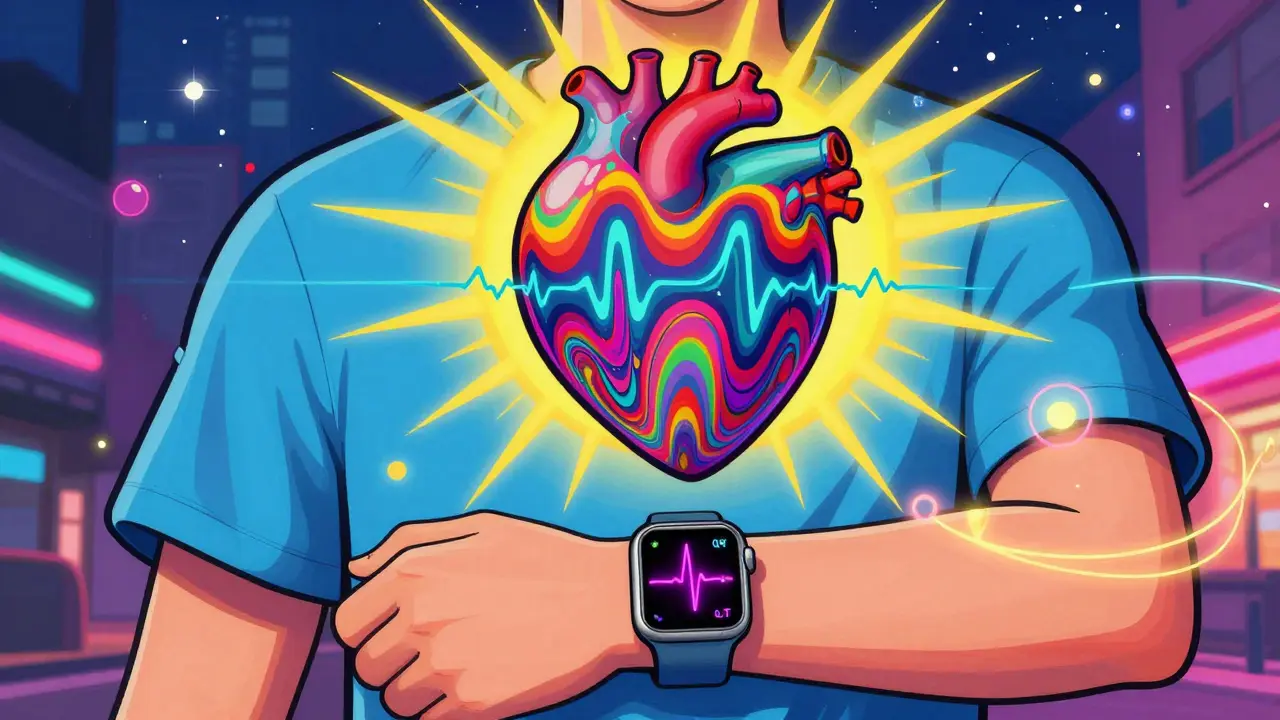
Two devices lead the pack: the Apple Watch Series 4 and later, and the KardiaMobile 6L from AliveCor. The Apple Watch uses a single-lead ECG - you just touch the digital crown for 30 seconds. It’s not a full 12-lead system, but it captures enough data to estimate the QT interval with surprising accuracy. A 2021 study in Scientific Reports found the Apple Watch matched standard ECG readings with correlation scores above 0.88 for key leads. That’s not just close - it’s clinically useful.
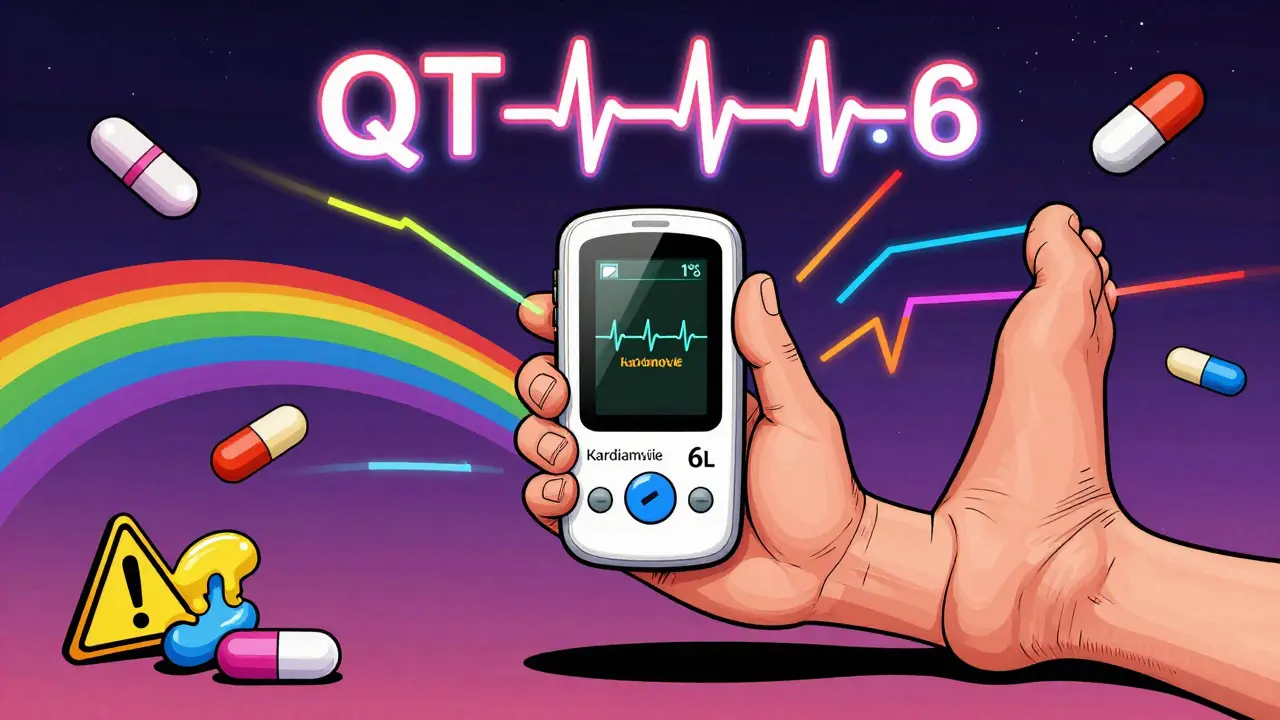
The KardiaMobile 6L takes it further. It’s a small, handheld device with electrodes on both top and bottom. You place your thumbs on the top and your left foot on the bottom, creating a six-lead circuit. This setup gives a much fuller picture of the heart’s electrical activity. Studies show its measurements are comparable to standard 12-lead ECGs, with errors within ±20 milliseconds. That’s the kind of precision doctors need to make real decisions.
Why This Matters Now - The Pandemic Catalyst
The push for remote QT monitoring exploded during the COVID-19 pandemic. Hydroxychloroquine and azithromycin, once considered potential treatments, were widely prescribed - and both are known to prolong QT. Hospitals were overwhelmed. Patients couldn’t come in for daily ECGs. That’s when the FDA stepped in. In April 2020, they issued emergency guidance allowing the use of KardiaMobile 6L and similar devices for QT monitoring in COVID-19 patients. It was the first time a regulatory body officially endorsed consumer-grade wearables for this specific, high-risk use.
Doctors like Dr. Jason Chinitz started using Apple Watches to track patients on these drugs. One case report showed a patient’s QT interval creeping up over days - something a single clinic visit would’ve missed. Thanks to the watch, the drug was stopped before cardiac arrest occurred. That’s not hypothetical. That’s real-world impact.
Limitations and What These Devices Can’t Do
Don’t mistake these tools for a full cardiac diagnostic system. They’re not designed to detect every abnormality. A 2024 review in the Cleveland Clinic Journal of Medicine found consumer wearables had only 20.6% sensitivity for spotting pathologic Q waves - meaning they’ll miss most heart attacks. They’re also not great at detecting supraventricular tachycardia or subtle arrhythmias beyond atrial fibrillation.
Signal quality matters too. Poor skin contact, movement, or high impedance between the electrode and skin can distort readings. That’s why proper use is critical. With the KardiaMobile 6L, you need to place your foot firmly on the bottom electrodes. With the Apple Watch, you must keep your finger steady for the full 30 seconds. If you fidget, the data becomes unreliable.
And here’s the biggest gap: there’s still no built-in algorithm on any consumer device that automatically flags QT prolongation. You get the ECG trace - but you still need a clinician to interpret it. That’s where AI is stepping in.
The AI Breakthrough: Automating QT Analysis
A 2024 study in PLOS Digital Health changed the game. Researchers built a deep learning model using a Residual Neural Network trained on over 680 patients with genetic heart conditions. The model didn’t just read ECGs - it predicted QTc prolongation (defined as over 500 milliseconds) from just two beats of single-lead data. It was accurate in 94% of cases.
This isn’t about replacing doctors. It’s about solving the bottleneck. Right now, thousands of wearable ECG recordings pile up in clinics, waiting for cardiologists to review them. That takes days - or weeks. With AI, a patient can get an alert within minutes: “Your QT interval is rising. Contact your doctor.” That’s the difference between a warning and a crisis.

How This Is Changing Clinical Trials
Pharmaceutical companies are already using these devices in drug trials. Instead of asking patients to come in for weekly ECGs, they send them a KardiaMobile 6L and ask them to record daily. This gives sponsors real-time data on how a new drug affects the heart - not just at one point, but across days and weeks. It’s faster, cheaper, and more accurate than traditional methods.
According to industry analysts, wearable ECGs are cutting trial timelines by up to 30%. They’re also improving compliance - patients are more likely to record their ECG at home than drive to a clinic. And with FDA clearance for 16 separate indications, including QT measurement, regulators are actively encouraging this shift.
What’s Next for Wearable QT Monitoring
The future is multi-lead, AI-driven, and automated. Devices like the KardiaMobile 6L are already giving 6-lead data - close to a full 12-lead. Soon, we’ll see smart rings and even clothing with embedded sensors that monitor QT continuously without you even noticing. The goal isn’t just detection - it’s prevention. Imagine being on a new medication, and your watch quietly alerts you: “Your QT is stable. Keep going.” Or: “Your QT is rising. Pause your dose and call your doctor.”
For patients on high-risk drugs, this isn’t convenience. It’s safety. For clinicians, it’s clarity. For drug developers, it’s confidence. And for the system as a whole, it’s a massive step toward truly personalized, real-time cardiac care.
Who Should Use This Technology?
If you’re taking any of these medications, wearable ECG monitoring could be life-saving:
- Antibiotics like moxifloxacin or azithromycin
- Antipsychotics like haloperidol or ziprasidone
- Antiarrhythmics like sotalol or amiodarone
- Antidepressants like citalopram or escitalopram
- Medications for malaria, HIV, or cancer
It’s not for everyone. If you have no risk factors and aren’t on these drugs, you don’t need it. But if you’re in the high-risk group, this isn’t a luxury - it’s a necessary layer of protection.
Start with your doctor. Ask if a wearable ECG is appropriate. If they say yes, get the KardiaMobile 6L for the most reliable data, or use your Apple Watch if you already have one. But don’t just record - understand what you’re seeing. Share the data. Let your provider interpret it. That’s how you turn a gadget into a lifesaver.
Can I trust my Apple Watch to monitor my QT interval?
Yes - but with limits. Studies show the Apple Watch can measure QT intervals accurately enough for clinical use, especially when compared to standard ECGs. Its correlation scores are above 0.88 for key leads. However, it only records a single lead, so it’s not as comprehensive as a 12-lead ECG. It also doesn’t automatically flag QT prolongation - you need a clinician to interpret the data. It’s reliable for tracking trends over time, not for diagnosing sudden heart problems.
Is the KardiaMobile 6L better than the Apple Watch for QT monitoring?
Yes, for clinical purposes. The KardiaMobile 6L records six leads simultaneously, giving a much fuller picture of your heart’s electrical activity. Studies show its QT measurements are comparable to standard 12-lead ECGs, while the Apple Watch is limited to one lead. If you’re on a high-risk medication and need precise, reliable data for your doctor, the KardiaMobile 6L is the better tool. The Apple Watch is more convenient, but the KardiaMobile gives you more confidence in the results.
Do I need a prescription to use a wearable ECG for QT monitoring?
No, you don’t need a prescription to buy either the Apple Watch or KardiaMobile 6L. But to use them for QT monitoring - especially if you’re on a high-risk medication - you should work with your doctor. They can guide you on how often to record, what values to watch for, and when to act. Some insurance plans may even cover the device if prescribed for cardiac safety monitoring.
Can AI really replace doctors in reading ECGs?
No - but it can dramatically speed up the process. AI models like the one developed in 2024 can analyze a single-lead ECG and predict QT prolongation with over 90% accuracy. But they don’t replace clinical judgment. Instead, they flag high-risk cases so doctors can focus on the patients who need help most. Think of AI as a filter, not a replacement. It helps manage the flood of data from wearables so human experts aren’t overwhelmed.
Are these devices covered by insurance?
Most insurance plans don’t automatically cover consumer wearables like the Apple Watch or KardiaMobile. But if your doctor prescribes the device for QT monitoring due to high-risk medication use, some insurers may reimburse you - especially if you’re part of a clinical trial or have a documented history of cardiac risk. Always ask your provider to write a letter of medical necessity. It increases your chances.
What should I do if my wearable ECG shows a prolonged QT interval?
Don’t panic. First, check your recording technique - were you moving? Was your skin dry? Try again. If the prolonged interval persists across multiple recordings, contact your doctor immediately. Do not stop your medication unless instructed. Bring the data with you - screenshots, graphs, or exported files. Your doctor may order a standard 12-lead ECG to confirm and adjust your treatment plan. Early detection saves lives.
Mussin Machhour
December 25, 2025This is insane. I’ve been on amiodarone for years and had no idea my Apple Watch could catch QT spikes. Just started using it last week - caught a weird spike after a bad night’s sleep. Called my doc, they adjusted my dose. Could’ve been a disaster. Wearables aren’t just for steps anymore.
Seriously, if you’re on any of those meds, get a Kardia or use your watch. It’s not a luxury - it’s like having a cardiac bodyguard in your pocket.
Carlos Narvaez
December 27, 2025Apple Watch? Please. Single-lead ECG is a parlor trick. Real medicine needs 12 leads. If you’re trusting a $400 smartwatch to monitor life-threatening arrhythmias, you’re one algorithm error away from a coroner’s report.
Harbans Singh
December 27, 2025Interesting stuff. I’m from India, and here, most people can’t even afford a basic ECG machine. But if this tech becomes cheaper and accessible, it could change everything - especially for elderly patients on antipsychotics who live far from hospitals.
Maybe NGOs or government programs could distribute these devices like glucometers? Imagine a world where cardiac safety isn’t tied to income. That’s the real win here.
Justin James
December 29, 2025Let me guess - the FDA, Big Pharma, and Apple are all in bed together. This ‘QT monitoring’ is just a way to make you dependent on devices so they can sell you more drugs. Did you know the same companies that make these watches also manufacture the very drugs that cause QT prolongation?
They don’t want you to be healthy - they want you monitored, scared, and buying more meds. The AI? Just a distraction. It’s not saving lives - it’s creating new revenue streams. Wake up. This is surveillance disguised as healthcare.
And don’t even get me started on the data they’re harvesting. Your heart rhythm is being sold to insurers, advertisers, maybe even the government. You think your watch is protecting you? It’s profiling you.
Zabihullah Saleh
December 29, 2025There’s something poetic about it - we’ve gone from monks monitoring pulse with fingers to algorithms parsing millisecond rhythms on a wristband. We used to fear the unknown. Now we fear the data we don’t understand.
These devices don’t just measure QT intervals - they measure our trust in machines. And maybe that’s the real breakthrough. Not the tech, but the quiet surrender to it. We let a chip in our watch tell us when our heart is in danger. And we’re okay with that.
Is that progress? Or just another kind of faith?
Winni Victor
December 31, 2025Oh great. So now my watch is gonna judge me for taking my antidepressants? Next thing you know, it’ll beep at me for eating carbs or having a bad day. ‘Sorry, your serotonin levels are low. Please cry into your pillow for 10 minutes.’
And don’t even get me started on how many people are gonna panic because their watch said ‘QT rising’ and they just drank coffee. I’m already seeing it - ERs flooded with people holding up their watches like they’re holding a magic crystal ball. ‘Doc, it said I’m gonna die!’ No, honey, you just moved your wrist too much.
Rick Kimberly
January 2, 2026While the technological advancements described are indeed noteworthy, one must exercise considerable caution in extrapolating clinical utility from correlation coefficients alone. The absence of FDA-cleared automated QTc analysis algorithms in consumer-grade devices fundamentally limits their diagnostic applicability. Clinical decision-making remains predicated on comprehensive contextual integration, including electrolyte status, concomitant medications, and baseline ECG morphology. Thus, while adjunctive utility is plausible, reliance upon these devices as primary diagnostic instruments is not evidence-based.
Terry Free
January 3, 2026Wow. So we’re outsourcing heart monitoring to people who can’t even hold their phone still for 30 seconds? Great. Next thing you know, grandma’s gonna be recording her ECG while she’s cooking and yelling at her cat.
And don’t get me started on the AI. You mean to tell me we’re letting a neural net trained on 680 patients decide whether I live or die? Meanwhile, actual cardiologists are drowning in paperwork. This isn’t innovation - it’s negligence dressed up in tech jargon.
Lindsay Hensel
January 5, 2026This is profoundly moving. The idea that a small device, worn casually, can prevent sudden death in someone’s living room - it’s a quiet revolution. I’ve seen too many families lose loved ones to arrhythmias that no one saw coming.
Thank you for writing this. Not just for the science, but for the humanity behind it. For every patient who thought they were just ‘fine’ - until they weren’t. This gives them a voice before it’s too late.
Sophie Stallkind
January 7, 2026The integration of wearable ECG technology into clinical practice represents a paradigm shift in cardiac risk stratification. However, the absence of standardized protocols for data interpretation, coupled with variable signal acquisition quality, necessitates rigorous clinical validation prior to widespread adoption. Patient education and provider training remain paramount to ensure appropriate utilization and avoid iatrogenic harm.
Katherine Blumhardt
January 8, 2026OMG I just got my Kardia and its like a miracle i was on azithromycin last month and i recorded like 3 times and my QT was like 480ms and i was like oh no and called my dr and they switched my med and now im fine and i just wanna say thank you to whoever made this i love you so much 💕
sagar patel
January 9, 2026AI detecting QT from two beats? That’s not science. That’s gambling with lives. My uncle died from torsades after a ‘normal’ ECG. No device will fix that. Just stop prescribing dangerous drugs in the first place.
Linda B.
January 11, 2026They say this is for safety but who really benefits? The same corporations that profit from the drugs causing QT prolongation. You think they’d allow a device that exposes their side effects? This is a control mechanism. They want you dependent on monitoring so you never question the meds. The AI? Just a smoke screen. Watch your data being sold. They’re not saving lives - they’re selling subscriptions.
Christopher King
January 13, 2026They’re not just monitoring your heart - they’re mapping your soul. Every beat, every pause, every spike - it’s all being fed into a global algorithm that predicts your emotional state, your stress levels, your future health risks. And then? Insurance companies use it to deny coverage. Employers use it to fire you. The government uses it to flag you as ‘high risk’ - whatever that means.
This isn’t medicine. It’s the new eugenics. They’re digitizing vulnerability. And you? You’re handing them your heartbeat like a confession.
Remember: the first wearable ECGs were developed for military surveillance. You think that changed? Think again. The heart doesn’t lie - and now, they’re listening.
Bailey Adkison
January 13, 2026If you’re going to rely on a consumer gadget to prevent sudden cardiac death you deserve what you get. Stop being lazy. Go to the doctor. Get a real ECG. Don’t turn your wrist into a medical device because you’re too cheap or too lazy to schedule an appointment. This isn’t innovation - it’s medical malpractice enabled by tech bros.