
7 Feb 2026
- 11 Comments
Non-alcoholic fatty liver disease, now called MASH (Metabolic Dysfunction-Associated Steatohepatitis), isn't just about a fatty liver-it's a sign your body's metabolism is out of balance. And the good news? The most powerful tool to reverse it isn't a pill. It's weight loss. But not just any weight loss. The kind that actually changes your liver's health.
If you're carrying extra weight and have been told you have fatty liver, you're not alone. Around 1 in 3 adults in the U.S. have some form of this condition. The scary part? It can quietly lead to scarring, liver failure, or even cancer. But here’s the truth: losing just 5% of your body weight can shrink that fat in your liver. Lose 10% or more, and you might actually reverse the damage. No magic. No miracle cure. Just science.
Why Weight Loss Works-And How Much You Really Need
Most people think they need to drop 50 pounds to fix their liver. That’s not true. Studies show that losing 5% of your total body weight cuts liver fat by nearly half. For someone who weighs 200 pounds, that’s just 10 pounds. That’s doable. But if you want to reverse scarring-fibrosis-you need to go further. Aim for 10% or more. That’s when liver tissue starts to heal. A 2022 study found that only 25% of people who lost weight kept it off long enough to see lasting benefits. So it’s not just about losing. It’s about keeping it off.
The liver doesn’t care about the number on the scale. It cares about fat inside it. When you lose weight, your body pulls that fat out of the liver and burns it for energy. It’s like cleaning out a clogged pipe. The more you lose, the clearer it gets. And the better your insulin works. The lower your triglycerides. The more your liver can breathe again.
Diet: What to Eat (and What to Avoid)
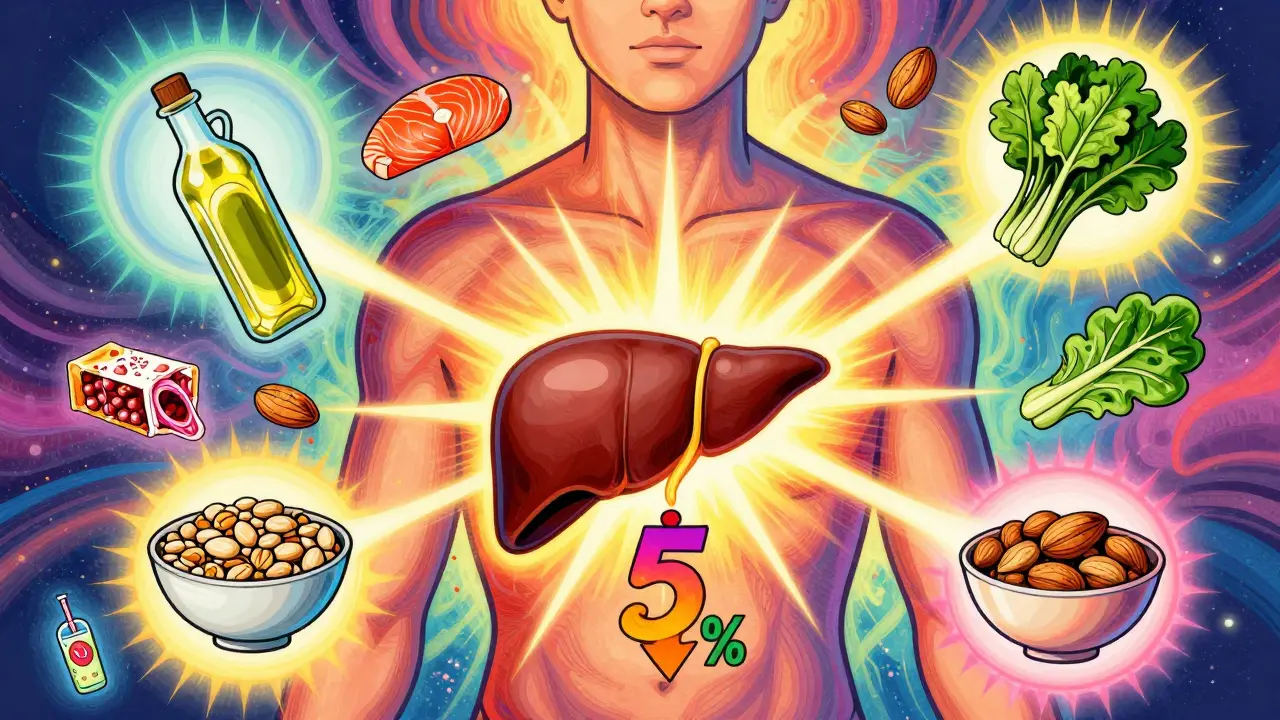
Forget fad diets. The Mediterranean diet is the most proven. It’s not about counting calories alone-it’s about what you put on your plate. Think: olive oil, fatty fish like salmon, nuts, beans, leafy greens, whole grains, and fruit. Avoid sugary drinks, white bread, pastries, fried food, and processed snacks. These spike your blood sugar and dump fat straight into your liver.
One meta-analysis found that people on this diet saw a 30% drop in ALT-a key liver enzyme that spikes when the liver is damaged. Liver stiffness, a sign of scarring, also improved. That’s not luck. That’s food as medicine.
Here’s a simple rule: if it comes in a bag or box, and you can’t name all the ingredients, skip it. Focus on real food. Eat protein with every meal-it keeps you full longer. Swap soda for sparkling water with lemon. Swap white rice for brown rice or quinoa. You don’t need to be perfect. Just better.
Exercise: Move More, Even If You Hate the Gym
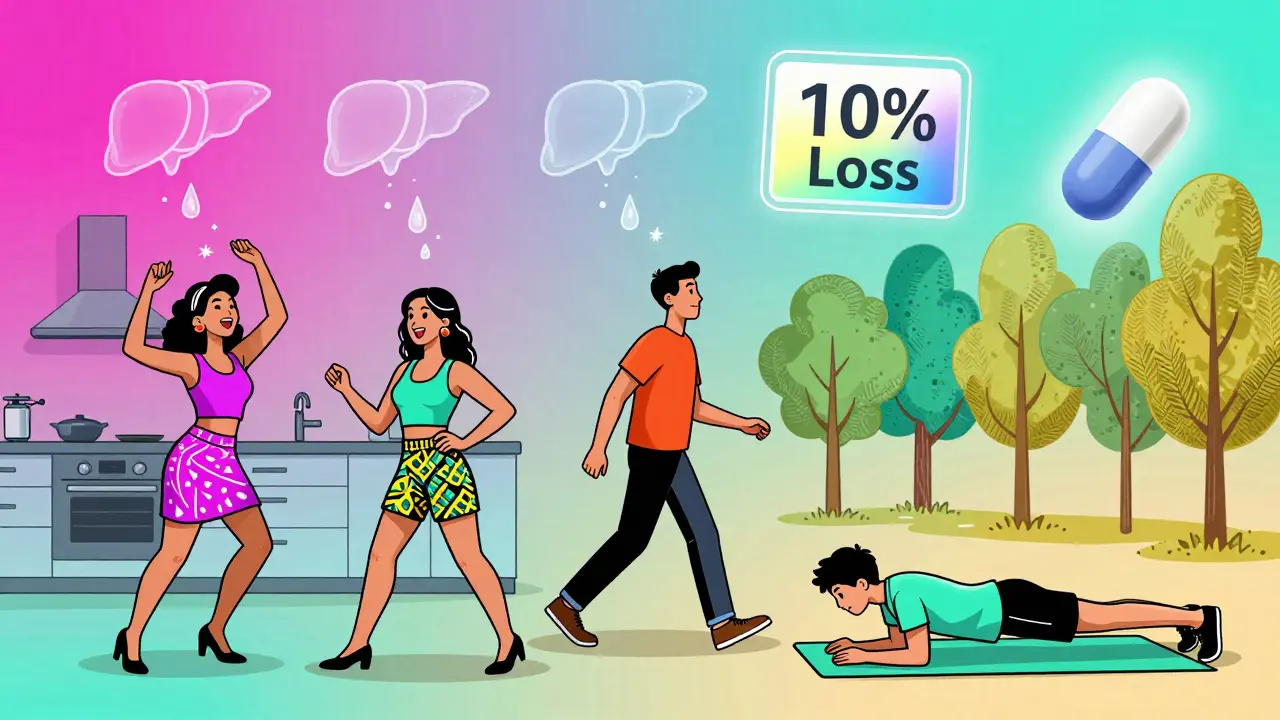
You don’t need to run marathons. The goal is 150 minutes a week of moderate activity-that’s 30 minutes, five days a week. Brisk walking counts. Gardening counts. Dancing around the kitchen counts. Studies show that even without weight loss, exercise reduces liver fat. Why? Because movement helps your muscles use up sugar and fat before your liver has to store it.
Strength training matters too. Two days a week of lifting weights or doing bodyweight exercises (squats, push-ups, resistance bands) helps build muscle. More muscle means your body burns more calories-even when you’re sitting. And muscle improves insulin sensitivity. That’s huge for your liver.
Start small. Walk 10 minutes after dinner. Take the stairs. Park farther away. Build up slowly. The goal isn’t to burn 500 calories in one session. It’s to move every day. Consistency beats intensity every time.
Medication: The New Option-Semaglutide (Wegovy)
In August 2025, the FDA approved semaglutide (a GLP-1 receptor agonist marketed as Wegovy) specifically for treating MASH in adults with moderate-to-advanced liver scarring. This was the first time a drug got approval for liver disease, not just weight loss. That’s a big deal.
Semaglutide works by slowing digestion, reducing appetite, and helping your body make insulin more efficiently. In clinical trials, nearly 90% of people stayed on it for over a year. Two-thirds saw less liver inflammation. More than one-third had actual reduction in scarring. That’s not small. That’s life-changing.
But here’s the catch: it’s expensive. Without insurance, it costs about $1,350 a month. That’s more than most people can afford. Generic metformin, which costs $4-$40 a month, helps with insulin resistance but doesn’t shrink liver fat like semaglutide does. Orlistat and SGLT2 inhibitors show some promise but lack strong proof for liver repair.
Most experts agree: semaglutide isn’t a replacement for diet and exercise. It’s a tool to help you stick with them. If you’ve tried losing weight before and failed, this might be the support you need. But if you’re not ready to change how you eat or move, a pill won’t fix your liver.
What Doesn’t Work (And Why)
There’s a lot of noise out there. Detox teas. Juice cleanses. Keto for months on end. None of these have solid proof for reversing MASH. Some, like extreme low-carb diets, can actually raise liver enzymes in the short term. The liver doesn’t need to be “detoxed.” It needs to be nourished and rested.
Alcohol? Even small amounts can make things worse. So if you have MASH, skip it. Completely. No exceptions. Smoking? Quit. High blood pressure? Control it. Diabetes? Manage it. All of these things feed the fire in your liver.
And don’t fall for supplements. Milk thistle? Vitamin E? Some studies show tiny benefits, but none are strong enough to recommend as primary treatment. Stick to what’s proven: food, movement, and-if needed-medication.
How to Make It Stick
Most people lose weight fast, then gain it back. Why? Because they didn’t change their habits. They changed their diet for a month. That’s not enough.
Real change takes 3 to 6 months to become automatic. You need to learn portion sizes. Read labels. Plan meals. Sleep well. Manage stress. These aren’t side notes-they’re the foundation.
Find support. A dietitian. A personal trainer. A group of people going through the same thing. Talk to your doctor. Ask about behavioral therapy. Many clinics now offer programs that combine nutrition, exercise, and mental health support. These work better than any pill.
Plateaus happen. After 6 months, your weight might stall. That’s normal. It doesn’t mean you’re failing. It means your body is adjusting. Keep going. Your liver is still healing, even if the scale doesn’t move.
What’s Next?
The approval of semaglutide for MASH is just the beginning. More drugs are coming-combination therapies, longer-acting versions, even pills that target liver cells directly. But none of them will work if you don’t fix your lifestyle.
The future of liver health isn’t about drugs. It’s about metabolic health. And that starts with how you eat, how you move, and how you treat your body every day.
If you have MASH, you’re not broken. You’re just out of balance. And balance can be restored. Slowly. Steadily. For real.
Can you reverse NAFLD/MASH without losing weight?
No. Weight loss is the only treatment proven to reverse liver fat and scarring. While exercise helps reduce liver fat even without weight loss, you still need to lose at least 5% of your body weight to see significant improvement. Medications like semaglutide help you lose weight, but they’re not a substitute for lifestyle changes.
How long does it take to see liver improvement?
You can see changes in liver enzymes within 3-6 months of starting diet and exercise. Improvements in liver fat show up on scans after 6-12 months. Fibrosis reversal takes longer-usually 12-24 months, especially if you lose 10% or more of your body weight. Consistency matters more than speed.
Is semaglutide covered by insurance for MASH?
Coverage is still patchy. As of 2026, only about 40% of commercial insurance plans cover semaglutide for MASH, even though it’s FDA-approved. Many require proof of advanced fibrosis (via biopsy or FibroScan) and failure of lifestyle changes first. Medicare and Medicaid coverage varies by state. Always check with your insurer and ask your doctor to submit prior authorization.
Can I take metformin instead of semaglutide?
Metformin helps with insulin resistance and is often prescribed for people with prediabetes or type 2 diabetes alongside MASH. But studies show it doesn’t reduce liver fat or scarring as effectively as semaglutide. It’s a helpful support, not a replacement. If you’re trying to reverse liver damage, semaglutide has stronger evidence-but only if you can access it.
What if I can’t afford semaglutide?
You don’t need it. Focus on diet and exercise. The Mediterranean diet, 150 minutes of weekly movement, and losing 5-10% of your body weight will improve your liver more than most medications. Many clinics offer free or low-cost nutrition counseling. Community centers have walking groups. Online support forums are full of people sharing tips. You can heal your liver without spending $1,300 a month.
Do I need a liver biopsy to qualify for semaglutide?
Not always. The FDA approved semaglutide for MASH based on evidence of moderate-to-advanced fibrosis, which can be detected with non-invasive tests like FibroScan, ELF blood test, or MRI. Many doctors now use these instead of biopsies. Ask your hepatologist which test they recommend. Biopsies are still the gold standard, but they’re not required for treatment eligibility anymore.
Can children or teens have MASH?
Yes. MASH is rising fast in teens and even younger children, especially those with obesity or type 2 diabetes. Lifestyle changes are the first-line treatment for all ages. Medications like semaglutide are not yet approved for those under 18, but weight loss through diet and activity is safe and effective at any age. Early intervention prevents lifelong liver damage.
What happens if I stop semaglutide?
Most people regain weight and see liver fat return within months of stopping. Semaglutide doesn’t cure MASH-it helps you manage it. Think of it like blood pressure medication: you take it to stay healthy, not because it fixes the root cause. The goal is to use it long enough to build sustainable habits, then maintain your weight without it. Stopping too soon means losing the progress you made.
THANGAVEL PARASAKTHI
February 7, 2026i been tryna fix my fatty liver for years. tried keto, juice cleanses, all that hype. turned out the real deal was just walking after dinner and swapping soda for sparkling water with lemon. no magic, just consistency. my alt dropped 40 points in 6 months. not gonna lie, i still snack on chips sometimes, but now i know it’s not about perfection. just better.
Frank Baumann
February 8, 2026Let me tell you something that no one else will say out loud - this whole MASH thing is a corporate scam dressed up as medical advice. Semaglutide? $1,350 a month? Are you kidding me? They didn't approve it because it works - they approved it because they could charge you a fortune for a drug that makes you feel full. Meanwhile, your grandma in 1972 never heard of MASH and lived to 92 eating fried chicken and lard. The liver doesn’t need ‘healing’ - it needs to be left alone. Stop micromanaging your food. Stop buying into this metabolic fearmongering. Eat real food? What even IS real food? Is kale real? Or is it just a leaf that Big Greens sold you?
Scott Conner
February 8, 2026hmm so if i lose 5% i cut liver fat by half? that sounds too good. but i read a paper once where they did mri scans before and after weight loss and yeah… it kinda checked out. still weird tho. like, my liver’s just like… ‘oh cool, less fat, thanks’? no drama? no detox? no ‘liver cleanse’? i always thought it needed to be ‘cleansed’ lol. also, 150 mins a week? i walk 20 mins to the bus and back. is that enough? i feel like i’m already winning.
Susan Kwan
February 9, 2026Oh sweetie. You really think a pill that costs more than my rent is the answer? Let me guess - you also believe ‘eating clean’ means buying $12 avocado toast at a café that uses organic microgreens from Chile. The liver doesn’t care if your kale is fair trade. It cares if you stop eating the damn bag of Cheetos at 2 a.m. Stop romanticizing ‘lifestyle changes’ and start facing the fact that you’re addicted to sugar and stress. And no, I don’t care if you ‘can’t afford semaglutide.’ Neither can half the country. So get off your phone and go walk around the block. Twice.
Random Guy
February 9, 2026I just want to say - I tried losing weight. I lost 12 lbs. Then I cried. Then I ate an entire pizza. Then I cried again. Then I Googled ‘can you reverse MASH with only tears?’ Turns out… no. But I did find a Reddit thread where someone said ‘your liver is a warrior.’ So now I call my liver ‘Thor.’ He’s been through a lot. I’m trying. I really am. 🥲
Simon Critchley
February 9, 2026The metabolic dysfunction paradigm is fundamentally flawed. You're conflating adiposity with pathology. The liver doesn't 'store fat' - it metabolizes lipids. The real issue is insulin dysregulation, not BMI. Semaglutide’s mechanism is GLP-1 agonism - which modulates gastric emptying and hypothalamic satiety signaling - but it's a pharmacological band-aid. What’s missing is the gut microbiome axis. Recent metagenomic studies show Bacteroidetes:Firmicutes ratios correlate more strongly with hepatic fat than weight loss alone. And don't get me started on the confounding effects of circadian misalignment. You think walking 30 minutes fixes it? Try 7-hour fasting windows + low blue light exposure post-sunset. That’s the real biohack. 🧬⚡
Joshua Smith
February 10, 2026I really appreciate how practical this is. I’ve been following the Mediterranean diet for a few months now - olive oil on everything, beans twice a week, no sugary drinks. I didn’t even realize how much sugar I was eating until I started reading labels. My doctor said my ALT dropped 30%. I’m not even trying to lose weight - just eating better. It feels good to know I’m doing something that actually helps. Thanks for the clear info.
Patrick Jarillon
February 11, 2026You people are being manipulated. Semaglutide was approved because Big Pharma bought off the FDA. The real cause of MASH? 5G radiation. It disrupts your liver’s mitochondrial function. That’s why it’s rising so fast - because we’re all being zapped by cell towers. The fact that they’re pushing ‘weight loss’ is a distraction. They don’t want you to know about the microwave-induced oxidative stress. I’ve been using copper wire wrapped around my liver area (yes, really) and my scans improved. No one believes me. But I’ve got the data. And the photos. And the YouTube channel.
Randy Harkins
February 12, 2026This post gave me hope. I was diagnosed with MASH last year and felt like I was doomed. I started walking 10 minutes after dinner, swapped soda for sparkling water, and cut out processed snacks. I didn’t even lose weight yet - but my energy is better. I’m not ‘fixed,’ but I feel like I’m moving in the right direction. Thank you for saying it doesn’t have to be perfect. Just better. 💪❤️
Camille Hall
February 14, 2026I’m a dietitian who works with MASH patients, and I want to say - you’re not alone. So many people think they need to go from zero to 100 overnight. But real change is slow. It’s one week of cooking at home. One month of not keeping junk food in the house. One year of walking with your dog. I’ve seen people reverse fibrosis with just 8% weight loss and consistent movement. You don’t need a pill. You need patience. And a support system. And someone to say, ‘I see you trying.’ You’re doing better than you think.
Ritteka Goyal
February 15, 2026I am from India and we have been eating dal, roti, and ghee for centuries. My grandma had fatty liver at 70 and she never even heard of this MASH word. She used to eat fried samosas daily and still lived to 95. So why now? Why this fear? Maybe it's not the food. Maybe it's the stress. Maybe it's the pollution. Maybe it's the fact that we sit all day in offices and drink bottled water. Stop blaming food. Stop blaming weight. Start blaming the system. And if you want to fix your liver - go outside. Walk barefoot on grass. Drink rainwater. Sleep early. Stop watching screens. Your liver will thank you. No pills. No diets. Just old wisdom.