
28 Feb 2026
- 13 Comments
Simvastatin Interaction Checker
Check Your Simvastatin Safety
This tool identifies dangerous combinations with simvastatin based on FDA guidelines and clinical evidence
Simvastatin is one of the most commonly prescribed cholesterol-lowering drugs in the world. But here’s the catch: if you’re taking it at a high dose-especially 80 mg daily-and you’re also on another medication or drinking grapefruit juice, you could be putting yourself at serious risk. Not just a mild side effect. We’re talking about simvastatin interactions that can lead to muscle breakdown, kidney failure, and even death.
Why the 80 mg Dose Is a Red Flag
The FDA didn’t issue a safety warning about simvastatin lightly. In 2011, after reviewing data from over 10,000 patients, they made it clear: the 80 mg dose is dangerous for most people. The risk of rhabdomyolysis-a condition where muscle tissue breaks down and floods your bloodstream with toxic proteins-jumps from 0.08% at 20-40 mg to 0.61% at 80 mg. That’s more than a sevenfold increase. And once rhabdomyolysis kicks in, it can quickly lead to kidney damage, hospitalization, or worse.Even worse? The 80 mg dose was once prescribed to nearly 15% of simvastatin users. Today, it’s less than 2%. Why? Because doctors learned the hard way. Patients on 80 mg who also took antibiotics like clarithromycin or antifungals like ketoconazole showed up in emergency rooms with severe muscle pain, dark urine, and elevated creatine kinase levels. Many didn’t even know they were at risk.
The CYP3A4 Enzyme: Your Body’s Weak Spot
Simvastatin doesn’t just float around in your blood. It’s processed by a liver enzyme called CYP3A4. Think of this enzyme like a gatekeeper. When it’s working normally, it breaks down simvastatin so your body can get rid of it. But if something blocks that gate-like another drug or grapefruit juice-simvastatin piles up. And when it piles up too much, it starts attacking your muscles.Strong CYP3A4 inhibitors are the worst offenders. These include:
- Antibiotics: clarithromycin, erythromycin
- Antifungals: ketoconazole, itraconazole, voriconazole
- HIV drugs: ritonavir, atazanavir, cobicistat
- Immunosuppressants: cyclosporine, danazol
- Antidepressants: nefazodone
When you take simvastatin with any of these, your blood levels of the drug can spike by 300% or more. That’s not a typo. A 2020 study found that patients on clarithromycin and simvastatin 80 mg had a 20 times higher chance of developing rhabdomyolysis than those on simvastatin alone. The FDA says if you absolutely must take one of these drugs, your simvastatin dose should never exceed 10 mg. And even then, it’s risky.

Grapefruit Juice: The Silent Killer
You might think grapefruit juice is just a healthy breakfast drink. For people on simvastatin, it’s a hidden danger. A single 8-ounce glass can increase simvastatin levels by up to 260%. That’s because grapefruit contains chemicals that block CYP3A4-just like the drugs above. And unlike pills, you can’t just skip a dose. People drink grapefruit juice every day. They don’t realize it’s the same as doubling their statin dose without telling their doctor.A 2023 GoodRx survey found that 43% of patients on high-dose simvastatin continued drinking grapefruit juice despite warnings. One pharmacist in Sydney reported a case where a 68-year-old man on simvastatin 40 mg developed rhabdomyolysis after drinking two glasses of grapefruit juice daily for three weeks. He didn’t have any other risk factors. No other meds. No diabetes. Just juice.
Other Dangerous Combinations
It’s not just grapefruit and antibiotics. Other common drugs also raise the risk:- Colchicine: Often used for gout. Even at low doses, it can worsen muscle toxicity with simvastatin. There are documented cases of rhabdomyolysis when these two are combined.
- Amiodarone: A heart rhythm drug. The FDA says if you’re on amiodarone, your simvastatin dose should be capped at 5 mg per day.
- Diltiazem or Verapamil: Blood pressure meds. Max dose: 10 mg simvastatin.
- Fenofibrate or Niacin: Used with statins to lower triglycerides. They increase the risk of muscle damage, especially at higher simvastatin doses.
Here’s the thing: many of these drugs are prescribed for long-term conditions. A patient might be on simvastatin for cholesterol, amiodarone for atrial fibrillation, and colchicine for gout. All three together? That’s a perfect storm. No wonder pharmacists are now running automated checks before filling prescriptions.
What Doctors Do When Risks Are High
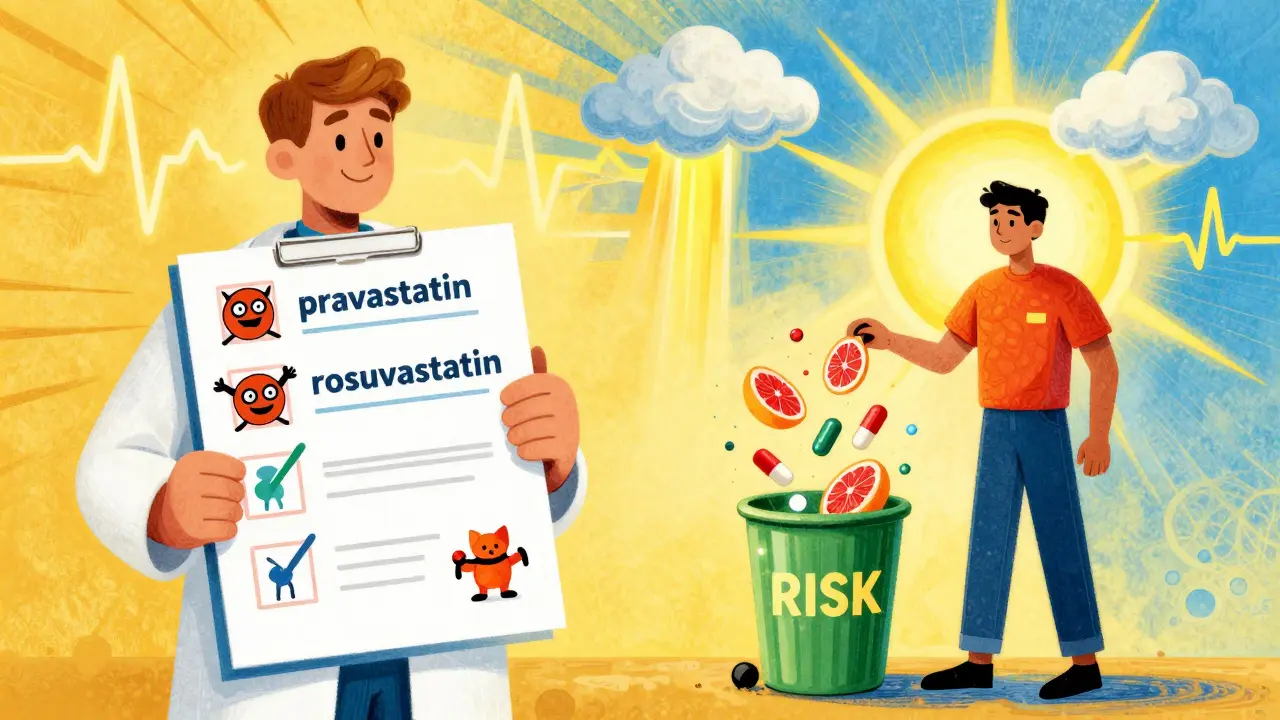
When a patient needs a strong CYP3A4 inhibitor and also takes simvastatin, doctors don’t just say “be careful.” They act. Here’s what they do:- Switch the statin: Pravastatin or rosuvastatin are much less dependent on CYP3A4. They’re safer choices.
- Lower the dose: If switching isn’t possible, they drop simvastatin to 5 mg or 10 mg.
- Monitor blood tests: Liver enzymes (ALT, AST) and CK (creatine kinase) levels are checked every 3-6 months, or sooner if symptoms appear.
- Use genetic testing: Some patients have a variant in the SLCO1B1 gene that makes them extra sensitive to simvastatin. Testing for this can prevent disaster before it starts.
Since 2011, the use of simvastatin 80 mg has dropped by 82%. That’s not because the drug stopped working. It’s because doctors realized the cost wasn’t worth the risk. The same cholesterol-lowering effect can be achieved with lower doses or safer statins.
What You Need to Do Right Now
If you’re taking simvastatin, here’s your checklist:- Check your dose. If it’s 80 mg, ask your doctor if you really need it. Most people don’t.
- Review every medication you take-even over-the-counter ones. Some cold medicines and herbal supplements can interact.
- Stop drinking grapefruit juice. Not “sometimes.” Not “a little.” Not “if I space it out.” Just stop.
- Know the signs of muscle damage: Unexplained muscle pain, weakness, or dark urine. If you feel this, call your doctor immediately.
- Ask if your pharmacist has checked for interactions. Most pharmacies now run automated screens. But if they haven’t, ask them to.
Simvastatin works. It saves lives. But it’s not a one-size-fits-all drug. At high doses, with the wrong combination, it becomes a ticking time bomb. You don’t need to stop taking it. But you do need to know what’s safe-and what could kill you.
Can I take simvastatin with antibiotics?
Some antibiotics are safe, but many are not. Clarithromycin, erythromycin, and azithromycin can dangerously raise simvastatin levels. If you need an antibiotic, tell your doctor you’re on simvastatin. They’ll pick a safer option like amoxicillin or doxycycline. Never take clarithromycin or erythromycin with simvastatin 40 mg or higher.
Is grapefruit juice really that dangerous with simvastatin?
Yes. A single glass of grapefruit juice can increase simvastatin levels by over 250%. This effect lasts for days. Even if you drink it at breakfast and take your pill at night, the interaction still happens. No amount is safe. Switch to orange juice or water instead.
Why is the 80 mg dose banned in many countries?
It’s not banned-but it’s strongly discouraged. The FDA and European Medicines Agency both say the 80 mg dose should only be used in patients who have been on it for years without side effects and who need very aggressive cholesterol lowering. For new patients, it’s no longer recommended. The risk of muscle damage far outweighs the benefit for most people.
What are the signs of rhabdomyolysis?
The main signs are severe muscle pain (especially in the shoulders, thighs, or lower back), weakness, and dark brown or tea-colored urine. You might also feel tired, nauseous, or confused. If you have these symptoms, go to the ER. Rhabdomyolysis can cause kidney failure within hours if not treated.
Are there safer statins than simvastatin?
Yes. Pravastatin, rosuvastatin, and fluvastatin are metabolized differently and have far fewer drug interactions. If you’re on multiple medications, switching to one of these can cut your risk of side effects by more than half. Talk to your doctor about whether a switch makes sense for you.
Aisling Maguire
March 2, 2026I work in pharmacy in Dublin and I can't tell you how many times I've had to stop a script for simvastatin 80mg with clarithromycin. Patients are always shocked. 'But my GP said it was fine!' Nope. Not anymore. Grapefruit juice? Same deal. One glass = 260% spike. I keep a printed handout in my drawer now. Give it to 'em. Save a life.
Also, if you're on amiodarone and simvastatin? That's a one-way ticket to the ER. Switch to rosuvastatin. Easy.
Sneha Mahapatra
March 3, 2026It’s funny how we treat medicine like it’s a one-size-fits-all tool… like our bodies are just machines with preset settings. But they’re not. We’re complex, messy, living systems. Simvastatin at 80mg? It’s not the drug’s fault. It’s the system’s. We push high doses because we want fast results… but biology doesn’t work on deadlines. 🌿
Byron Duvall
March 5, 2026Y’all realize the FDA is just doing Big Pharma’s bidding right? They banned 80mg because they want you on five different drugs instead. Rosuvastatin? That’s just simvastatin with a patent renewal. They’re not trying to save you. They’re trying to sell you more pills. And grapefruit? It’s a natural CYP3A4 inhibitor. Maybe the real problem is that we don’t trust natural things anymore.
Katherine Farmer
March 6, 2026Honestly, it's embarrassing that this even needs to be said. The 80mg dose was never appropriate for the general population. It's like prescribing 100mg of aspirin for a headache. The fact that 15% of patients were on it speaks volumes about the state of primary care in the US. If you're taking simvastatin 80mg and aren't under a lipid specialist, you're being malpracticed. Period.
Full Scale Webmaster
March 8, 2026I read this whole thing and I'm just sitting here thinking: this is the exact reason I stopped trusting doctors. You get prescribed this drug, you're told it's safe, you take it for years, then suddenly-oh wait, you're on grapefruit juice? And now you're at risk of your muscles melting? What kind of medical system lets this happen? I had a friend who got rhabdomyolysis from simvastatin and clarithromycin. He was in the ICU for three weeks. His kidneys never fully recovered. And his doctor? Said he 'should've known'.
Who the hell is supposed to know? The drug label? The pharmacist? The internet? No one tells you until it's too late. This isn't medicine. This is Russian roulette with a prescription pad.
Brandie Bradshaw
March 8, 2026I’ve been on simvastatin 40mg for 7 years. No issues. Then my doctor switched me to rosuvastatin 10mg because I started taking omeprazole. I asked why. She said, ‘CYP3A4 interaction.’ I looked it up. I had no idea. I’ve been taking omeprazole for 12 years. I thought it was just for heartburn.
Doctors don’t explain this. Pharmacists don’t explain this. Patients are left in the dark. And then-when the damage is done-we’re told it’s our fault for not reading the fine print. The fine print is 37 pages long. And it’s in 8-point font.
It’s not patient negligence. It’s systemic failure.
Angel Wolfe
March 8, 2026Grapefruit juice is dangerous? Really? That’s what they’re worried about? What about the 500 other things in your fridge that interact with meds? Why not ban all fruit? Why not ban coffee? Why not ban sunlight? This is just another way to scare people into taking more drugs. The real danger is trusting doctors who don’t even know what CYP3A4 means. I don’t take statins. I eat butter. My cholesterol is fine. And I’m still alive.
Sophia Rafiq
March 9, 2026CYP3A4 is the gatekeeper. Grapefruit is the lockpick. Simvastatin 80mg is the loaded gun.
Bottom line: if you’re on a statin and on more than 2 meds, get your pharmacist to run a med review. It’s free. Do it. Don’t wait for a crisis. Also-rosuvastatin > simvastatin. Always.
Martin Halpin
March 10, 2026I’ve been taking simvastatin 40mg for 11 years. My doctor told me to stop grapefruit juice. I said, ‘But I’ve been drinking it for 30 years!’ He said, ‘Yeah, but you weren’t on 40mg then.’
So I switched to orange juice. And then I found out orange juice has furanocoumarins too-just less. So now I drink apple juice. But my wife says apple juice is just sugar water. I said, ‘So is my life if I get rhabdomyolysis.’ She laughed. I didn’t.
And now I’m paranoid. I check every OTC med. I call the pharmacy before I buy anything. I even asked my dentist if my mouthwash interacts. He said no. But I don’t believe him. I think he’s lying. I think they’re all lying. I think the whole system is a scam. I think I’m the only one who gets it.
Eimear Gilroy
March 12, 2026I’m a med student in Cork. We were taught simvastatin 80mg as a last-resort option. But in clinical rotations, I saw it prescribed for patients with no other risk factors. One woman, 54, on simvastatin 80mg, metoprolol, and omeprazole. No one checked interactions. She came in with muscle pain. CK was 18,000. She was admitted. We switched her to pravastatin. She’s fine now.
But why did it take her being hospitalized to fix it? We need better systems. Not just more warnings.
Ajay Krishna
March 12, 2026I’m from India. We don’t have the same access to pharmacists or genetic testing. But I’ve seen people here take simvastatin with turmeric, ashwagandha, and grapefruit juice. They think it’s all ‘natural’ so it’s safe.
It’s not. Natural doesn’t mean harmless. I started a small community group to teach people about drug interactions. We use WhatsApp. We share simple diagrams. We don’t use jargon. We say: ‘If it’s on this list, don’t mix.’
Small steps. But it’s something.
Charity Hanson
March 12, 2026I was on simvastatin 80mg for 6 months. My doctor said I had ‘severe familial hypercholesterolemia.’ I believed him. Then I got sick. Couldn’t walk. Dark urine. ER. CK 25,000. I spent 10 days in hospital. Now I’m on rosuvastatin 5mg. My cholesterol is better. I feel better.
But here’s the thing-I didn’t know grapefruit juice was dangerous. My mom gave me a gallon every week. She said it ‘cleansed my blood.’
So now I tell everyone: if you’re on statins, ditch the juice. And if your doctor doesn’t mention interactions? Ask them. Don’t wait to almost die.
Noah Cline
March 12, 2026CYP3A4 inhibition is not a ‘risk.’ It’s a pharmacokinetic inevitability. The 80mg dose violates the therapeutic index of simvastatin. The FDA’s 2011 advisory was a correction of a systemic error rooted in industry-driven prescribing norms. The fact that 15% of patients were exposed to this level of exposure indicates a catastrophic failure in clinical decision support infrastructure. Rosuvastatin’s hepatic excretion pathway renders it far less susceptible to CYP3A4-mediated interactions. Therefore, switching is not merely prudent-it is pharmacologically imperative.