
1 Dec 2025
- 13 Comments
Every year, the U.S. Food and Drug Administration (FDA) issues dozens of official notices about new risks tied to medications you’re already taking. These aren’t ads. They aren’t rumors. They’re FDA Safety Communications-critical updates that can change how you use your medicine, or even whether you should keep taking it. But if you’ve ever opened one and felt lost, you’re not alone. The language is dense, the format is technical, and the stakes are high. This guide breaks it down simply: how to find them, what to look for, and what to do next.
What Are FDA Safety Communications, Really?
These are official alerts the FDA sends out when new safety information emerges about a drug after it’s already on the market. Think of it like this: when a drug is first approved, the FDA reviews data from clinical trials. But those trials only include a few thousand people over months or a couple of years. Real-world use involves millions of people over decades. That’s where problems sometimes show up-rare side effects, dangerous interactions, or misuse patterns that weren’t visible before. Since 2007, the FDA has had stronger legal power to monitor drugs after they’re sold. Today, they issue about 50 to 70 major safety communications annually. These aren’t just warnings. They’re detailed reports that explain what changed, why, and what you should do.Where to Find Them
The FDA posts all safety communications on its official website: fda.gov/drugs/drug-safety-and-availability. But you don’t have to check it daily. You can sign up for email alerts. Just go to that page, scroll to the bottom, and subscribe. You can choose alerts for specific drug classes-like opioids, diabetes meds, or blood thinners-or for all medications. This way, you’ll get a direct email when something important comes out about a drug you take. You’ll also see these alerts on your pharmacy’s website, your doctor’s office, or sometimes in the Medication Guide that comes with your prescription. But don’t rely on those alone. The FDA’s site is the original source. Everything else is a copy, and sometimes copies get outdated or simplified too much.How to Read One-Step by Step
Each FDA Safety Communication follows a clear structure. You don’t need to read every word, but you do need to know where to look.- Start with “What Safety Concern Is FDA Announcing?” This is the headline. It tells you the core issue in plain language. For example: “FDA warns of serious liver injury linked to duvelisib (Copiktra).” That’s your signal to pay attention.
- Look for “Boxed Warning” changes. This is the FDA’s strongest warning. It’s printed in a bold black border at the top of the drug’s prescribing information. If this section changed, it means the risk is serious-possibly life-threatening. Don’t ignore it.
- Check “For Patients” or “What This Means For You.” The FDA now includes a simplified section for patients. It tells you in clear terms: “Stop taking this drug immediately,” or “Talk to your doctor before making any changes.” This is your action step.
- Find the “Highlights of Prescribing Information.” This section summarizes key changes in a table. It shows exactly what wording was added, removed, or updated in the official drug label. For example, a previous warning might have said “Do not abruptly stop,” and now it says “Do not rapidly reduce or abruptly stop.” That tiny change matters-it means the risk of stopping too fast is even higher than thought.
- Look for section references like “2.x, 5.x.” These point to where the changes appear in the full prescribing information. If you’re a healthcare provider, you’ll use these to update your records. If you’re a patient, you can ask your pharmacist to show you the updated label.
What the FDA Is Trying to Tell You
Not all safety updates mean the same thing. The FDA uses specific language to signal urgency:- “STOP using this medication immediately.” This is rare, but when you see it, it means there’s a known, immediate danger. Don’t wait. Call your doctor or go to urgent care.
- “Do not use if you have…” or “Contraindicated in…” This means the drug is unsafe for certain people-like those with liver disease or pregnant women.
- “Consider this information when prescribing.” This is informational. It doesn’t mean stop, but it does mean your doctor should weigh the risks more carefully.
- “Labeling updated to reflect new data.” This is the most common. It means the FDA added or changed details based on new evidence, but the drug is still considered safe when used correctly.
Why This Matters for You
Let’s say you take a blood thinner like warfarin. A new study shows that taking it with a common over-the-counter painkiller increases your risk of bleeding. The FDA issues a safety communication. If you don’t read it, you might keep taking both, unaware you’re putting yourself at risk. But if you do read it, you can ask your doctor: “Is this still safe for me?” A 2021 study found that only 37% of primary care doctors regularly read these alerts. That means many patients are flying blind. You don’t have to be one of them. Even if you’re not a doctor, you can understand the basics. You don’t need to decode medical jargon-you just need to know where to find the plain-language summary.What to Do After Reading
Once you’ve read the communication, here’s what to do:- Don’t panic. Most changes are about fine-tuning use, not pulling the drug off the market.
- Don’t stop your medication on your own. Unless the alert says “STOP,” never quit cold turkey. Some drugs can cause serious withdrawal or rebound effects.
- Call your doctor or pharmacist. Say: “I just read an FDA safety alert about my medication. Can we talk about what this means for me?” Bring the alert if you can print it or show it on your phone.
- Check your Medication Guide. Every prescription comes with a small booklet explaining side effects, how to take it, and what to avoid. The FDA requires this guide to be written at an 8th-grade reading level. If yours is hard to read, ask for a new copy.
- Sign up for email alerts. Set it up now, so you don’t have to remember to check later.
Common Misunderstandings
Many people confuse FDA Safety Communications with other types of alerts:- Drug Alerts are shorter, faster notices-often about urgent issues like contamination or manufacturing problems. They’re not always about safety risks tied to how the drug works.
- Drug Recalls mean the product is pulled from shelves. This is rare and usually due to contamination, not side effects.
- Medication Guides are the handouts you get at the pharmacy. They’re based on FDA communications, but they’re simplified. Always go back to the original FDA alert for full context.
What’s Changing in 2025
The FDA is making these alerts easier to understand. Since early 2023, they’ve started testing plain-language summaries for high-risk drugs. These are short, visual, and available in English and Spanish. They’re being rolled out to patient portals and pharmacy apps. By 2027, the FDA aims to boost patient understanding from 54% to 75%. They’re also working with electronic health record systems so that safety alerts pop up automatically when a doctor prescribes a drug. Right now, only 32% of systems do this. That’s changing.Final Tip: Make It a Habit
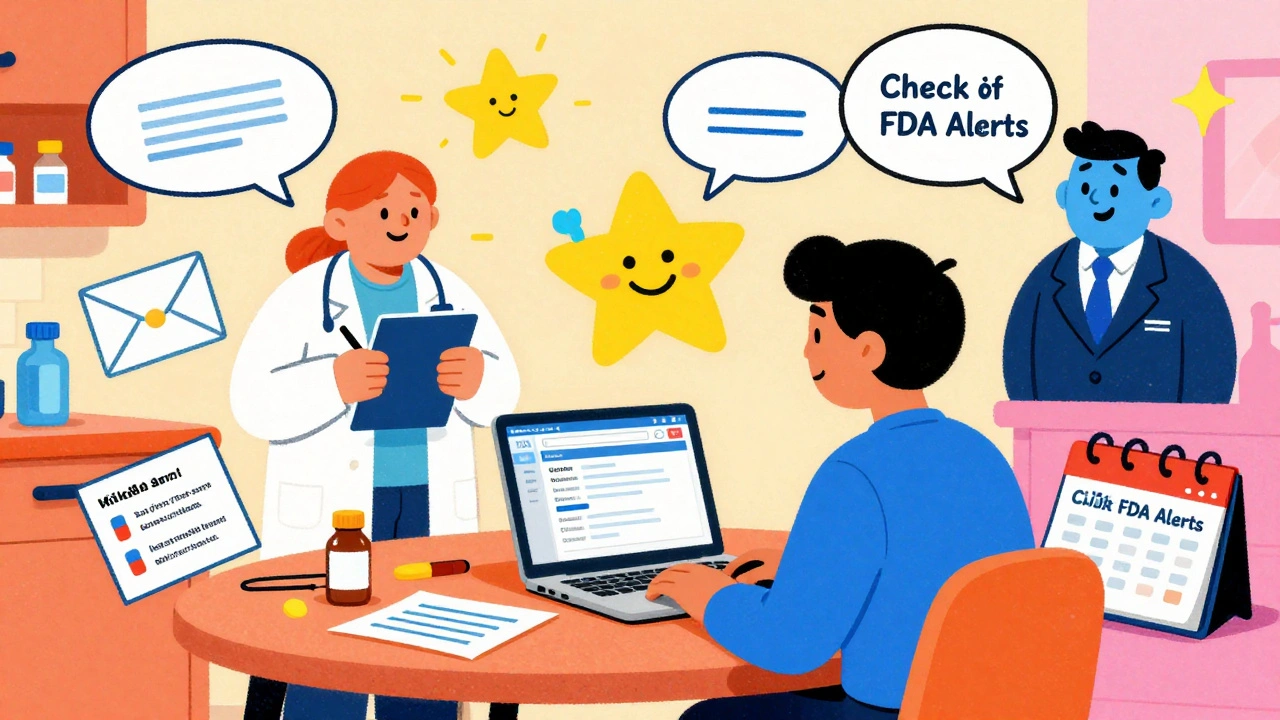
Treat FDA Safety Communications like a monthly health check-up. Set a reminder on your phone: “Check FDA alerts for my meds” every three months. If you take more than one prescription, pick one to review each month. You don’t need to be an expert. You just need to be informed. The goal isn’t to scare you. It’s to give you power. You’re not just a patient-you’re a partner in your care. Knowing what the FDA says about your medication means you can ask better questions, make smarter choices, and stay safer.Are FDA Safety Communications only for doctors?
No. While they’re written for healthcare professionals, the FDA now includes a clear “For Patients” section in every communication. This part uses plain language to explain what you need to do. You don’t need a medical degree to understand it.
Should I stop taking my medicine if I see an FDA alert?
Only if the alert says “STOP using this medication immediately.” Otherwise, never stop on your own. Some drugs can cause dangerous withdrawal symptoms or make your condition worse. Always talk to your doctor first.
How often do these alerts come out?
The FDA issues about 50 to 70 major Drug Safety Communications each year. They also release shorter Drug Alerts more frequently, sometimes weekly. Signing up for email alerts ensures you won’t miss anything important.
Can I trust the information in the Medication Guide that comes with my prescription?
Yes, but only as a starting point. The Medication Guide is required to be clear and written at an 8th-grade level. However, it’s a summary. The full FDA Safety Communication contains more detail, including the exact changes made to the drug’s label. Always cross-check with the FDA’s official page if you’re unsure.
What if I don’t understand the medical terms in the alert?
That’s normal. Take the alert to your pharmacist or doctor. Say, “I read this, but I’m not sure what it means for me.” Pharmacists are trained to explain these alerts in simple terms. Many pharmacies now offer free safety reviews when you pick up a new prescription.
Do these alerts apply to me if I live outside the U.S.?
If you’re taking a medication approved by the FDA, yes-the safety risks are the same no matter where you live. But your country’s health agency (like Australia’s TGA or Canada’s Health Canada) may have different guidelines. Always check with your local health authority and your doctor about how U.S. alerts apply to you.
Ella van Rij
December 2, 2025Oh great. Another FDA document that reads like a legal contract written by someone who hates humans. 🙄 I read one last month and still don’t know if my blood pressure med is gonna kill me or just make me mildly dizzy. Thanks for the wall of text, I guess.
Alicia Marks
December 3, 2025This is actually super helpful. Seriously, if you take any meds, bookmark this. You’re not being paranoid-you’re being smart.
Roger Leiton
December 4, 2025I used to ignore these until my mom had a bad reaction to a combo med. Now I check every quarter. 🙌 Thanks for making it feel doable!
dave nevogt
December 4, 2025The real tragedy isn’t the complexity of the FDA’s language-it’s the fact that we’ve outsourced our health literacy to institutions that operate like ancient bureaucracies with a PowerPoint addiction. We are taught to consume medicine like we consume fast food: blindly, efficiently, and without curiosity. The FDA’s communications are not failures of clarity-they are symptoms of a system that sees patients as data points, not beings with agency. To read one of these alerts is to confront the uncomfortable truth: your life is being managed by a machine that doesn’t know your name, your fears, or your sleepless nights worrying about whether that little blue pill is going to quietly dissolve your liver. And yet, here we are, expected to decode it all ourselves-with no training, no support, no damn manual. This guide? It’s not just helpful. It’s revolutionary. Because it says: you are not powerless. You can learn. You can ask. You can care.
Elizabeth Grace
December 6, 2025I read one of these and started crying. Not because I was scared-because I realized no one ever told me I was allowed to care about this stuff. Like, I’m not a doctor but I’m the one who takes the pills. Why is it my job to be the detective? 😭
Laura Baur
December 7, 2025It’s laughable that the FDA waits until after millions of people have been exposed to a drug before issuing a warning. This isn’t safety-it’s damage control dressed up as transparency. And don’t get me started on the ‘For Patients’ section. It’s like giving a child a scalpel and saying, ‘Here, fix your appendix.’ You don’t need to be a doctor to understand the language-you need to be a trained forensic analyst. This system is broken, and this guide is just a Band-Aid on a hemorrhage.
Steve Enck
December 8, 2025The notion that a layperson can meaningfully interpret pharmacovigilance data without a background in biostatistics or clinical trial design is not merely optimistic-it is epistemologically naive. The FDA’s "plain language" summaries are performative gestures, designed to absolve institutional responsibility while maintaining the appearance of patient empowerment. The data is still inaccessible. The risk stratification is still opaque. And the burden of interpretation remains squarely on the patient’s shoulders-exactly where it should never be.
Lynn Steiner
December 9, 2025I hate that I have to be this vigilant. I just want to take my pills and not feel like I’m playing Russian roulette with my body. 🤬 I’m tired. I’m so tired. And no one cares.
Joel Deang
December 10, 2025I live in the US but my cousin in Mexico takes the same med. She had no idea the FDA had a warning. She just trusted her local pharmacy. Now she’s in the hospital. 😞 This stuff matters everywhere. #GlobalHealth
Paul Keller
December 10, 2025The FDA’s methodology is fundamentally sound. The issue lies not in the content of the communications, but in the societal erosion of medical literacy. The average citizen is not equipped to interpret pharmacological risk, nor should they be expected to be. The solution is not to dumb down the language-it is to integrate pharmacovigilance education into secondary curricula, to train community pharmacists as frontline educators, and to mandate that electronic health records provide real-time, contextualized alerts to patients at the point of dispensing. This article, while commendable, is a stopgap. We need systemic reform.
Shannara Jenkins
December 12, 2025I just signed up for the alerts. Took me 5 minutes. You can too. No excuses. You deserve to know what’s in your body. 💪
मनोज कुमार
December 13, 2025FDA alert = useless. Pharma pays them. Just take your pills and stop overthinking. If you die its your fault for not reading the tiny print. #IndiaKnowsBetter
Jack Dao
December 15, 2025I’m not sure whether to applaud this guide or weep for the state of American healthcare. That someone needs a 2,000-word tutorial to understand whether their medication might kill them is not a triumph of transparency-it’s a monument to institutional failure. You shouldn’t need a decoder ring to survive your own prescription. This isn’t empowerment. It’s survival training for a system that abandoned you.