
5 Jan 2026
- 9 Comments
When two or more drugs are combined into a single pill or formulation, getting the doses right isn’t just about matching numbers-it’s about making sure the body responds the same way, every time. This is the core challenge of therapeutic equivalence in combination products. It’s not enough for two pills to contain the same active ingredients. The doses, how they’re released, and even the inactive ingredients can change how well they work-and whether they’re safe to swap.
What Therapeutic Equivalence Really Means
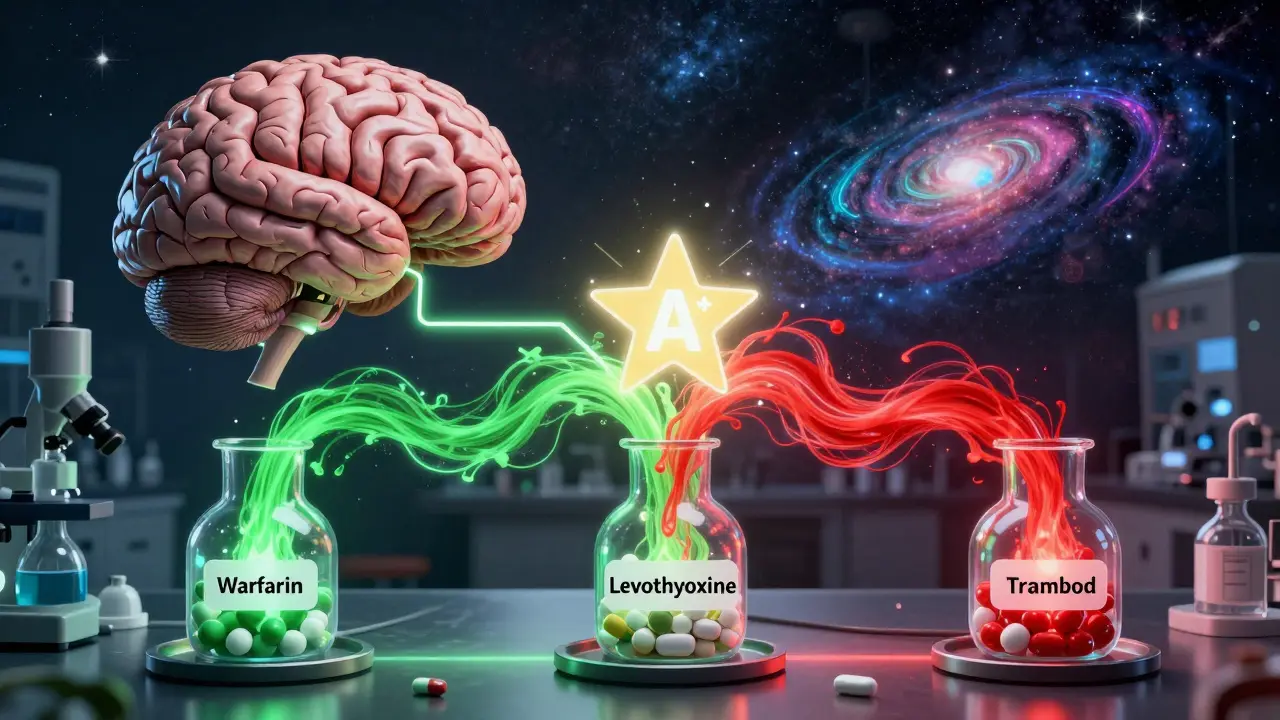
Therapeutic equivalence means two drug products can be swapped without changing the outcome for the patient. The U.S. FDA defines it strictly: same active ingredients, same strength, same dosage form, same route of administration. That’s it. No wiggle room. If you’re switching from a brand-name combination like Advair Diskus (fluticasone/salmeterol) to a generic version, the FDA requires proof that the body absorbs and responds to both in nearly identical ways. In 2023, over 14,000 drug products were rated for therapeutic equivalence in the FDA’s Orange Book, and 95% of them got an “A” rating-meaning they’re considered interchangeable. But here’s the catch: “interchangeable” doesn’t mean “identical.” Two generic versions of the same combination drug might use different fillers or coatings. One might dissolve faster. Another might release the drug more slowly. For most people, this doesn’t matter. But for drugs with a narrow therapeutic index-like warfarin, levothyroxine, or phenytoin-tiny differences can mean the difference between control and crisis.Why Dose Equivalence Gets Complicated in Combinations
Simple math doesn’t work when you’re dealing with combination drugs. Take tramadol and acetaminophen. Tramadol works on opioid receptors; acetaminophen works on pain pathways in the brain. Together, they don’t just add up-they multiply. Studies show their combined effect is greater than the sum of their parts. That’s called synergy. But if you switch from one brand’s combination to another with different ratios-say, 37.5mg tramadol/325mg acetaminophen versus 50mg/325mg-you can’t just assume the higher dose of tramadol is “better.” The body’s response isn’t linear. One study used a formula called beq(a)=CBγ(1+CAa)−1 to calculate dose equivalence between drugs with different maximum effects. In one case, topotecan reduced cell growth by 88.9%, while sirolimus only hit 69.8%. To match the effect, you’d need a different ratio of each drug. That’s not something a pharmacist can guess. It requires modeling. Even when two combination products have the same TE code (“A”), they might not behave the same in every patient. A 2018 study in the Journal of Clinical Endocrinology & Metabolism found that 12% of patients switching between generic levothyroxine products had changes in thyroid hormone levels-even though both met FDA bioequivalence standards. That’s because absorption can vary based on gut pH, food intake, or even the type of filler used.How the FDA Rates Combination Products
The FDA uses a letter system to rate therapeutic equivalence. “A” means the product is interchangeable. “B” means there’s uncertainty-usually because the generic hasn’t proven it’s bioequivalent under all conditions. For combination products, things get messy. There are three main paths to approval:- ANDA (Abbreviated New Drug Application): The generic copies a brand-name drug exactly. Usually gets an “A” rating.
- 505(b)(2) NDA: The company modifies an existing drug-maybe changes the dose ratio, adds a new inactive ingredient, or alters release timing. This can still get an “A” rating… or it might get a “B” if the changes affect absorption.
- Petitioned ANDA: A generic maker asks the FDA to approve a product that’s not an exact copy. Often used for combination products where the original brand has been discontinued. Ratings here are unpredictable.

Real-World Problems Pharmacists Face
A pharmacist in Sydney told me about a patient who was switched from a brand-name amlodipine/benazepril combination to a generic. The original was 5mg/20mg. The generic was 5mg/10mg. The pharmacist thought it was a typo. It wasn’t. The generic manufacturer had simply combined two separate tablets into one pill. The dose of benazepril was cut in half. The patient’s blood pressure spiked. That’s not rare. The FDA’s Adverse Event Reporting System logged 247 incidents in 2022 linked to incorrect dose conversions in combination products. Nearly 40% involved cardiovascular drugs. Another 30% involved psychiatric combinations like sertraline/nortriptyline. On Reddit, a pharmacist with 12 years of experience wrote: “I’ve had three dose-related errors in six months just from switching between different generics of the same combination. No one checks the actual dose-just the name.” The problem? Many electronic prescribing systems don’t show the exact strength of the generic. They just say “amlodipine/benazepril.” The pharmacist has to manually check the manufacturer’s label. That’s time-consuming. And mistakes happen.How to Manage Therapeutic Equivalence Safely
There are proven ways to reduce errors:- Verify the active ingredients and exact doses. Don’t assume. Look at the pill imprint, the manufacturer, and the strength on the label.
- Check the Orange Book TE code. Just because two products have the same name doesn’t mean they’re rated equivalent. Use the FDA’s online database.
- Use barcode scanning. Many hospitals now scan every combination product before dispensing. If the system flags a mismatch, it stops the process.
- Monitor high-risk patients for 72 hours after switching. Especially for NTI drugs like warfarin, lithium, or levothyroxine. Check blood levels if possible.
- Keep standardized conversion tables. Don’t rely on memory. Print them out. Post them in the pharmacy. Update them quarterly.
What’s Changing in 2026
The FDA is moving toward more sophisticated evaluations. In early 2023, they released draft guidance on “Therapeutic Equivalence Considerations for Complex Combination Products.” This acknowledges that not all combinations follow simple dose-response curves. Some have inverted U-shaped effects-where too much of a drug reduces effectiveness. They’re also testing machine learning tools that predict whether a generic version might fail based on its formulation. In early trials, the algorithm correctly flagged 89% of high-risk substitutions. There’s also talk of introducing an “A*” rating-for combination products that have proven therapeutic equivalence across multiple strengths. Right now, if a brand offers 5/10mg, 10/20mg, and 10/40mg, the generic only needs to prove equivalence for one strength. The others are assumed. That’s changing. And in the future? The NIH predicts that by 2030, 30% of therapeutic equivalence decisions will include pharmacogenomic data. If a patient metabolizes drugs slowly due to a genetic variant, their “equivalent” dose might need to be lower. That’s personalization meeting regulation.When Not to Substitute
Don’t swap combination products without a plan if:- One or more components have a narrow therapeutic index.
- The patient has had a bad reaction to a previous generic.
- The combination includes a drug with complex pharmacokinetics (like antiepileptics or anticoagulants).
- The patient is elderly, has kidney or liver disease, or takes five or more other medications.
Bottom Line
Therapeutic equivalence is a powerful tool to cut costs and improve access. Generic combination products saved the U.S. healthcare system $1.7 trillion over the last decade. But it’s not magic. It’s science-and it requires attention to detail. A pill might look the same. The name might be the same. But the dose, the release, the filler, the patient’s body-they all matter. Managing therapeutic equivalence isn’t about checking a box. It’s about understanding the chemistry, the biology, and the human factor behind every substitution.What does an 'A' rating mean in the FDA Orange Book?
An 'A' rating means the drug product has been evaluated by the FDA as therapeutically equivalent to the reference listed drug. This means it contains the same active ingredients in the same strength and dosage form, and has been proven to be bioequivalent. It can be substituted without clinical concern under most circumstances.
Can two generic combination drugs with the same name be different?
Yes. Two generics with the same name and TE code can have different inactive ingredients, manufacturing processes, or release profiles. These differences can affect how quickly the drug is absorbed, especially in patients with digestive issues or those taking multiple medications. While they meet FDA standards, they’re not always identical in effect.
Why are narrow therapeutic index (NTI) drugs riskier in combinations?
NTI drugs have a very small window between an effective dose and a toxic one. Even minor changes in absorption-like switching from one generic to another-can push levels into the toxic range. For drugs like warfarin or levothyroxine, the FDA requires stricter bioequivalence standards (90-111% instead of 80-125%), but errors still occur. Combination products with NTI components require extra caution.
Is it safe to switch between brand and generic combination drugs?
For most patients, yes-if the product has an 'A' rating and the patient is stable. But for those on NTI drugs, elderly patients, or those with complex regimens, switching should be done with monitoring. Always check the TE code and confirm the exact dose. Don’t assume equivalence just because the names match.
How do I check if a combination product is therapeutically equivalent?
Use the FDA’s Orange Book database online. Search by the brand name or active ingredients. Look for the TE code next to the product listing. An 'A' rating means it’s considered interchangeable. If it’s a 'B', there’s unresolved bioequivalence data-don’t substitute without consulting a pharmacist or prescriber.
Do other countries have the same system as the FDA?
The European Medicines Agency (EMA) follows similar principles but requires additional in-vivo studies for fixed-dose combinations where components have different absorption rates. Australia’s TGA uses a similar rating system but doesn’t publish a public equivalent of the Orange Book. Pharmacists there rely on internal databases and manufacturer documentation to assess equivalence.
Tiffany Adjei - Opong
January 7, 2026Okay but let’s be real-FDA’s ‘A’ rating is basically a suggestion with a stamp. I’ve seen generics with the same TE code make patients feel like they got hit by a bus. One guy switched from brand to generic lamotrigine/valproate combo and started seeing colors. No joke. He said the sky turned purple for three days. The pharmacy said ‘it’s bioequivalent.’ Yeah, and my toaster is ‘bioequivalent’ to a nuclear reactor if you squint.
Ryan Barr
January 9, 2026Irrelevant. Bioequivalence ≠ therapeutic equivalence. The FDA’s system is archaic.
Cam Jane
January 9, 2026Y’all need to stop treating generics like they’re all the same. I’m a clinical pharmacist and I’ve seen this play out too many times-patient on levothyroxine combo, switches to generic, TSH spikes, they think they’re ‘just stressed.’ Then they end up in the ER. Don’t just trust the label. Check the manufacturer. Check the batch. And if your patient is elderly or on five meds? Don’t switch unless you’re watching them like a hawk. I keep a printed cheat sheet by my desk-‘NTI combos = no swaps without labs.’ It’s saved lives. Seriously. Print one. Stick it up. Your future self will thank you.
Tom Swinton
January 10, 2026I just want to say-thank you. Thank you for writing this. As a pharmacist who’s spent 14 years watching people get screwed over because someone assumed ‘same name = same pill,’ this is the kind of clarity we need. I had a patient last month who was on a 10/20mg amlodipine/benazepril combo, got switched to a generic that was 5/10mg… and collapsed at the grocery store. No one checked the dose. The system didn’t flag it. The pharmacist didn’t catch it. And now? She’s on a new med regimen, and her husband says she’s not the same. I cried when I read this post. Not because I’m weak-but because I’ve been screaming into the void for years. We need more of this. We need better systems. We need to stop letting cost cut corners on human lives.
Harshit Kansal
January 11, 2026Bro this whole thing is a scam. I saw my uncle take a generic version of his blood pressure combo and he started hallucinating spiders. Like actual spiders crawling on his walls. He said the pills were ‘different.’ Turns out the generic had a different filler that reacted with his acid reflux meds. Now he won’t take anything that’s not brand. And he’s not even rich. So yeah-FDA says ‘A’ but my uncle says ‘nope.’ Who you gonna believe? The algorithm or the man who saw spiders?
Vinayak Naik
January 12, 2026Man, this is wild. I work in a pharmacy in Delhi and we get these combo generics from China and India and sometimes the pills look like they were molded by a toddler. One batch of tramadol/paracetamol had a weird chalky taste-like licking a battery. Patients complained. We checked the TE code-‘A’. But the dissolution profile? Totally off. I had to call the distributor. They said ‘it’s approved.’ I said ‘approved for what? A science fair project?’ We started tracking by lot number now. No more guessing. If it tastes like regret, it’s probably not the same.
Saylor Frye
January 13, 2026Interesting. But the entire premise assumes therapeutic equivalence is a meaningful concept. It’s not. It’s regulatory theater. Real pharmacokinetics don’t care about your letter ratings.
Kiran Plaha
January 14, 2026So if I’m on a combo drug and my doctor says switch to generic, what should I ask? Just curious. I don’t want to mess up.
Matt Beck
January 15, 2026Deep breaths… 🌌 We’re all just stardust trying to dissolve in a pill… The FDA’s ‘A’ rating? Just a cosmic suggestion. The body? It remembers. Every filler. Every coating. Every microsecond of delayed release… It’s not just chemistry-it’s poetry. And when you swap pills like trading baseball cards… you’re not just changing a dose… you’re rewriting someone’s internal symphony. 🎻🫀 Maybe… just maybe… we’re not meant to simplify the sacred. Maybe the answer isn’t in the Orange Book… but in the silence between heartbeats.