
17 Jan 2026
- 14 Comments
Beta-Blocker Safety Checker for Asthma Patients
Beta-Blocker Safety Assessment Tool
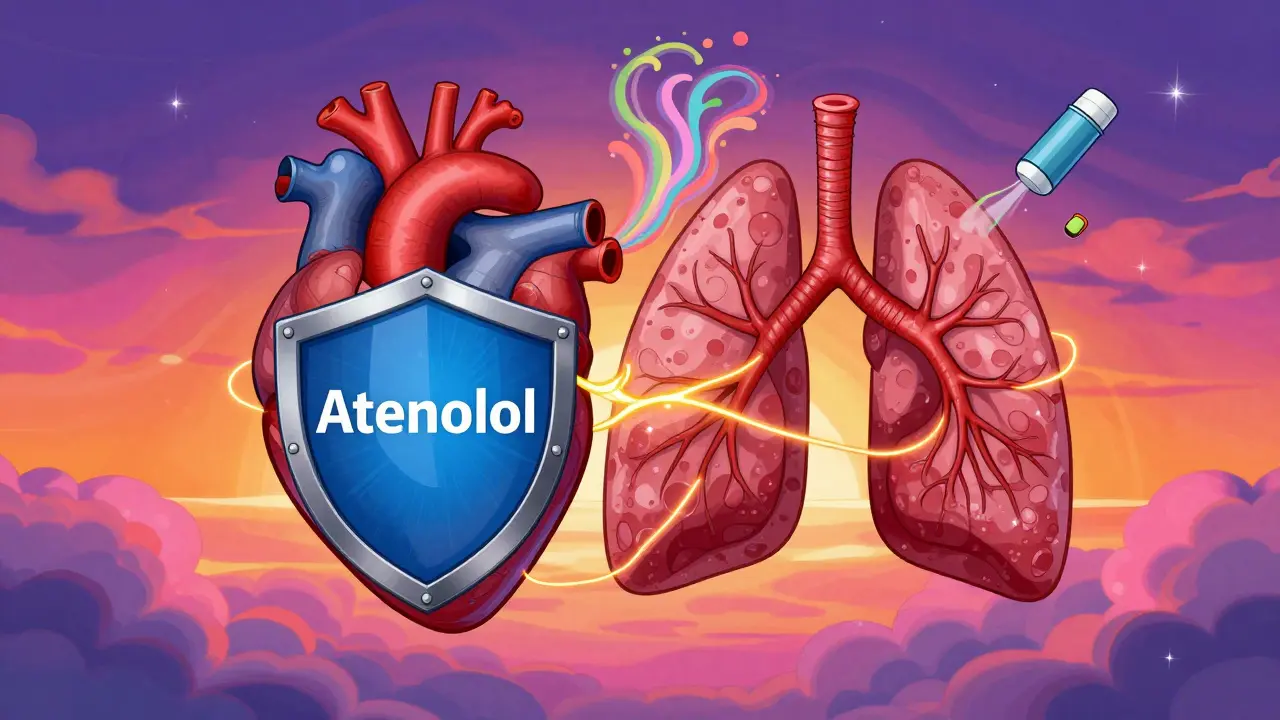
For years, doctors told asthma patients to avoid beta-blockers at all costs. The warning was clear: these heart medications could trigger a life-threatening asthma attack by tightening the airways. But today, that advice is changing - and for many people with asthma and heart disease, the old rule doesn’t hold up anymore.
Why Beta-Blockers Were Once Forbidden in Asthma
Beta-blockers work by blocking adrenaline, which slows the heart and lowers blood pressure. They’re used after heart attacks, for high blood pressure, and to manage irregular heartbeats. But early versions - like propranolol and nadolol - didn’t discriminate. They blocked beta-1 receptors in the heart and beta-2 receptors in the lungs. And that’s the problem.Beta-2 receptors in the lungs help keep airways open. When blocked, they can cause bronchospasm - a sudden tightening of the muscles around the airways. That’s what leads to wheezing, coughing, and shortness of breath. In severe cases, it can trigger a full asthma attack. That’s why the British National Formulary (BNF) still says beta-blockers should usually be avoided in asthma patients.
But here’s the catch: not all beta-blockers are the same.
The Rise of Cardioselective Beta-Blockers
Newer beta-blockers are designed to target only the heart. These are called cardioselective beta-blockers. They have at least 20 times more affinity for beta-1 receptors than beta-2 receptors. That means they’re much less likely to affect the lungs.Common cardioselective options include:
- Atenolol
- Metoprolol
- Bisoprolol
- Practolol
Studies show these drugs cause only a small, temporary drop in lung function - around 7.5% in forced expiratory volume (FEV1) - and that drop reverses completely when patients use their rescue inhaler. In contrast, non-selective beta-blockers like propranolol cause a 10% drop, and some patients report worsened symptoms.
A 2023 analysis of 29 clinical trials found that in patients with mild to moderate asthma, cardioselective beta-blockers caused no increase in asthma attacks, no hospitalizations, and no need for emergency treatment. None of the 240 patients in single-dose studies had a dangerous reaction.
Atenolol: The Safest Choice for Asthma Patients
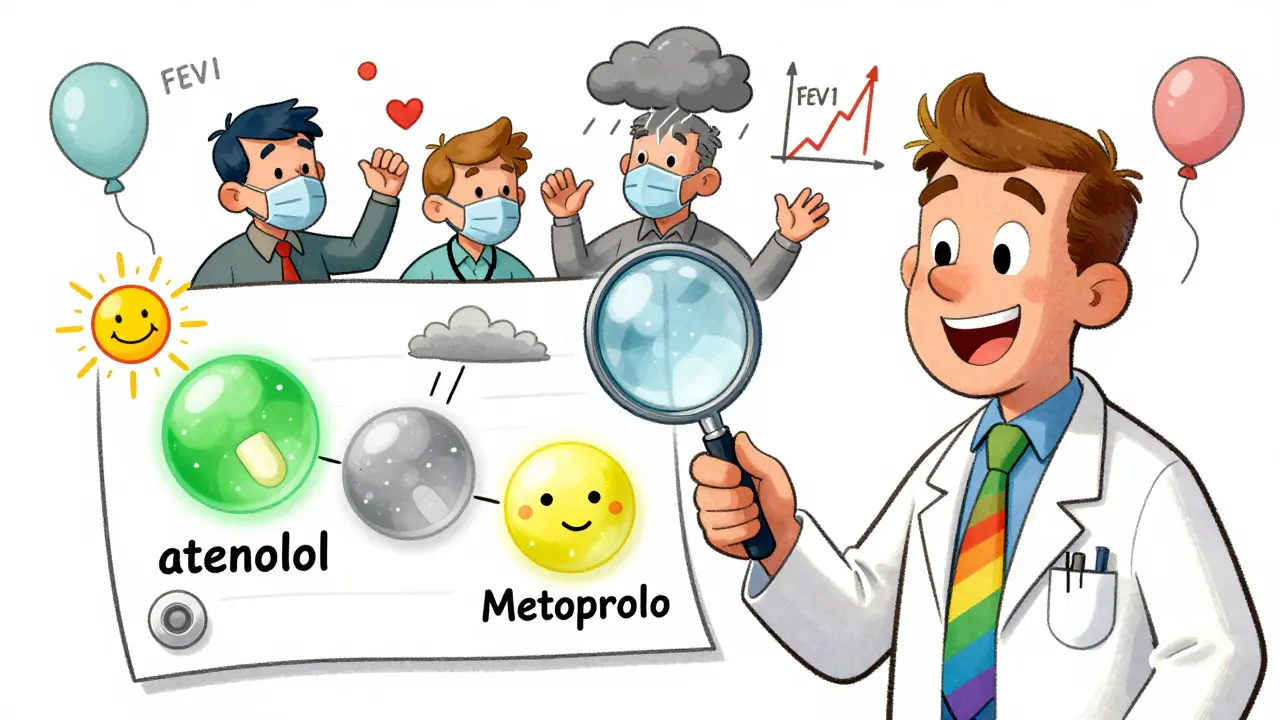
Among cardioselective options, atenolol stands out. In a direct head-to-head study with metoprolol, 14 asthma patients taking atenolol had fewer wheezing episodes, more asthma-free days, and better evening lung function. The difference was statistically significant.Why? Atenolol is less likely to cross into lung tissue compared to metoprolol. It’s also not metabolized by the liver, which reduces drug interactions. Experts from the European Journal of Clinical Pharmacology recommend atenolol as the first choice when beta-blockers are needed in asthma patients - especially when paired with a beta-2 agonist like albuterol.
And here’s something surprising: long-term use of cardioselective beta-blockers may actually reduce airway inflammation. Animal studies show that after weeks of treatment, airway hyperresponsiveness - a key feature of asthma - actually improves. This suggests that over time, these drugs might help calm the airways, not just the heart.
What About Rescue Inhalers?
A big fear among asthma patients is that beta-blockers will make their inhalers useless. After all, albuterol works by activating beta-2 receptors. If those receptors are blocked, how can the inhaler help?Good news: research shows this isn’t a major issue with cardioselective agents. In a study of 19 asthma patients taking bisoprolol daily for two weeks, rescue inhalers worked just as well as they did before treatment. The bronchodilator response - how much the airways opened up after albuterol - was nearly unchanged.
Even more reassuring: in patients taking cardioselective beta-blockers, the average improvement in FEV1 after using a rescue inhaler was 16%. That’s only slightly lower than the 23% seen in patients not on beta-blockers. Compare that to non-selective beta-blockers, where FEV1 barely moved - a 1% decline.
Who Should Still Avoid Beta-Blockers?
This isn’t a green light for everyone with asthma. These drugs are only considered safe under specific conditions:- You have mild to moderate asthma - not severe or uncontrolled
- Your asthma is stable, with no recent hospitalizations or emergency visits
- You’re under the care of a specialist - not just your primary doctor
- You’re starting with the lowest possible dose
- You’re monitored with lung function tests before and after starting
People with severe asthma, frequent exacerbations, or COPD with significant airway obstruction should still avoid beta-blockers unless there’s no other option - and even then, only under strict supervision.
Also avoid:
- Propranolol - non-selective, high risk
- Nadolol - long-acting, harder to reverse
- Timolol - used in eye drops for glaucoma, can still affect lungs
- Labetalol - blocks both alpha and beta receptors, increases airway resistance

Real-World Outcomes: Survival vs. Risk
The stakes are high. After a heart attack, beta-blockers reduce the risk of death by up to 34%. For someone with both heart disease and asthma, not taking a beta-blocker might be more dangerous than taking the right one.A 2024 review of 330 asthma patients on cardioselective beta-blockers found no reports of fatal bronchospasm. No deaths. No ICU admissions. Just stable heart function and controlled asthma.
That’s why the American Academy of Family Physicians now says: “Cardioselective beta-blockers are safe in patients with mild to moderate reactive airway disease - and clearly reduce mortality.”
What to Do If You Need a Beta-Blocker
If you have asthma and your doctor recommends a beta-blocker, here’s what to do:- Ask if a cardioselective option is available - atenolol is the top choice
- Confirm your asthma is well-controlled - no recent flare-ups
- Request a lung function test (FEV1) before starting
- Start with the lowest dose - half the usual starting amount
- Keep your rescue inhaler with you at all times
- Schedule a follow-up in 2-4 weeks to check lung function again
- Report any new wheezing, coughing, or shortness of breath immediately
Don’t stop your asthma medications. Don’t skip your inhaler. And don’t assume your doctor knows the latest guidelines - many still follow outdated warnings. Bring this research with you.
The Bottom Line
The old rule - “beta-blockers are dangerous for asthma patients” - is outdated. It was based on drugs we don’t use much anymore. Today, we have safer options. For people with heart disease and mild to moderate asthma, cardioselective beta-blockers like atenolol can be life-saving - without triggering attacks.It’s not about avoiding beta-blockers altogether. It’s about choosing the right one, at the right dose, with the right monitoring. The goal isn’t to eliminate risk - it’s to balance it. Your heart needs protection. Your lungs need care. With the right approach, you can have both.
Dayanara Villafuerte
January 18, 2026Okay but like… why are we still treating asthma like it’s 1998? 🤦♀️ I’ve been on metoprolol for 3 years with my mild asthma and my inhaler still works like a charm. My pulmonologist laughed when I asked if I should stop it. "You’re not dying from your heart, honey." 💉❤️
Kristin Dailey
January 18, 2026Atenolol is the only safe one. End of story.
Wendy Claughton
January 18, 2026I used to think this was just another medical myth… until my dad had a heart attack and his asthma flared up every time he tried a non-selective beta-blocker. We switched him to atenolol and he’s been stable for 18 months now. I’m not a doctor, but I’ve seen the difference. It’s not magic-it’s science. 🌱
Aysha Siera
January 18, 2026They’re hiding something. Big Pharma pushed cardioselective beta-blockers because they’re more profitable. Look at the timeline-right after the patent on propranolol expired, suddenly everyone’s saying it’s "safe." Wake up. The lungs don’t lie.
rachel bellet
January 20, 2026The literature is unequivocal: cardioselective beta-blockers exhibit negligible beta-2 receptor affinity at therapeutic plasma concentrations, thereby preserving bronchodilatory response in patients with mild-to-moderate obstructive airway disease. The BNF’s caution is outdated, and the AAFP’s updated guidance reflects evidence-based practice. Non-compliance with this paradigm constitutes clinical negligence.
Pat Dean
January 21, 2026You people are gambling with your lives. My cousin died after taking metoprolol. He had "mild" asthma too. Now he’s in the ground. Don’t listen to this "new science"-old doctors knew what they were doing. You want to live? Don’t touch these drugs.
Jay Clarke
January 22, 2026I get why people are scared. I was too. But let’s be real-when your heart’s failing, you don’t get to pick which risk you want to take. I took atenolol after my stent. My lungs wheezed once for 2 days. Then nothing. My heart’s fine now. My asthma? Still under control. It’s not about being brave. It’s about being smart.
Selina Warren
January 24, 2026Stop being afraid of your own body. You think your lungs are fragile? They’re tougher than you think. I’ve been on bisoprolol for 5 years. I run marathons. I use my inhaler like a backup, not a lifeline. This isn’t a crisis-it’s an upgrade. You’re not broken. You’re just being told you are by people who haven’t updated their textbooks.
Robert Davis
January 24, 2026I read the 2023 meta-analysis. The sample size was tiny. And the patients were all carefully screened-no one with severe asthma. That’s not real life. Real people don’t get pre-screened by specialists before they get prescribed meds. This is lab science, not bedside wisdom.
Nishant Sonuley
January 24, 2026I’m from India, and here, most docs still avoid beta-blockers like plague. But I’ve seen patients on atenolol in Mumbai clinics with no issues-especially when they’re on regular inhalers. It’s not about the drug. It’s about the system. If you’re not monitored, nothing’s safe. But if you are? You’ve got options. Don’t let fear silence your access to care.
Chuck Dickson
January 26, 2026If you’re reading this and you’re scared-good. That means you care. But don’t let fear make your decisions for you. Talk to a pulmonologist. Get your FEV1 tested. Start low. Go slow. Keep your inhaler close. You’re not a guinea pig-you’re a person with a plan. And you’ve got every right to protect both your heart and your breath.
Naomi Keyes
January 28, 2026I must point out that the referenced 2024 review lacks a control group, and the term "no reports of fatal bronchospasm" is statistically meaningless without denominator data. Furthermore, the exclusion of COPD patients from the safety profile is a critical oversight. The conclusion that these agents are "clearly" life-saving is a misrepresentation of the data’s limitations.
Robert Cassidy
January 29, 2026This is why America’s healthcare is broken. We’ve got people on heart meds because they’re too lazy to diet, and now we’re telling asthmatics it’s fine to take them? My grandpa died from asthma because some doctor gave him a beta-blocker in the '80s. You think your fancy "cardioselective" drug is gonna fix that? Wake up. We’re not lab rats. We’re Americans.
Andrew Qu
January 30, 2026Just wanted to add: if you’re on atenolol and your asthma feels worse, don’t panic. It might be a temporary adjustment. But if your FEV1 drops more than 15% after 2 weeks, talk to your doctor. I’ve helped dozens of patients transition safely. It’s not risky-it’s just new. And new is scary. But it’s also better.