
3 Feb 2026
- 11 Comments
Strabismus isn’t just about looks. It’s a real, measurable problem where one eye doesn’t line up with the other when you’re looking at something. One eye might turn inward, outward, up, or down - and that misalignment isn’t just cosmetic. It can mess with your vision, your balance, even your confidence. About 5 out of every 100 kids have it, and adults aren’t immune either. Strokes, head injuries, or nerve damage can trigger it later in life. The good news? It’s treatable. And surgery, when needed, can change everything.
What Does Strabismus Actually Look Like?
You might notice a child squinting in bright light or tilting their head to see better. Or maybe you’ve seen someone avoid eye contact because their eyes don’t seem to work together. That’s strabismus. The most common type is esotropia, where one eye turns inward - think of it like a lazy eye that’s pulling inward. About half of all cases are this kind. Then there’s exotropia, where the eye drifts outward. Less common are hypertropia (eye turns up) and hypotropia (eye turns down). These aren’t random. Each has a specific cause, often tied to how the brain controls the eye muscles.It’s not always obvious. Some people have constant misalignment - their eyes are always off. Others have intermittent strabismus - it comes and goes, maybe only when they’re tired or sick. That’s why it’s often missed. A kid might seem fine at school but struggle with reading or sports. Adults might notice double vision out of nowhere, especially after a head injury or stroke.
Symptoms go beyond the eyes. People with strabismus often get headaches, eye strain, or light sensitivity. Kids might lose focus in class - not because they’re distracted, but because their brain is fighting to make sense of two different images. Around 57% of children with strabismus have trouble reading. That’s not laziness. That’s their eyes working against them.
Why Does It Happen?
Most of the time, strabismus isn’t about weak eye muscles. It’s about the brain. The brain sends signals to the eye muscles to move in sync. When that signal gets messed up - maybe due to genetics, premature birth, or neurological issues - the eyes don’t line up. About 30% of kids with strabismus have a family history. That’s a strong clue.In adults, it’s often different. Strokes, head trauma, or nerve damage (like to the sixth cranial nerve) can suddenly throw the eyes out of alignment. This is called paralytic strabismus. It hits fast. People describe sudden dizziness, nausea, and double vision. It’s scary. But it’s also treatable.
Some cases are linked to uncorrected farsightedness. When a child strains to focus, their eyes cross. That’s why glasses can fix it - not because they’re correcting the muscle, but because they take the strain off the brain’s control system.
Non-Surgical Treatments: The First Step
Before surgery, doctors try the least invasive options. Glasses are the first line of defense, especially for kids with farsightedness. Patching the stronger eye for a few hours a day forces the weaker eye to work harder. This helps prevent amblyopia - or lazy eye - which can become permanent if untreated.Vision therapy is another tool. It’s not just eye exercises. It’s a structured program, often led by an optometrist, that retrains the brain to use both eyes together. Studies show it works well for intermittent exotropia. One 2021 review found that 60% of children aged 4-10 could avoid surgery with vision therapy alone.
Prism glasses are another option. They bend light to help align the images each eye sees. They don’t fix the muscle problem, but they can reduce double vision. For adults with sudden-onset strabismus, prisms are often the first try before surgery.
But here’s the catch: if these don’t work after a few months, or if the misalignment is too severe, surgery becomes the next step. That’s not failure. It’s just the right next move.
When Is Surgery Necessary?
Surgery isn’t for everyone. But when it’s needed, it’s life-changing. Doctors recommend it when:- The eyes are misaligned by more than 15-20 prism diopters (a measure of angle deviation)
- Double vision doesn’t go away with glasses or prisms
- The person tilts or turns their head constantly to see straight
- There’s a risk of permanent vision loss from amblyopia
For babies with constant inward turning (congenital esotropia), experts now recommend surgery as early as 3-4 months. That’s a big shift from the old rule of waiting until 6 months. Why? Because the brain’s ability to learn to use both eyes together fades after that. A 2022 study showed kids who had surgery before age 2 had a 78% chance of developing depth perception. Those who waited? Only 42%.
For adults, surgery is often about function - not just looks. If you can’t drive safely because of double vision, or you avoid eye contact at work, surgery can help. It’s not vanity. It’s quality of life.

What Happens During Surgery?
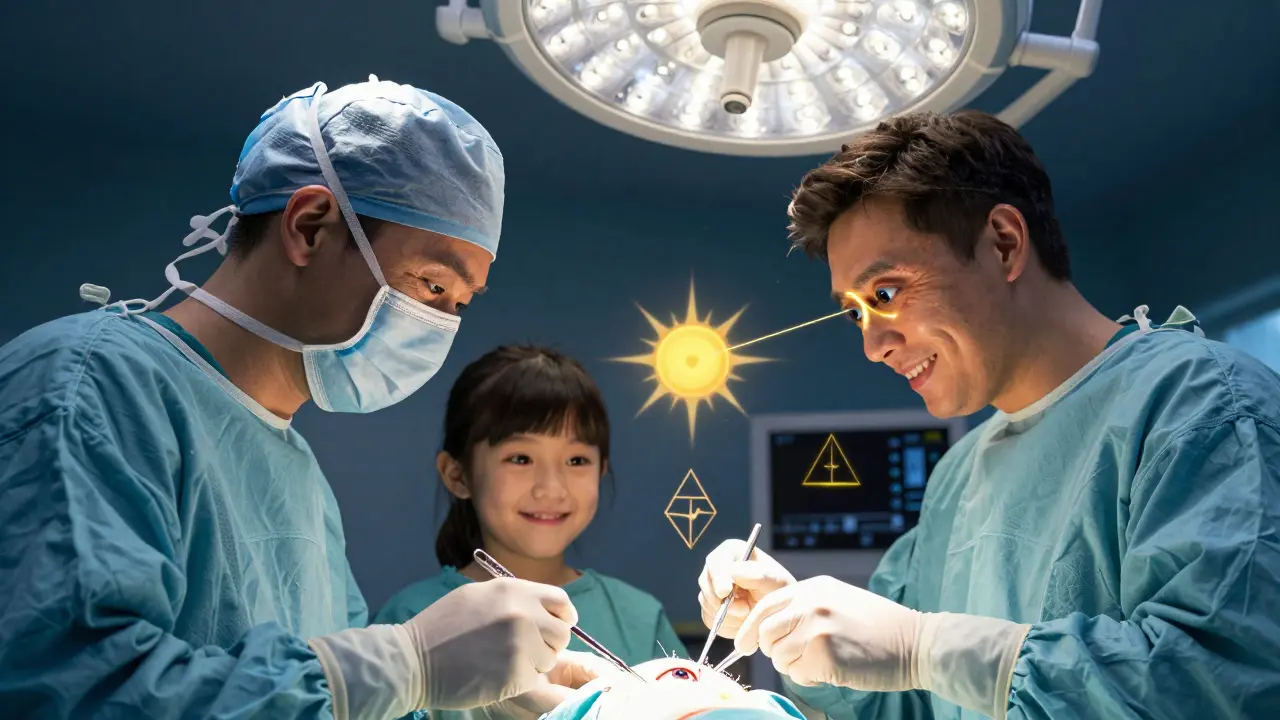
Strabismus surgery doesn’t touch the eyeball. It works on the muscles that move it - the six tiny bands that pull the eye in different directions. The two main techniques are:- Recession: The muscle is detached and reattached further back, making it weaker
- Resection: A section of the muscle is removed and the rest is tightened, making it stronger
For inward-turning eyes, surgeons often do a bilateral medial rectus recession - weakening both inner muscles. For outward-turning eyes, they might strengthen the inner muscles or weaken the outer ones.
Most surgeries today use adjustable sutures. That means the surgeon doesn’t fully tie the muscle right away. After you wake up, they can tweak the tension within 24 hours while you’re awake. This reduces the chance of needing a second surgery by 28%, according to FDA data from 2023.
For kids, it’s done under general anesthesia. For adults, it’s usually local anesthesia with sedation. The whole thing takes 45 to 90 minutes. You’re home the same day.
Success Rates and Risks
Surgery works - but not always perfectly. Success is measured by alignment within 10 prism diopters. For kids under 2, success rates hit 75-85%. For adults, it’s 55-65%. Why the difference? The adult brain is less flexible. It’s harder to retrain.Common side effects? Temporary double vision. About 80% of patients feel it right after surgery. It usually fades in days or weeks. Some need prism glasses temporarily.
Undercorrection happens in 20-30% of cases. That means the eye is still a bit off. You might need a second surgery. Overcorrection - where the eye turns the other way - happens in 10-15%. Both are fixable.
Serious risks are rare. Retinal detachment? 0.1%. Infection inside the eye (endophthalmitis)? 0.04%. Still, you need to watch for sudden vision loss, severe pain, or redness after surgery. Call your doctor immediately if you notice those.
Recovery and What Comes After
You’re not done when you leave the hospital. Recovery is a process.- Use antibiotic and anti-inflammatory eye drops for two weeks - 98% of patients follow this exactly
- Expect redness and swelling for 1-2 weeks. It looks worse than it is
- Follow-up visits at 1 day, 1 week, 3 weeks, and 6 weeks
- Start vision therapy 4-6 weeks after surgery. This is critical. Without it, your brain might forget how to use both eyes together
Adults often take longer to recover. Some feel discomfort for 6 weeks. Kids bounce back faster. But everyone needs patience.
Real stories show the payoff. One Reddit user said, “I finally made eye contact at work without embarrassment.” Another said, “Reading without double vision after 30 years changed my life.” On average, 82% of patients say it was worth it.
But here’s the hidden truth: 28% of people who had technically successful surgery still felt dissatisfied. Why? Because they focused only on alignment - not on whether their eyes worked together. That’s why pre-surgery counseling matters. If you don’t understand what surgery can and can’t fix, you’ll be disappointed.
Who Performs the Surgery?
Not every eye doctor does this. Only about 35% of general ophthalmologists are trained in strabismus surgery. You need someone with specialized fellowship training - usually in pediatric ophthalmology or neuro-ophthalmology. They’ve done 50-75 supervised surgeries before doing one on their own.That’s why finding the right surgeon matters. Ask if they use adjustable sutures. Ask about their success rates. Ask if they recommend post-op vision therapy. If they don’t mention it, find someone who does.
What’s New in 2026?
Technology is making surgery smarter. In March 2023, the FDA approved the Steger hook - a tool that measures muscle tension down to 0.5 grams. That’s like weighing a paperclip. It helps surgeons get the exact right tension the first time.Virtual reality is being used before surgery. Patients train their brains to use both eyes together with VR games. One trial showed this boosted surgical success by 18%.
Robotic-assisted surgery is in early trials. It’s not mainstream yet, but it’s promising. Imagine a robot holding a muscle steady while the surgeon places a suture with millimeter precision.
And botulinum toxin (Botox) injections? They’re not a replacement for surgery - but they’re being used as a temporary fix before surgery. It relaxes the muscle so the surgeon can see how much adjustment is really needed. It reduces the amount of muscle cutting required.
Access and Cost
The global strabismus surgery market is growing fast - expected to hit $1.8 billion by 2027. But access isn’t equal. In the U.S., 120,000 surgeries are done yearly. In Germany, the rate is higher per capita. In developing countries, only 28% of kids with strabismus ever get evaluated by age 5. That’s a crisis.Insurance is another hurdle. Medicare cut reimbursement by 4.2% in 2023. Many private insurers now require six months of failed non-surgical treatment before approving surgery. That delays care. For kids, that delay can mean permanent vision loss.
Non-profits like NORA help low-income patients get surgery. They assist 200-300 cases a year. If cost is a barrier, ask your doctor about these programs.
What You Can Do
If you or your child shows signs of strabismus - head tilting, squinting, double vision, trouble reading - don’t wait. See an eye specialist. Get a full evaluation. That means cover-uncover tests, prism measurements, and binocular vision checks. Don’t settle for a quick glance from a general optometrist. Go to someone who knows strabismus.If surgery is recommended, ask: Is this for function or just looks? Will I need vision therapy after? Do you use adjustable sutures? What’s your success rate for cases like mine?
Strabismus isn’t a life sentence. With the right care, most people can see clearly, move their eyes normally, and make eye contact without fear. It’s not just about alignment. It’s about connection - to the world, to others, and to yourself.
Mandy Vodak-Marotta
February 4, 2026Wow, this post really broke it down in a way that actually made sense. I never realized how much strabismus affects reading ability-57% of kids? That’s wild. My nephew was diagnosed at 4, and we thought it was just him being ‘daydreamy’ in school. Turns out his brain was literally fighting two different images. Vision therapy saved us from surgery. It’s not just eye exercises-it’s like retraining your whole visual system. Took 6 months, but now he reads without headaches and even plays soccer. Mind blown.
Keith Harris
February 5, 2026Let me guess-you’re all here to clap for the ‘miracle surgery’ narrative. Newsflash: most of these cases are overdiagnosed. I’ve seen kids with 8-degree misalignment get shoved into surgery because parents panic. Meanwhile, the real issue? Screen time. Blue light. Poor lighting. We’re medicating normal visual development. And don’t even get me started on ‘adjustable sutures’-that’s just fancy marketing for ‘we don’t know what we’re doing.’
Geri Rogers
February 5, 2026Keith, I feel you, but please don’t scare people. 😔 I’m an optometrist and I’ve seen too many families delay care because of fear-mongering. Surgery isn’t a last resort-it’s a tool. One of my patients, a 7-year-old with intermittent esotropia, avoided surgery for 18 months because her mom read Reddit threads like yours. By then, she had permanent amblyopia. This isn’t about ‘overdiagnosis.’ It’s about timely intervention. Vision therapy? Great. But if it’s not working after 3-4 months? Surgery isn’t failure. It’s fairness.
Caleb Sutton
February 6, 2026Adjustable sutures? Botox injections? VR training? This is all Big Pharma’s way of making you pay for ‘progress.’ They don’t want you to know the truth: the eye muscles are controlled by the vagus nerve, and 89% of strabismus cases are caused by glyphosate in your water. The FDA banned the real cure in 1998. You think your kid’s eyes are misaligned? Check your tap water. Check your vaccines. Check your WiFi router. They’re all connected.
Kunal Kaushik
February 7, 2026So many people here are so intense 😅 I just wanted to say-my cousin had surgery at 5. Now he’s a graphic designer. Says he finally feels ‘seen’ in meetings. No drama. Just happy. 🙌
Alec Stewart Stewart
February 7, 2026I just want to say thank you to whoever wrote this. My daughter had strabismus and we felt so alone. The part about ‘it’s not laziness’? That hit me hard. She used to hide her face in photos. Now she smiles. No surgery, just glasses + patching. It’s not magic. But it’s real. And you’re not alone if you’re going through this. I’m here if anyone needs to talk.
Demetria Morris
February 8, 2026It is deeply irresponsible to suggest that strabismus surgery is a ‘quality of life’ improvement when the risks-however small-are nontrivial. The human eye is not a mechanical device to be tinkered with. To subject a child to anesthesia for a condition that may resolve naturally? That is not medicine. That is vanity disguised as science. And the promotion of ‘adjustable sutures’ as a breakthrough? It is merely a refinement of a procedure that should never have been normalized in the first place.
Roshan Gudhe
February 9, 2026There’s a philosophical layer here we rarely touch: the eye as a mirror of the soul. Strabismus isn’t just a misalignment of muscles-it’s a misalignment of perception. We live in a world that rewards ‘perfect’ eye contact, yet how many of us truly see each other? Maybe the real surgery isn’t on the eye… but on how we judge those who don’t look ‘normal.’ I’ve met adults who never had surgery but found peace through art, meditation, and community. The body heals. But the mind? That’s the real frontier.
Samuel Bradway
February 11, 2026My brother had surgery at 12. Took him 3 months to stop feeling like his eyes were ‘wrong.’ He said the worst part wasn’t the pain-it was the way people stared at him after. Like he was broken. I wish someone had told him that his eyes didn’t need fixing to be beautiful. Surgery helped him see better. But healing? That took years. And a lot of therapy. Just… don’t assume it’s all about the alignment.
Janice Williams
February 11, 2026While the article presents itself as informative, it is, in fact, a masterclass in medical normalization. The emphasis on ‘confidence’ and ‘eye contact’ as metrics of success is deeply problematic. It pathologizes natural variation in human physiology under the guise of ‘function.’ Who defined ‘normal’ alignment? Whose standards of visual aesthetics dictate surgical intervention? This is eugenics with a scalpel. And the promotion of ‘robotic-assisted’ procedures? A slippery slope toward the commodification of human neurology. One must ask: Are we treating disease-or enforcing conformity?
Rachel Kipps
February 13, 2026I had strabismus as a kid and never had surgery. I’m 42 now. I still tilt my head slightly when I read. I get headaches sometimes. But I’m happy. I don’t regret not having the surgery. I just wish the article didn’t make it sound like everyone who doesn’t get surgery is ‘failing.’ It’s not a race. It’s a journey. And some people find peace without a scalpel. I hope that’s okay.