
12 Jan 2026
- 14 Comments
When you pick up a prescription, the tiny printed sheet inside the box isn’t just paperwork-it’s a life-saving document. The FDA drug label holds everything your doctor needs to know to prescribe safely, and everything you should understand to use the medication correctly. Yet most people glance at the name and dosage, then set it aside. That’s dangerous. In fact, over half of medication errors linked to dosing mistakes or wrong routes of administration come from misreading or ignoring the label. This isn’t about legal jargon-it’s about survival. Here’s how to read it right.
The Three Parts You Can’t Skip
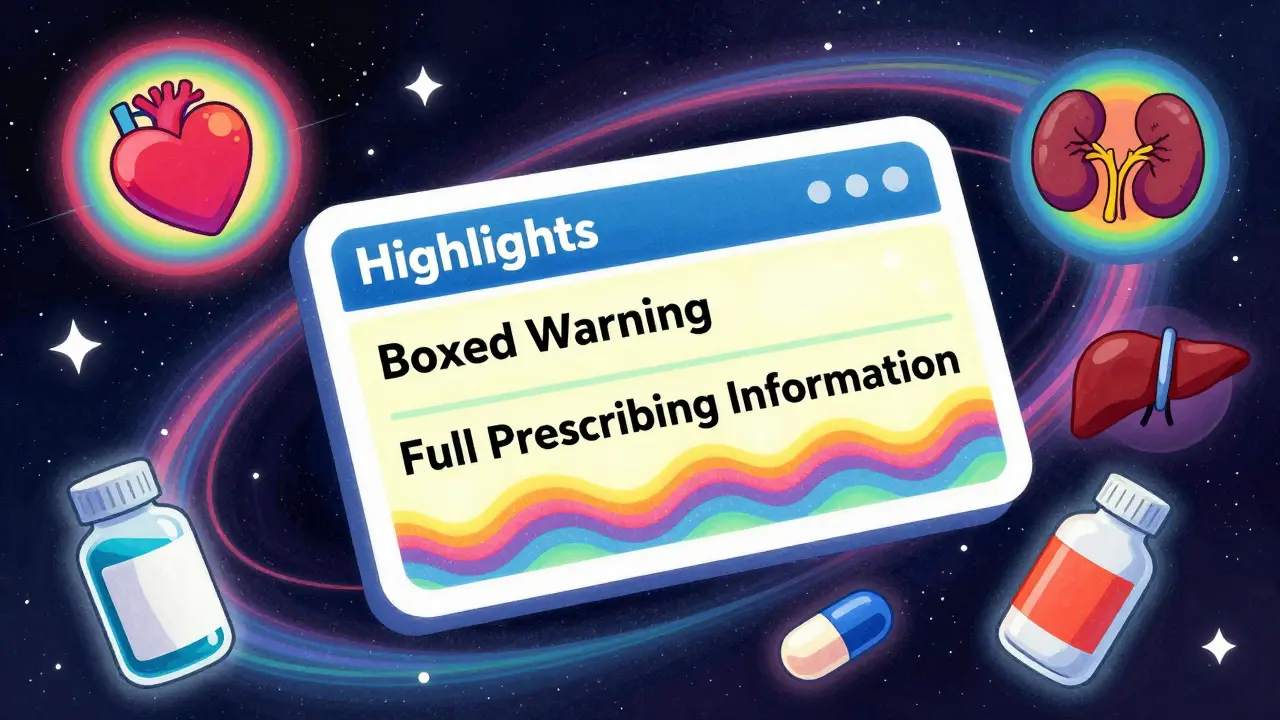
FDA drug labels aren’t random pages. They’re built in three layers, each serving a different purpose. The Highlights section is the front page summary-no more than half a page long. It’s designed to give you the big picture fast: what the drug treats, the most serious risks, and the standard dose. But here’s the catch: it’s incomplete. The FDA requires this section to include a disclaimer saying it doesn’t contain all the details. That means if you stop here, you’re flying blind.
Beneath the Highlights is the Table of Contents. It’s not decorative. It’s your roadmap. Every section number matches exactly to the Full Prescribing Information (FPI). If you need to find out if the drug is safe during pregnancy, go to Section 8. If you’re worried about side effects, head to Section 6. The numbering hasn’t changed since 2006, so once you learn it, you’ll always know where to look.
The real meat is in the Full Prescribing Information. This is the 17-section document that doctors and pharmacists rely on. It’s long, but you don’t need to read it all at once. You just need to know where to find what matters to you.
Section 1: Indications and Usage
This tells you exactly what the drug is approved for. Not what your friend uses it for. Not what a blog says. The FDA only approves drugs for specific conditions. If a drug says it treats Type 2 diabetes, that’s it. Using it for weight loss-even if a doctor prescribes it off-label-isn’t covered by the label’s safety data. Look for the phrase “Established Pharmacologic Class” here. It tells you how the drug works in the body, like “SGLT2 inhibitor” or “SSRI.” Knowing this helps you understand why it’s being prescribed and how it might interact with other meds.
Section 2: Dosage and Administration
This is where people make the biggest mistakes. It doesn’t just say “take one tablet daily.” It says: take one tablet with food, do not crush, adjust dose for kidney impairment, avoid alcohol. The 2024 FDA update made this section even clearer, especially for patients with liver or kidney problems. If you’re over 65, pregnant, or have chronic illness, this section is your safety net. A 2022 Mayo Clinic study found doctors spend nearly 5 minutes just reading this part during appointments. Don’t skip it.
Section 5: Warnings and Precautions - Especially the Boxed Warning
This is the red flag section. The most serious risks-like heart failure, suicidal thoughts, or fatal liver damage-are highlighted in a black box at the top of this section. It’s called the Boxed Warning, and it’s legally required. If a drug has one, it’s not a suggestion-it’s a warning from the FDA that this drug can kill if used wrong. In 2023, 47 warning letters were sent to drugmakers for missing or downplaying Boxed Warnings. If you see it, read it twice. Then talk to your doctor. Don’t assume it’s just a formality.
Section 6: Adverse Reactions
This isn’t a list of “possible side effects.” It’s a ranked list based on real clinical trial data. The FDA requires manufacturers to report how often each side effect occurred in studies. Look for the percentages: “≥10%” means it happened in more than 1 in 10 people. “1-10%” means it happened in up to 1 in 10. Anything below 1% is rare. If you’re told “this drug causes nausea,” check the label. If it’s listed as 2%, that’s not rare-but it’s not guaranteed. Compare it to other drugs in the same class. Sometimes the side effect profile is better than you think.
Section 7: Drug Interactions
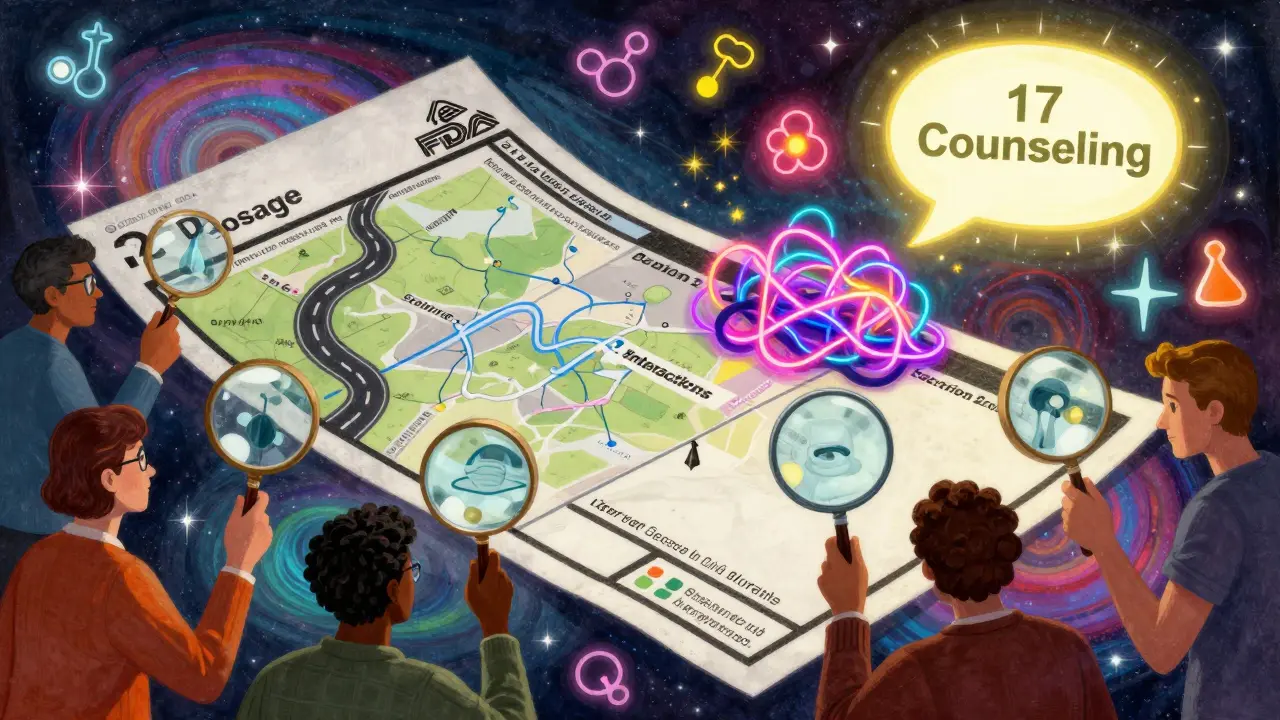
Most people don’t realize their blood pressure pill can turn deadly when mixed with a common painkiller. Section 7 lists every known interaction-food, supplements, other drugs, even grapefruit juice. The FDA now requires this section to be organized by severity. Look for “Contraindicated” first-that means never combine them. Then “Serious” and “Moderate.” A 2023 study found that 12.7% of pharmacy dispensing errors happened because pharmacists missed a drug interaction listed here. Always bring your full medication list to every appointment. Don’t assume your doctor knows what you’re taking.
Section 8: Use in Specific Populations
Is the drug safe for kids? Pregnant women? Seniors? This section answers those questions with data. For example, some antidepressants are not recommended for teens because of increased suicide risk. Others are cleared for use in elderly patients only with lower doses. If you’re in one of these groups, this section is critical. A 2024 survey found that 27% of patients misunderstood their drug’s safety during pregnancy because they only read the Highlights. Don’t be one of them.
Section 16: How Supplied / Storage and Handling
Most people ignore this, but it’s where you find the NDC code-a 10-digit number broken into three parts: labeler, product, and package code. This is how pharmacies and insurers track your exact medication. If your pill looks different than last time, check the NDC. It could be a generic switch, or worse-a counterfeit. This section also tells you how to store the drug. Some need refrigeration. Others must be kept away from light. Improper storage can make a drug useless-or dangerous.
Section 17: Patient Counseling Information
This is the FDA’s direct script for healthcare providers to use when talking to patients. It includes exactly what to say about side effects, what to avoid, and how to take the drug correctly. Yet only 38% of providers use it. Why? Time pressure. But you can use it yourself. Look up your drug’s label online at the FDA’s website. Scroll to Section 17. Print it. Take it to your next appointment. Ask: “Is this what you’re supposed to tell me?” You’ll be surprised how often the answer is yes.

What’s New? The Recent Major Changes Section
Since 2018, every label must include a “Recent Major Changes” section. It lists every section updated in the last six months. A 2024 study showed this cut the time between label updates and clinical adoption by 35%. If your drug’s label changed last month, this section will tell you why. Maybe a new warning was added. Maybe the dose changed. Don’t assume your doctor knows. Check this section before every refill.
How to Use This in Real Life
Here’s a simple three-step system:
- Start with the Boxed Warning and Highlights. If something feels scary, stop. Call your doctor.
- Go to Section 2 (Dosage) and Section 7 (Interactions). Make sure your current meds and habits match up.
- Check Section 17 for the exact advice your provider should give you. Ask them if they followed it.
For pharmacists, focus on Sections 2, 3, 6, and 7. For patients, focus on 1, 2, 5, 8, and 17. Don’t try to read the whole thing. Read what matters to you.
Why This Matters More Than Ever
The FDA is pushing for digital, interactive labels by 2027. That means labels might change based on who’s reading them-doctors get the full data, patients get simplified summaries. But until then, the paper label is your only guarantee. And with 98% of electronic health records pulling data directly from FDA labels, what’s on that sheet affects everything-from your insurance coverage to your hospital records.
Drug labeling isn’t perfect. Doctors still spend too long reading it. Patients still misunderstand it. But the system is designed to protect you. You just have to use it.
Can I trust the drug label if my doctor prescribes it for something not listed?
Yes, but with caution. Doctors can prescribe drugs for uses not listed on the label-that’s called off-label use. But the FDA’s safety data only covers what’s written. If your doctor prescribes it for something new, ask: “Is there data on how safe this is for my condition?” and “What side effects have been seen in other patients using it this way?” The label doesn’t change, but your doctor should be able to explain the risks beyond what’s printed.
What if the label says one thing but my pharmacy gives me a different pill?
Check the NDC code on the bottle (Section 16). If it matches the original label, it’s a generic version-same active ingredient, different shape or color. If the NDC is different, ask your pharmacist: “Is this the exact drug prescribed?” Sometimes, manufacturers switch suppliers, and the pill looks different. If you’re unsure, call your doctor. Never take a pill you can’t identify.
Why do some drug labels have so many side effects listed?
The FDA requires every side effect observed in clinical trials to be listed, even if it happened in just one person. That doesn’t mean you’ll get them. Look at the percentages. If nausea is listed as 2%, you have a 2 in 100 chance. If “taste disturbance” is listed as 0.1%, that’s 1 in 1,000. Most side effects are rare. The long list isn’t meant to scare you-it’s meant to inform you. Focus on the common ones and the serious warnings.
Can I rely on the Highlights section alone?
No. The Highlights are meant to be a quick reference, not a complete guide. The FDA requires it to say it’s incomplete. Many patients think they’ve read the label after seeing the Highlights-but they miss critical details like dose adjustments for kidney disease, drug interactions, or storage requirements. Always check the Full Prescribing Information, especially if you have other health conditions or take multiple medications.
How often do drug labels change?
On average, a drug label updates every 14.3 months, according to FDA tracking. Changes usually happen because of new safety data, new uses, or new warnings. The “Recent Major Changes” section tells you what’s new in the last six months. Always check this section before starting a new prescription or refilling an old one. If your doctor says the drug is the same, ask: “Has anything changed on the label?”
Next Steps: What to Do Today
Find one prescription you’re currently taking. Go to the FDA’s website and search for the drug name. Download the full prescribing information. Open Section 5-look for the Boxed Warning. Then go to Section 2-check the dosage instructions. Finally, find Section 17 and read the exact patient counseling points. Write down one question you have. Bring it to your next appointment. You’re not just reading a label-you’re taking control of your health.
mike swinchoski
January 14, 2026You people act like reading a drug label is some kind of moral duty. It's 2024. If your doctor can't explain it in plain English, they're not doing their job. I don't need a 17-section PDF to know not to mix my blood pressure med with grapefruit. Common sense still exists.
lucy cooke
January 15, 2026Oh, the sacred FDA label - the new Bible of pharmaceutical orthodoxy. We've replaced divine revelation with regulatory bureaucracy. The Boxed Warning is our modern-day plague cross, and we bow before it like faithful pilgrims. But tell me - who wrote the scripture? A committee of bureaucrats who've never held a dying patient's hand. The label doesn't heal. It just certifies fear.
Kimberly Mitchell
January 17, 2026The Highlights section is a joke. It's designed to be misleading. The FDA requires disclaimers because they know the summary is incomplete - which means the entire system is built on intentional opacity. If you're not reading Section 7 and Section 16, you're not reading at all. You're just consuming marketing.
Diana Campos Ortiz
January 18, 2026I used to ignore these labels too - until my mom had a bad reaction because she didn't know her statin couldn't be taken with grapefruit. Now I print Section 17 and bring it to every appointment. It's not about being paranoid. It's about being prepared. Small steps matter.
laura Drever
January 19, 2026Section 6 is just fearmongering. They list every single side effect ever reported by one person in a trial of 10k. I got dizzy once on a med and now the label says 'dizziness ≥0.03%' like it's a threat. Stop scaring people with stats nobody understands.
James Castner
January 20, 2026It is not merely a matter of reading the label - it is a profound act of epistemic responsibility. The pharmaceutical industrial complex, with its labyrinthine regulatory architecture, has created a system wherein the patient, stripped of medical authority, is paradoxically burdened with the cognitive labor of self-advocacy. The FDA label, therefore, is not documentation - it is emancipation. To neglect it is to surrender autonomy to the very institutions that profit from your ignorance. One must not merely consume information - one must interrogate it, contextualize it, and internalize it as a moral imperative.
Adam Rivera
January 20, 2026Just read the label. Seriously. I'm from a small town in Texas - never went to college - but I learned to read these things after my dad had a bad reaction. You don't need a degree. You just need to care enough to look. I keep a folder with all my meds and the Section 17 printouts. It's saved me twice already.
Angel Molano
January 20, 2026If you're not checking Section 5 before taking any new drug, you're a liability to yourself and everyone around you. Boxed Warnings aren't suggestions - they're obituaries waiting to happen. Stop being lazy. Read it.
Vinaypriy Wane
January 21, 2026I'm from India, and here, people don't even know what an NDC code is. I showed my cousin how to check the label on his insulin - he cried because he realized he'd been storing it wrong for two years. This isn't just American stuff. This is life or death everywhere. Thank you for writing this.
Robin Williams
January 21, 2026the box warning is legit scary but i think we need to talk about how pharma companies bury the real risks in section 6 by listing them as 'rare' when they're actually underreported. i saw a study where 70% of serious side effects never made it into the official data. labels are a start - but they're not the whole truth.
Trevor Davis
January 22, 2026I used to be super chill about meds. Then I got prescribed something with a boxed warning. I read the whole thing. Called my doctor. Asked if there were alternatives. He said, 'Wow, you're the first patient who actually read the label.' That’s not empowering. That’s horrifying.
John Tran
January 22, 2026Let’s be real - the FDA label is a product of corporate lobbying disguised as public safety. The 'Recent Major Changes' section? Often just cosmetic tweaks to avoid lawsuits. The real dangers? The ones buried in the fine print of Phase 3 trials that never got published. We’re being asked to trust a system designed to protect shareholders, not patients. The label is a mirror - and it reflects our collective denial.
Pankaj Singh
January 23, 2026Section 8 is a lie. They say 'safe for elderly' but the trials had 12 patients over 75. That’s not data - that’s a statistical afterthought. And they still list it as 'recommended with caution.' Caution? That’s not caution. That’s negligence dressed in bureaucratic clothing.
jefferson fernandes
January 24, 2026This is exactly why we need patient education programs in every pharmacy - not just pamphlets, but live walkthroughs. I work in a clinic and I’ve seen people cry because they finally understood their own label. You’re not alone. You’re not dumb. You just never had someone show you how to read it. Start with Section 5. Then Section 2. Then ask your pharmacist to walk you through it. You’ve got this.