

15 Dec 2025
- 11 Comments
Imagine looking at a traffic light and not being able to tell the difference between red and green. Not because you’re squinting or it’s foggy - but because your eyes just don’t see those colors the way most people do. This isn’t rare. About 8% of men and less than 0.5% of women around the world live with this every day. It’s called red-green color blindness, and it’s not a disease. It’s a genetic quirk - one that’s been passed down for generations, often without anyone realizing why.
What Actually Happens in Your Eyes?
Your eyes have three types of cone cells that detect color: one for red, one for green, and one for blue. These cones contain light-sensitive proteins called photopsins. In people with red-green color blindness, the red or green photopsins don’t work right. Sometimes they’re missing. Sometimes they’re swapped. Sometimes they’re just slightly off. The problem lies in two genes: OPN1LW for red cones and OPN1MW for green cones. These genes sit on the X chromosome - the same one that determines biological sex. That’s why this condition hits men far more often than women. Men have one X and one Y chromosome. If the X they inherit from their mom carries a faulty red or green gene, they’ll have color blindness. Women have two X chromosomes. They’d need both to carry the mutation to be affected. That’s statistically unlikely. So while 1 in 12 men have it, only about 1 in 200 women do.The Two Main Types: Protanopia and Deuteranopia
There are two major forms of red-green color blindness, and they’re named after which cone is affected.- Protanopia means the red cones are missing or non-functional. Reds look dark, almost black. Some greens and yellows get mixed up too.
- Deuteranopia means the green cones are gone. This is the most common type - affecting about 5% of men. Reds and greens look muddy, like different shades of beige.
Why Is This Inherited So Unevenly?
It all comes down to biology. Women have two X chromosomes. Even if one carries the color-blind gene, the other often compensates. Men don’t have that backup. If their single X has the mutation, they’re affected. This isn’t just theory. Genetic studies from the National Eye Institute show that the red and green genes sit next to each other in a row on the X chromosome. During sperm production, these genes can accidentally swap places or delete parts of themselves. That’s why you’ll sometimes see a man with a hybrid gene - part red, part green - that doesn’t work properly. And here’s the kicker: if a man has red-green color blindness, he won’t pass it to his sons. Why? Because he gives his sons his Y chromosome, not his X. But he will pass the faulty gene to all his daughters. They’ll become carriers - and if they have sons, those sons have a 50% chance of being color blind.How Is It Diagnosed?
The most common test is the Ishihara Color Test. It’s those plates with colored dots that form numbers. People with normal vision see a 5. Someone with deuteranopia might see a 2. Or nothing at all. But that’s just the start. Eye doctors now use more advanced tools like the Farnsworth-Munsell 100 Hue Test, which asks you to arrange colored caps in order. It’s not just about seeing red or green - it’s about how finely you can tell them apart. Most people aren’t diagnosed until school, when color-coded lessons trip them up. A child might pick the wrong crayon, or fail to spot the red circle in a group of green ones. Teachers often notice first.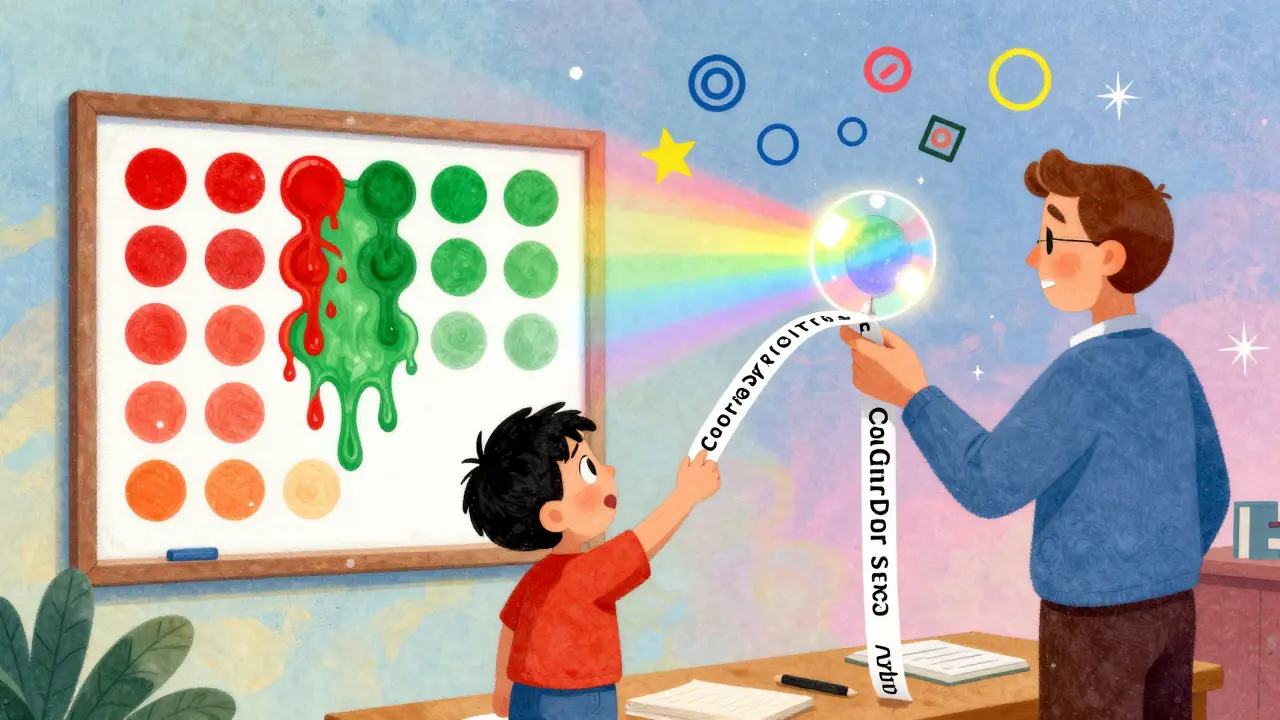
It’s Not Just About Traffic Lights
People assume color blindness is about missing red or green. But it’s more than that. It’s about missing contrast between colors that look similar.- Electrical wires: red and green can look identical. Many electricians use tape labels or numbered tags to avoid mistakes.
- Food: undercooked chicken and rare steak can look the same. A person with color blindness might rely on texture or a meat thermometer.
- Maps and charts: green lines on a map might blend into brown hills. Graphs with red bars next to green ones can be unreadable.
- Weather apps: red for heat, blue for cold - if you can’t tell the difference, you’re guessing.
Can You Fix It?
There’s no cure. But there are tools. EnChroma glasses are the most well-known. They cost between $329 and $499 and use special filters to block overlapping wavelengths of light. This helps separate red and green signals. Studies show about 80% of users report improved color distinction - but it’s not magic. It doesn’t restore normal vision. It just makes some colors pop more clearly. Then there are digital tools. Color Oracle is a free app that lets designers see how their work looks to someone with color blindness. Sim Daltonism does the same on phones. The Colorblindifier plugin for Photoshop has been downloaded over 45,000 times. Even big tech companies are stepping in. Apple’s iOS has had color filters since 2014. Microsoft added them to Windows in 2015. These let users shift colors to make them more distinguishable. Around 0.8% of iPhone users turn them on - which might sound small, but that’s hundreds of thousands of people.What About Careers?
Some jobs still screen for color vision - and that’s controversial. Pilots, electricians, firefighters, and military roles often require passing color tests. A Reddit user named “ProtanopePilot” shared how he was turned down for a commercial pilot license despite having perfect 20/20 vision. He could see the lights - just not the colors. He passed every other test. But the rules didn’t care. In the UK, the Equality Act 2010 says color blindness can be a disability if it limits daily activities. Between 2015 and 2022, over 1,200 workplace discrimination claims were filed related to color vision. Some employers now use alternatives: labels on wires, audio cues, or digital assistants.
What’s Next?
Science is moving fast. In 2022, researchers at the University of Washington used gene therapy to restore full color vision in adult squirrel monkeys. They injected a normal copy of the missing gene into the retina. The monkeys could see red and green for over two years. It’s not ready for humans - but it’s proof that it’s possible. The National Eye Institute is investing millions into restoring color vision. Meanwhile, companies like EnChroma are rolling out new lens tech that improves color discrimination by 30% over older models. And globally, the ColorADD system - a set of simple symbols that represent colors - is now used in public transport systems across 17 countries. A subway map doesn’t need red and green lines anymore. It can use a star, a circle, and a square.Living With It
Most people with red-green color blindness don’t see it as a tragedy. A survey by Colour Blind Awareness found that 92% consider it a minor inconvenience. One graphic designer on Reddit said, “I used to fight it. Now I design with contrast in mind. It made me better at my job.” You don’t need to fix it. You need to adapt. Use labels. Use patterns. Use apps. Ask for help. And if you’re designing something - make sure it works for everyone, not just the 99% who see colors the same way.It’s Not Blindness. It’s Different Vision.
The word “color blind” is misleading. People with this condition aren’t blind. They see color - just differently. Their world isn’t grayscale. It’s a palette with fewer distinctions. And many of them navigate it better than you’d think. The real problem isn’t their eyes. It’s a world built for one kind of vision - and not enough thought given to the others.Can color blindness get worse over time?
No. Red-green color blindness is genetic and present from birth. It doesn’t change or worsen with age. Unlike cataracts or macular degeneration, it’s not a degenerative condition. Your color perception stays the same your whole life.
Can women be color blind?
Yes, but it’s rare. Since the genes are on the X chromosome, a woman needs two copies of the faulty gene - one from each parent - to be affected. That happens in about 0.5% of women. Most women with one copy are carriers and don’t notice any difference, but they can pass the gene to their children.
Are color blind glasses worth it?
For some people, yes. They don’t cure color blindness, but they can help you see red and green more distinctly in certain lighting. They work best for deuteranomaly and protanomaly, not full deuteranopia or protanopia. Many users report better performance in tasks like picking ripe fruit or reading color-coded maps. But they’re expensive - and not covered by insurance.
Can I be color blind and still be a designer or artist?
Absolutely. Many successful designers and artists have red-green color blindness. They learn to rely on brightness, contrast, and texture instead of hue. Tools like Color Oracle or Sim Daltonism help them preview how others see their work. Some even say their condition made them more intentional with design choices.
Is color blindness tested during routine eye exams?
Not always. Standard eye tests check for sharpness and eye pressure, not color vision. Unless you mention trouble with colors or a family history, your optometrist might not test for it. If you suspect you have it, ask specifically for an Ishihara test or a color arrangement test.
Does color blindness affect depth perception?
Not directly. Depth perception comes from binocular vision and motion cues, not color. But some people with color blindness report feeling less confident judging distances in complex scenes - like traffic or stairs - because color helps with contrast in those environments. It’s not the color itself, but the lack of contrast between similar hues that can make things harder to judge.
Can children outgrow color blindness?
No. Color blindness is genetic and permanent. Children don’t outgrow it. However, they can learn strategies to adapt - like using labels, patterns, or asking for help. Early diagnosis helps schools and parents provide the right support.
Are there apps that help people with color blindness?
Yes. Apps like Colorblind Assistant, Color ID, and Daltonize can identify colors using your phone’s camera. Some even overlay labels or change the display in real time. They’re not perfect, but they’re helpful for quick checks - like matching clothes or reading a menu.
Peter Ronai
December 17, 2025Oh please, another ‘color blindness is just a quirk’ lecture. Newsflash: it’s not a quirk, it’s a biological flaw. If your eyes can’t distinguish red from green, you’re literally defective. And don’t give me that ‘different vision’ nonsense - if you can’t see traffic lights, you’re a hazard. I’ve seen guys get into accidents because they thought green was yellow. Fix your biology, don’t romanticize it.
Also, EnChroma glasses? $500 for a glorified tinted sunglasses? That’s corporate scamming people who can’t see red. The real solution is redesigning the world to work with normal vision - not coddling genetic outliers.
And no, I don’t care if it’s ‘inherited.’ That doesn’t make it okay to ignore safety standards. Pilots, electricians, train operators - these aren’t ‘artistic jobs.’ They’re life-or-death. If you can’t pass a color test, you shouldn’t be trusted with a lever or a steering wheel.
Stop pretending this is about inclusion. It’s about people refusing to accept biological reality. And that’s dangerous.
Michael Whitaker
December 19, 2025While I appreciate the thoroughness of the exposition, one must acknowledge the epistemological limitations inherent in the discourse surrounding color perception. The very notion of ‘normal’ vision is a construct predicated on the statistical majority, thereby marginalizing alternative perceptual modalities. One might argue that the diagnostic tools employed - Ishihara plates, for instance - are themselves culturally and neurologically biased, privileging a trichromatic paradigm that may not be universally applicable.
Moreover, the assertion that color blindness is ‘not a disease’ presupposes a medical model of deviation that, in the tradition of Foucault, pathologizes difference. One might instead posit a phenomenological framework wherein color perception is a spectrum of experience - not a binary of defect versus function.
Furthermore, the commercialization of corrective lenses by EnChroma, while ostensibly benevolent, operates within a neoliberal framework that commodifies disability. One must question whether the solution lies in individual augmentation - or in systemic redesign. The ColorADD initiative, for instance, represents a far more ethically coherent paradigm.
Brooks Beveridge
December 20, 2025Hey everyone - just wanted to say this post made me smile. 😊 I’m a deuteranope, and yeah, I mix up red and green sometimes. But you know what? I’ve learned to love how I see the world. I notice textures, shadows, and patterns that others miss. I’ve got a whole system for clothes - tags, buttons, placement. I even taught my niece how to spot ripe avocados by feel, not color.
And honestly? The fact that apps and companies are starting to build for us? That’s huge. I used to feel like I was the only one struggling with maps and charts. Now I see people designing with contrast in mind - and it’s beautiful. You don’t need perfect color vision to be brilliant. You just need to adapt, and the world is starting to adapt with you.
So if you’re reading this and you’re color blind - you’re not broken. You’re just seeing the world in a different, equally valid way. And that’s kind of awesome.
Also, if you’re a designer? Use labels. Use shapes. Use contrast. You’re not just helping me - you’re making everything better for everyone.
Jigar shah
December 21, 2025Interesting analysis. However, the genetic mechanism described requires clarification. The OPN1LW and OPN1MW genes are not merely adjacent on the X chromosome; they are highly homologous, sharing over 98% sequence identity. This near-identity facilitates unequal homologous recombination during meiosis, leading to gene deletions, fusions, or hybrid genes - which is the primary molecular cause of red-green color vision deficiencies.
Furthermore, the prevalence figures cited (8% of men, 0.5% of women) align with global estimates, but regional variation exists. In India, for example, studies report a slightly lower male prevalence (~5.6%), possibly due to population-specific allele frequencies.
Additionally, while Ishihara plates are widely used, they are not sensitive to mild anomalies. The Farnsworth-Munsell 100 Hue Test remains the gold standard for quantifying severity. Finally, the claim that color vision does not deteriorate with age is accurate for congenital forms, but acquired deficiencies due to retinal or optic nerve pathology must be differentiated.
Well-researched piece overall.
Joe Bartlett
December 22, 2025Right then. So 8% of blokes can’t tell red from green. Big deal. I’ve seen lads in the Royal Navy confuse red and green flares. Nearly got a ship sunk. You don’t get to be ‘different’ when lives are on the line.
EnChroma glasses? Waste of cash. If you can’t see the colors, don’t do the job. Simple.
And stop calling it ‘different vision.’ It’s not a superpower. It’s a limitation. Get over it.
Josh Potter
December 22, 2025bro i had no idea this was a thing 😭 i thought colorblind people just saw in black and white like in cartoons
wait so my cousin who thought the sky was green was just… colorblind? and he’s been calling grass red for 15 years??
also why do all the apps not work for him?? i tried to send him a google map and he got lost cause the red lines were ‘brown’
also enchroma glasses are so expensive?? i could buy a whole new phone for that price
but like… i’m glad people are trying to fix it? maybe we should just make everything with symbols?? like a star = red, circle = green??
also why is this not taught in school?? i’m 27 and just learned this
also why do traffic lights have the same shape?? why not make red taller??
anyone else feel like the world is designed for people who see colors??
Jody Patrick
December 24, 2025Red-green color blindness? That’s why Americans can’t tell ripe tomatoes from leaves. Pathetic.
Anna Giakoumakatou
December 24, 2025How quaint. We’ve turned a genetic anomaly into a TED Talk about ‘different vision’ and ‘inclusion.’ How very 2024. The real tragedy isn’t that someone can’t distinguish red from green - it’s that we’ve built an entire moral economy around pretending that biological limitations are just ‘perspectives.’
Next you’ll tell me that dyslexia is ‘a different way of reading’ and not a cognitive impairment. Or that nearsightedness is ‘a unique lens on the world.’
It’s not. It’s a deficit. And the sooner we stop romanticizing it, the sooner we can actually fix things - like making sure traffic lights have positional cues, not just color. But no, let’s sell $500 glasses and call it progress.
Donna Packard
December 25, 2025I just wanted to say thank you for writing this. I’ve lived with this my whole life and no one ever explained it so clearly. I used to feel like I was dumb because I picked the wrong crayons. Now I know it’s not me - it’s just how my eyes work.
And honestly? I think I see the world differently in a good way. I notice details others miss. I’m better at spotting patterns. I don’t get distracted by bright colors - I focus on what matters.
And if you’re reading this and you’re color blind? You’re not alone. And you’re not broken. You’re just you.
Keep being you. The world needs your way of seeing it.
Patrick A. Ck. Trip
December 26, 2025Thank you for this exceptionally well-researched and compassionate overview. I have been diagnosed with deuteranomaly since childhood, and while I have never considered it a disability, I have often felt isolated due to the lack of public awareness. The inclusion of practical adaptations - such as ColorADD and digital tools - is both timely and profoundly impactful. I particularly appreciate the emphasis on systemic redesign rather than individual remediation. It is my hope that educational curricula, workplace policies, and digital interfaces will continue to evolve toward universal design principles. Your final point - that this is not blindness, but different vision - resonates deeply. One does not require perfect trichromacy to perceive beauty, safety, or truth.
Sam Clark
December 27, 2025This is one of the clearest, most thoughtful explanations I’ve ever read on this topic. I’ve worked with color-blind colleagues for over a decade - designers, engineers, even a pilot who passed every flight simulation with flying colors (pun intended). They don’t need pity. They need thoughtful design.
I’ve started labeling wires in my workshop with tape and numbers. I’ve asked my team to add icons to charts. I’ve stopped assuming everyone sees what I see. It’s not hard. It’s just intentional.
And honestly? The world’s better for it. Everything becomes more accessible. More usable. More human.
Thank you for reminding us that inclusion isn’t about fixing people. It’s about fixing the world around them.