

14 Feb 2026
- 8 Comments
REMS Burden Calculator
REMS programs ensure safe access to high-risk medications but can create administrative burdens for healthcare providers and delays for patients. This calculator estimates how much time is required to process prescriptions with REMS requirements.
When a medication carries serious risks-like birth defects, life-threatening blood disorders, or sudden loss of consciousness after injection-how do doctors and patients still get access to it? The answer lies in REMS programs: Risk Evaluation and Mitigation Strategies. These aren’t just extra warnings on a label. They’re structured, legally required systems designed to let high-risk drugs reach patients who need them, while keeping dangers under control.
What Exactly Is a REMS Program?
REMS stands for Risk Evaluation and Mitigation Strategies. It’s a program created by the U.S. Food and Drug Administration (FDA) in 2007 under the Food and Drug Administration Amendments Act (FDAAA). The goal? Keep dangerous drugs on the market when their benefits clearly outweigh their risks-but only if there’s a plan to manage those risks. Think of it like this: some medications are too risky to approve without extra safeguards. REMS is how those safeguards get built.
Not every drug needs REMS. In fact, only about 5% of FDA-approved medications require it. The rest are managed with standard labeling and post-market safety monitoring. REMS kicks in when a drug can cause serious harm-like isotretinoin causing severe birth defects, clozapine wiping out white blood cells, or an antipsychotic injection triggering sudden sedation. Without REMS, these drugs might never reach patients. With it, they do.
How REMS Works: The Three Key Pieces
REMS isn’t one-size-fits-all. Each program is custom-built around the specific danger of the drug. But they all include at least one of these three core elements:
- Medication Guides: These are handouts given to patients that explain the risks in plain language. For example, anyone getting isotretinoin (Accutane) gets a guide warning about pregnancy risks and depression.
- Communication Plans: These target doctors and pharmacists. They might include training modules, emails, or alerts reminding providers about monitoring requirements-like checking blood counts for clozapine users every week.
- Elements to Assure Safe Use (ETASU): This is the heavy-duty part. ETASU can require prescribers to be certified, patients to enroll in a registry, or drugs to be dispensed only in certain locations.
Take Zyprexa Relprevv, a long-acting shot for schizophrenia. It can cause sudden dizziness, confusion, or coma within minutes after injection. So the REMS says: only certified clinics can give it, and patients must be watched for at least three hours afterward. No exceptions. That’s ETASU in action.
Who’s Responsible for REMS?
The FDA doesn’t run these programs day-to-day. The drugmaker does. If a company wants to sell a high-risk drug, it must propose a REMS plan, get FDA approval, and then pay for, build, and maintain the entire system. That means setting up websites, training systems, registries, and verification portals. It’s expensive. The average REMS costs a company $1.2 million a year. The most complex ones-like those requiring patient registries and special dispensing-can run over $15 million annually.
This system puts the burden squarely on pharmaceutical companies. If they fail to follow through, the FDA can issue warning letters or even fine them. In 2022 alone, the FDA issued 17 warning letters for REMS violations. One generic drugmaker paid a $2.1 million settlement for not properly managing clozapine’s REMS requirements.
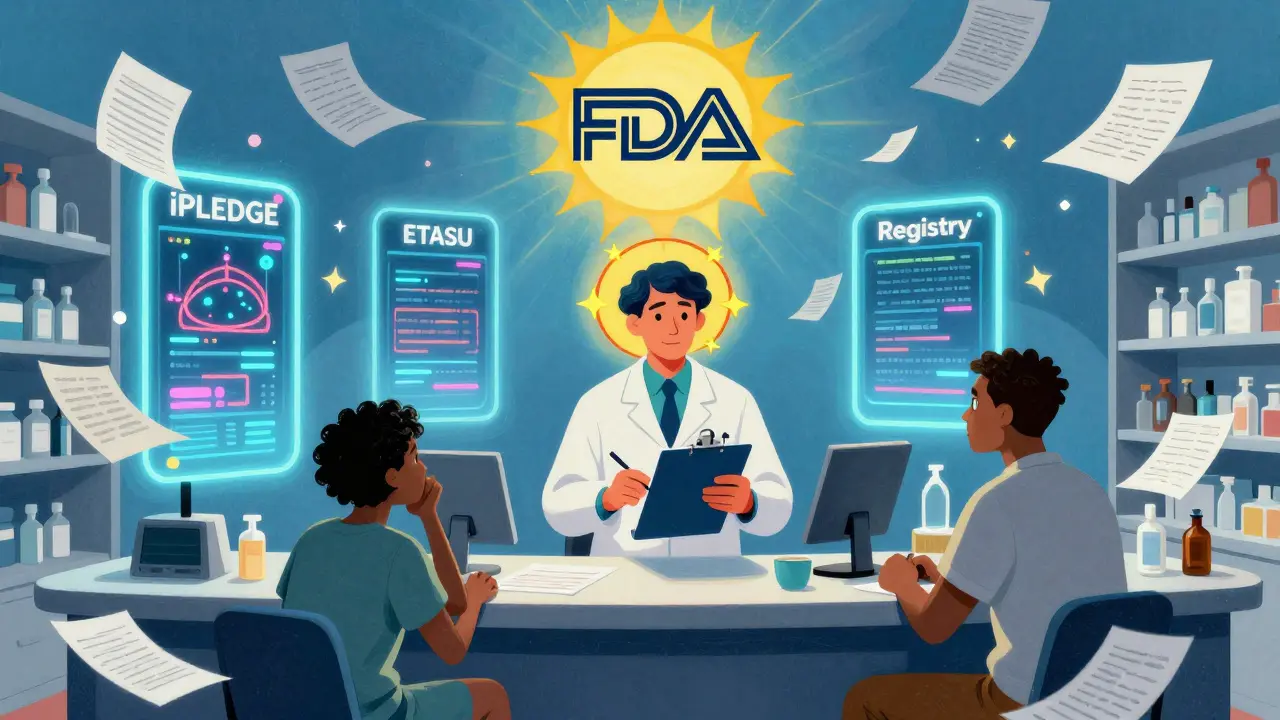
REMS vs. Other Safety Systems
It’s easy to confuse REMS with regular drug labeling or post-market safety reports. But they’re different.
Standard labeling lists all known side effects. REMS targets one or two serious risks that need active, ongoing management. For example, every opioid label warns about addiction. But only certain extended-release opioids require a REMS that forces prescribers to complete training before writing a prescription.
Compared to Europe’s Risk Management Plans (RMPs)-which apply to every new drug-U.S. REMS is much more selective. The FDA only uses it when the risk is severe and the benefit is high. That’s why REMS is mostly used for drugs treating cancer, epilepsy, autoimmune diseases, and serious mental illness.
Real-World Impact: Delays, Burdens, and Patient Stories
REMS saves lives-but it also slows things down.
A 2019 study in JAMA Internal Medicine found that REMS drugs took an average of 5.4 days longer to fill than non-REMS drugs. For patients with rare diseases, that delay can be deadly. One mother in Texas waited 11 days to get her daughter’s life-saving immunotherapy because of REMS paperwork.
Pharmacists are feeling it too. A 2023 survey by Pharmacy Times found 73% of hospital pharmacists spend 2-5 extra hours per week just managing REMS requirements. For clozapine, that means checking blood test results, verifying registries, and calling prescribers. One pharmacist described it as “a daily nightmare.”
And then there’s iPLEDGE-the REMS for isotretinoin. On Reddit’s r/pharmacy thread, dozens of pharmacists shared stories: patients showing up on Friday, only to be told they need to wait until Monday because the system requires two separate verifications, one of which only updates on weekdays. A three-day acne treatment delay isn’t just inconvenient-it’s demoralizing.
Who Benefits? Who Gets Hurt?
REMS has defenders and critics.
Dr. Robert Temple, former top official at the FDA’s drug center, called REMS “essential” for approving therapies that would otherwise be too risky. Without REMS, drugs like thalidomide (used to treat multiple myeloma) or clozapine (for treatment-resistant schizophrenia) might have been banned entirely.
But Dr. Aaron Kesselheim from Harvard Medical School argues that some REMS programs create barriers without adding safety. He pointed to the 2018 opioid REMS, which required prescriber training but didn’t require monitoring patients. He called it “administrative overhead with no real safety gain.”
The FDA itself admits it’s not perfect. In 2022, former Acting Commissioner Dr. Janet Woodcock said, “Not all REMS programs have been equally effective.” That’s why they’re now testing sunsets-removing REMS when it’s no longer needed. In August 2023, the FDA ended the REMS for thalidomide after 20 years. Why? Because better education, safer packaging, and stricter prescribing habits made the formal program unnecessary.

The Future of REMS: Digital Tools and Streamlining
The FDA is trying to fix the system. In 2023, it launched the REMS Integration Initiative, which is standardizing 22 of the 78 active REMS programs onto one shared platform. That means fewer logins, fewer portals, and less time wasted.
They’re also testing digital tools. Pilot programs are now using smartphone apps to track patients on anticoagulants-sending alerts if their blood levels dip too low. No more weekly lab visits. Just a phone check-in.
By 2027, Evaluate Pharma predicts 45% of new cancer drugs will need REMS. That’s up from 38% in 2023. As drugs get more targeted-and more powerful-they’ll also get more dangerous. REMS will stay relevant.
But the big question remains: are we protecting patients-or just making it harder for them to get care? The FDA now requires sponsors to prove their REMS doesn’t create unnecessary access barriers. That’s a step forward. The next step? Measuring whether REMS actually works. Right now, 63% of REMS programs have no clear way to tell if they’re helping or hurting.
Key Takeaways
- REMS programs are required by the FDA for drugs with serious, life-threatening risks.
- They’re not one-size-fits-all-each is custom-built around the specific danger.
- Drug companies pay for and run REMS, not the FDA.
- REMS can delay prescriptions by days or even weeks, especially for rare diseases.
- Pharmacists and doctors spend hours each week managing REMS paperwork.
- The FDA is now testing digital tools and sunsetting outdated REMS programs.
- REMS saves lives-but only if it’s smart, simple, and actually working.
Are REMS programs only for brand-name drugs?
No. REMS applies to both brand-name and generic versions of a drug. If a brand-name drug has a REMS, the generic version must follow the same rules. For example, if Zyprexa Relprevv has a REMS, any generic version of olanzapine injectable must also comply. The FDA ensures generics don’t bypass safety requirements.
Can a REMS program be removed?
Yes. The FDA can remove or modify a REMS if new data shows the risks are better managed by other means. In August 2023, the FDA ended the REMS for thalidomide after 20 years because improved prescribing practices and patient education made the formal program unnecessary. This is called a "sunset," and it’s becoming more common as the FDA refines its approach.
Do all prescribers need certification for REMS drugs?
Not always. Some REMS only require prescriber certification-for example, certain opioids or clozapine. Others, like the iPLEDGE program for isotretinoin, require both prescriber and pharmacist certification. The level of restriction depends on how severe the risk is and how easy it is to avoid.
Why do REMS programs delay prescriptions?
REMS delays happen because of the verification steps: checking patient registries, confirming prescriber certification, verifying lab results, and ensuring pharmacies are authorized. Many systems don’t talk to electronic health records, so staff must manually log in to multiple portals. A single REMS drug can add 15-20 minutes of work per prescription, and that adds up fast.
Is there a list of all current REMS programs?
Yes. The FDA maintains an official REMS Dashboard that lists all 78 active programs as of October 2023. It includes the drug name, the REMS elements required, and links to the program’s website. This is updated regularly and is publicly accessible on FDA.gov.
What’s Next?
REMS isn’t going away. As drugs get more powerful, so will the need for tight safety controls. But the future of REMS lies in simplicity. Digital tools, automated checks, and better integration with electronic health records will make it faster and less burdensome. The real test? Whether the system becomes smarter-not just stricter.
For patients, the message is clear: REMS exists to protect you. But if it’s making your treatment harder to get, that’s not protection-it’s a problem. And the FDA is finally listening.
Daniel Dover
February 14, 2026REMS is a necessary evil. I’ve filled clozapine scripts for years-yes, it’s a nightmare checking blood logs and registries every week, but I’d rather do the paperwork than see someone die from agranulocytosis. The system sucks, but it works.
Pharmacists aren’t the problem. The fragmented systems are. Why can’t this all just talk to Epic?
Kaye Alcaraz
February 16, 2026Let’s not forget the patients who benefit. My cousin has been on thalidomide for multiple myeloma since 2015. Without REMS, she wouldn’t be here. The delays? Yes, they’re frustrating. But the alternative is worse. We need to fix the bureaucracy-not eliminate the safety net.
The FDA’s sunset approach is smart. Remove what’s obsolete. Streamline what remains. Progress isn’t about more rules-it’s about smarter ones.
Josiah Demara
February 16, 2026Let’s be real-REMS is corporate theater. Drug companies don’t care about patient safety. They care about liability shields. They push REMS so they can charge $12,000 a month for a drug that should cost $200. Then they whine about the cost of running it. Bullshit.
The iPLEDGE system? A joke. A 17-year-old with acne waits three days for a script because some server only updates Monday to Friday? That’s not safety-that’s incompetence disguised as regulation. And don’t get me started on the $15 million budgets. That’s profit laundering disguised as compliance.
Joe Grushkin
February 18, 2026You people are missing the forest for the trees. REMS isn’t about safety-it’s about control. The FDA doesn’t trust doctors. Doesn’t trust pharmacists. Doesn’t trust patients. So they build walls. Barriers. Gates. And then they call it ‘mitigation.’
Meanwhile, in Europe, they just use RMPs-no certification, no registries, no 15-minute paperwork per script. And guess what? Their adverse event rates are lower. Because they trust professionals to do their jobs.
This isn’t innovation. It’s institutionalized distrust. And it’s killing access. Slowly. Deliberately. Under the banner of ‘safety.’
Betty Kirby
February 19, 2026Oh please. You think REMS is the problem? Try being a patient with a rare autoimmune disease and waiting 11 days for a life-saving infusion because your pharmacy has to call three different portals and wait for a fax that never comes.
And don’t give me that ‘it saves lives’ crap. It saves lives for the pharmaceutical industry’s bottom line. They make billions off these drugs. Meanwhile, I had to skip work for three days to chase down my daughter’s prescription. That’s not safety. That’s punishment.
And yes, I’ve read the FDA dashboard. I’ve cried over it. Because the system doesn’t care if I’m alive or dead-it only cares if the paperwork is stamped.
Esha Pathak
February 21, 2026REMS is the modern-day oracle-mysterious, expensive, and always demanding sacrifice. We bow before its rituals because we fear the dragon of side effects… but who really slays the dragon? The patient? The pharmacist? Or the corporate ledger?
Perhaps we are not meant to fix REMS. Perhaps we are meant to transcend it. To rise above bureaucracy with compassion. To see the human behind the prescription.
When the soul of medicine becomes a checklist, we have lost more than time-we have lost meaning.
Mike Hammer
February 21, 2026lol i’ve been a pharmacist for 12 years and i still dont get why we need 5 different logins for one drug
one time a patient came in with a zyprexa script and i had to call the prescriber, check the registry, verify the clinic, wait for the email from the REMS portal, and then manually enter the data into our system… all for a shot that takes 30 seconds to give
and the kicker? the patient didn’t even know what REMS stood for
we’re not protecting anyone. we’re just making everyone miserable while pretending we’re heroes
Virginia Kimball
February 22, 2026My brother got on clozapine after 5 other meds failed. We were terrified. But the REMS? It felt like a lifeline. The nurse called every week to check his blood, the pharmacy had a dedicated line, and they even mailed him a reminder card.
Yeah, it’s clunky. Yeah, it’s slow. But when your kid’s life is on the line, you don’t want ‘easy.’ You want ‘thorough.’
The FDA’s digital push? Yes please. Let’s get this into one app. But don’t cut the safety. Just make it smoother. We can do better-and we will.