
6 Jan 2026
- 13 Comments
When you’re taking medication for a chronic condition-whether it’s high blood pressure, chemotherapy, or depression-you’re not just managing the disease. You’re also fighting the side effects. Nausea. Fatigue. Dry mouth. Insomnia. Brain fog. These aren’t just annoyances. For many, they’re the reason people stop taking their meds altogether. And while doctors focus on the primary treatment, the side effects often get pushed to the back burner. That’s where complementary treatments come in-not as replacements, but as real, science-backed helpers.
What Counts as a Complementary Treatment?
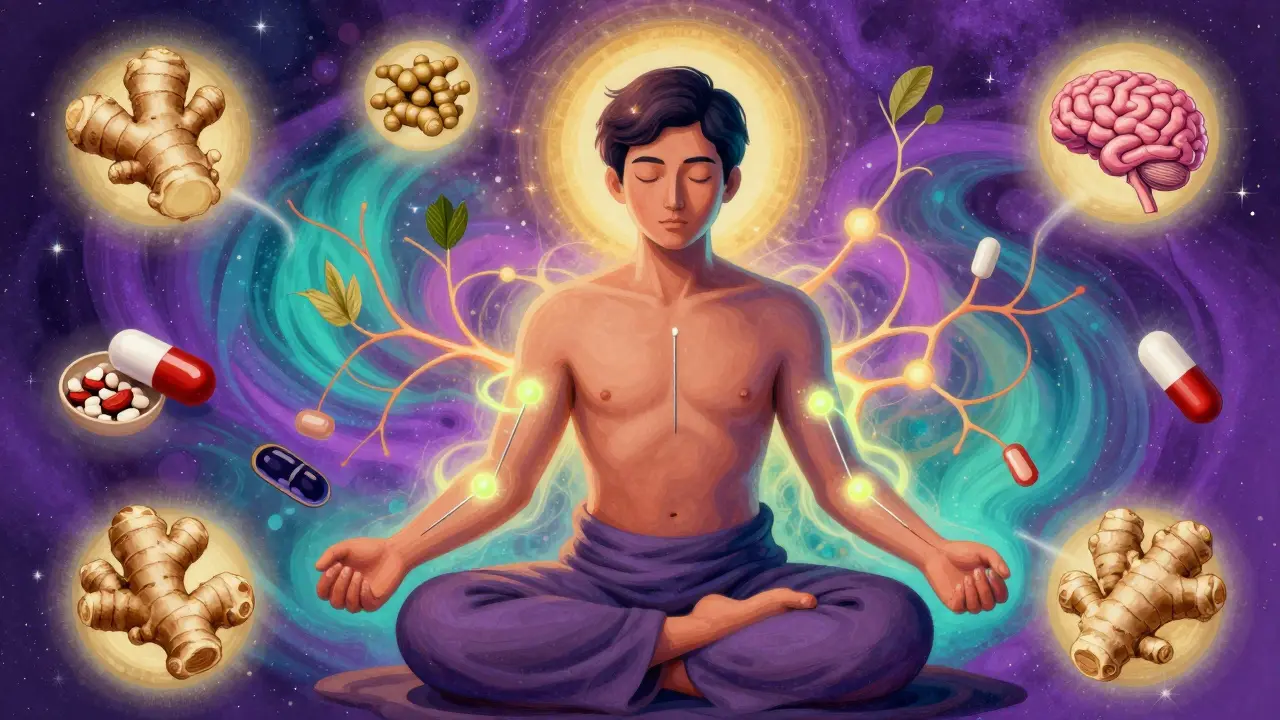
Complementary treatments are practices or products used alongside conventional medicine to ease symptoms. They’re not meant to cure the underlying illness. Think of them as support staff, not the main player. The most common types include:- Natural products: Herbs, vitamins, minerals, probiotics. These make up over a third of all complementary use in the U.S.
- Mind-body practices: Acupuncture, meditation, yoga, tai chi.
- Body-based methods: Massage, chiropractic care, reflexology.
According to the National Center for Complementary and Integrative Health, 38% of U.S. adults use at least one of these. The biggest reason? To manage side effects from prescription drugs. In one UK hospital study, nearly half of all CAM users said they started because their medications were making them feel worse.
Acupuncture: The Most Studied Option for Nausea and Pain
If you’re on chemotherapy and feel sick to your stomach every time you take your meds, acupuncture might be one of the few things that actually helps. A 2017 meta-analysis in JAMA Oncology looked at 11 high-quality trials involving over 1,000 cancer patients. The result? Acupuncture reduced chemotherapy-induced nausea by 36% compared to sham treatments (fake needle sticks). That’s not placebo-it’s measurable.It’s not just for cancer. A 2020 Cochrane review of 41 trials found acupuncture cut opioid-induced constipation by 32% more than standard laxatives alone. Patients reported fewer bloating episodes and less abdominal pain. And unlike many drugs, acupuncture has almost no serious side effects when done by a licensed practitioner.
Why does it work? The theory is that needles stimulate nerves that send signals to the brain, triggering natural painkillers and calming the gut. It’s not magic. It’s biology.
Ginger: A Kitchen Staple That Actually Works
You’ve probably used ginger for upset stomachs since childhood. But science now confirms it: 0.5 to 1 gram of ginger daily-whether as capsules, tea, or candy-can cut chemotherapy nausea by 40%. That’s from a 2013 study published in the Journal of Pain and Symptom Management.One patient on Reddit, u/ChemoSurvivor2022, wrote: “Ginger capsules reduced my nausea by 70% compared to ondansetron alone.” That’s not an outlier. Multiple clinical trials back this up. Ginger works faster than many anti-nausea pills and doesn’t cause drowsiness. It’s also cheap and easy to find.
But don’t go overboard. More than 4 grams a day can cause heartburn or mouth irritation. And if you’re on blood thinners like warfarin, talk to your doctor first-ginger can slightly increase bleeding risk.
Herbs: Powerful, But Risky
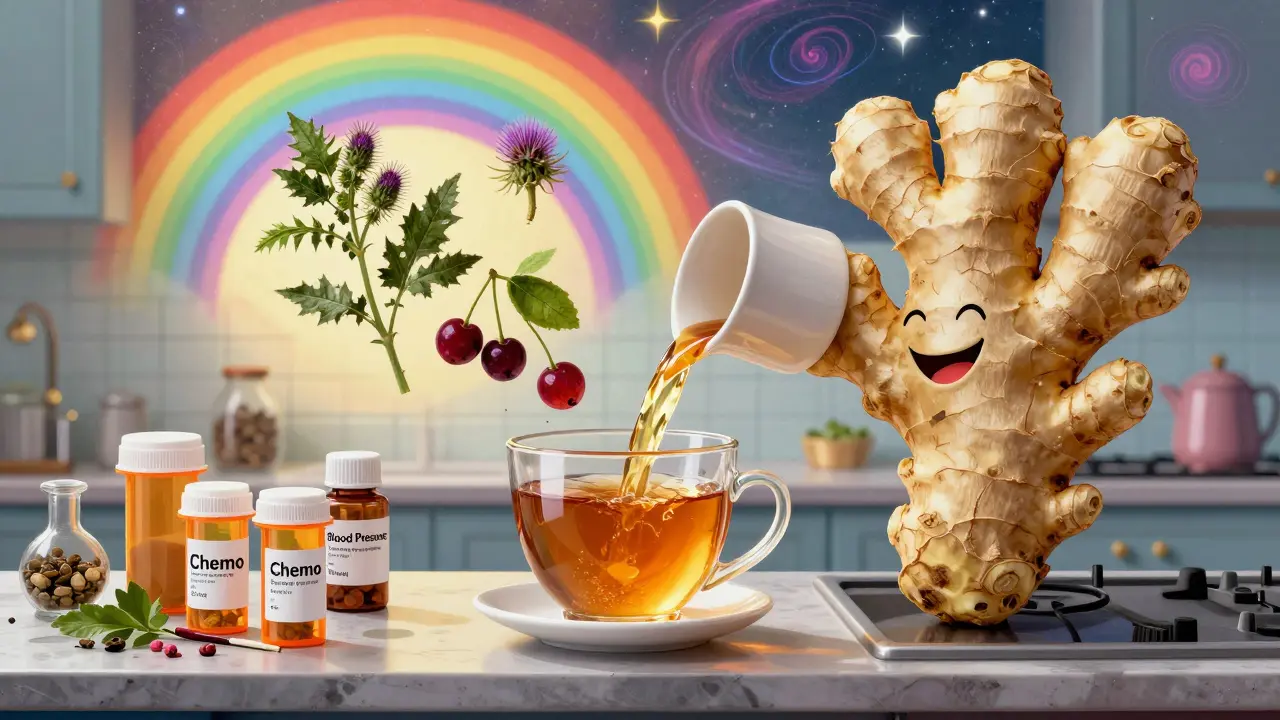
Herbs are where things get tricky. Many people assume “natural” means “safe.” It doesn’t. Take milk thistle, often used to “protect the liver” during chemo. One Reddit user, u/CancerWarrior87, ended up hospitalized after taking it with his treatment. His liver enzymes spiked. He wasn’t alone.Here’s the hard truth: 12.2% of cancer patients using complementary herbs were warned by their oncologists about dangerous interactions. Echinacea can interfere with immunotherapy. Garlic can thin your blood too much if you’re on aspirin or lisinopril. Kava kava has been linked to liver damage. Even something as common as fish oil can affect blood clotting.
And here’s the scary part: most people don’t tell their doctors. In that same UK hospital study, only 20.9% of patients using CAM disclosed it to their healthcare team. That means doctors are flying blind. You could be taking something that cancels out your meds-or makes them toxic.
Hawthorn and L-Arginine: Heart Medication Helpers (With Caveats)
If you’re on medication for heart failure or high blood pressure, you might have heard of hawthorn. This berry has been used in Europe for centuries to support circulation. A 2022 American Heart Association statement says hawthorn is generally safe when taken with ACE inhibitors or beta-blockers. In trials, it improved fatigue and shortness of breath without causing major side effects.L-arginine, an amino acid, has shown promise in improving blood flow and reducing chest pain in people with heart disease. But it’s not for everyone. At high doses, it can cause stomach upset, diarrhea, or low blood pressure. And if you’re on nitrates for angina, combining it with L-arginine could drop your blood pressure dangerously low.
Bottom line: These aren’t supplements to casually add to your routine. They’re tools that need medical supervision.
What You Should Never Try
Some complementary treatments are outright dangerous when mixed with common medications:- Blue cohosh: Can spike heart rate and blood pressure-risky if you’re on blood pressure meds.
- Lily of the valley: Extremely dangerous with digoxin (a heart drug). Can cause life-threatening low potassium.
- Kratom: The FDA has linked it to 195 deaths since 2016. It’s not regulated. Don’t risk it.
- Antioxidant supplements (vitamins A, C, E, selenium): Cancer Research UK warns these might protect cancer cells during chemo or radiation. The science isn’t settled, but the risk isn’t worth it without medical approval.
These aren’t “maybe” risks. They’re red flags. If you’re considering any of these, stop. Talk to your doctor first.
How to Use Complementary Treatments Safely
There’s no such thing as a “safe” complementary treatment without context. Safety depends on:- What medication you’re taking
- What dose you’re on
- How long you’ve been taking it
- Whether you’ve told your provider
Here’s how to do it right:
- Always tell your doctor. Write down every supplement, herb, or therapy you use-even if you think it’s harmless.
- Use trusted resources. The Memorial Sloan Kettering “About Herbs” app and the NCCIH interaction checker are updated monthly and free.
- Start low, go slow. Try one new thing at a time. Give it 2-4 weeks before deciding if it works.
- Don’t replace your meds. Complementary treatments support. They don’t substitute.
- Buy from reputable brands. Look for USP or NSF certification. Avoid products with “proprietary blends” that hide ingredient amounts.
Doctors need training to understand these interactions. A 2021 study found most physicians need at least 20 hours of education just to spot the big risks. That’s why you can’t wait for them to ask-you need to bring it up.

What’s Changing in 2026
The field is evolving fast. In 2023, the NIH allocated $142 million to research how complementary treatments can better manage side effects. That’s up 37% from the year before. The National Cancer Institute now recommends acupuncture and ginger as standard supportive care in some cancer centers.More hospitals are offering integrative medicine services. By 2022, 73% of U.S. cancer centers had them. But only 32% have formal protocols for managing drug interactions. That’s changing. The FDA is cracking down on unregulated products. Companies like Memorial Sloan Kettering are updating their herb databases monthly to include new interaction alerts.
And there’s a new frontier: personalized complementary care. The NIH’s Precision CAM initiative, launched in January 2023, is studying whether genetic markers can predict who will benefit from certain herbs or acupuncture. In five years, you might get a blood test before starting a supplement-not just a guess.
Real Talk: What Patients Say
On Trustpilot, integrative oncology services average 4.2 out of 5 stars. One patient wrote: “Acupuncture cut my neuropathy pain from Taxol by 50%.” Another said: “Wasted $300 on supplements that didn’t help my fatigue.”The pattern is clear: when used correctly-with medical guidance-complementary treatments can change lives. When used blindly, they can hurt you.
There’s no one-size-fits-all. What helps one person might do nothing-or worse-for another. That’s why knowledge matters more than hope.
Frequently Asked Questions
Can I use ginger instead of my anti-nausea pill?
No. Ginger can reduce nausea, but it’s not a replacement for prescribed anti-nausea medication. Use it alongside your doctor’s treatment, not instead of it. Some patients report better results when combining both, but never stop your prescribed meds without talking to your provider.
Are all herbal supplements safe because they’re natural?
Absolutely not. “Natural” doesn’t mean safe. Many herbs contain powerful chemicals that can interact dangerously with medications. For example, garlic can thin your blood too much if you’re on aspirin or warfarin. St. John’s wort can make birth control, antidepressants, and heart medications ineffective. Always check for interactions before taking anything.
Why don’t doctors talk about complementary treatments more?
Many doctors weren’t trained in complementary medicine. A 2022 survey found only 32% of physicians knew about tools like the MSK About Herbs app. Plus, patients often don’t disclose their use-only 20.9% in one study did. That means doctors are unaware of what’s being taken, making it harder to give advice. Bring the topic up yourself. Be specific: “I’m taking ginger for nausea. Is that safe with my current meds?”
How do I know if a supplement brand is trustworthy?
Look for third-party certifications: USP, NSF, or ConsumerLab. These mean the product was tested for purity, strength, and contamination. Avoid brands that use “proprietary blends” because they hide how much of each ingredient is actually in the product. If the label doesn’t list exact amounts, walk away.
Can acupuncture cause side effects?
When done by a licensed, trained practitioner, acupuncture has very few side effects. Some people feel slight soreness or bruising at the needle sites. Rarely, there’s dizziness or fainting-especially if you’re dehydrated or haven’t eaten. Serious complications like infection or organ injury are extremely rare when sterile, single-use needles are used. Always choose a licensed acupuncturist.
Next Steps
If you’re struggling with medication side effects, here’s what to do next:- Make a list of everything you’re taking-including vitamins, herbs, and teas.
- Download the MSK About Herbs app or visit the NCCIH website to check for interactions.
- Write down your biggest side effect (nausea? fatigue? insomnia?) and identify one evidence-based option to try.
- Book a 10-minute chat with your doctor or pharmacist. Say: “I’d like to explore safe ways to manage my side effects. Can we review what I’m using?”
Managing side effects isn’t about finding a miracle cure. It’s about making smart, informed choices-with your doctor as your partner, not your afterthought.
Alex Danner
January 7, 2026Acupuncture for chemo nausea? I’ve been doing it for 18 months. Not magic, but damn if it didn’t cut my vomiting episodes in half. My oncologist was skeptical until he saw my logs. Now he refers patients. It’s biology, not belief.
And ginger? Same thing. I take 1g capsules before every infusion. No drowsiness. No brain fog. Just calm. Ondansetron alone? I’d be on the floor. Ginger + meds? I’m functional.
But here’s the kicker-most people don’t tell their docs. I’ve seen too many patients crash because they took milk thistle with chemo. Liver enzymes went through the roof. Don’t be that guy. Talk to your team.
Ayodeji Williams
January 8, 2026bro why are you even here if you’re not taking kratom 😭 i got a whole bag of it and my chemo feels like a nap now 🤪
Kyle King
January 8, 2026Let me guess… the FDA’s ‘cracking down’? That’s code for ‘Big Pharma is scared.’
Acupuncture works because needles mess with the placebo circuitry in your brain. Ginger? It’s just spicy water. They’re pushing this ‘integrative medicine’ nonsense because hospitals want to charge $200/hour for ‘wellness sessions’ while your real meds are $3 a pill.
And don’t get me started on ‘USP certified’ supplements. That’s just a sticker. The FDA doesn’t regulate any of this. You think they’d let a $40 billion industry grow if it actually worked? Wake up.
Kamlesh Chauhan
January 10, 2026why do people think herbs are safe just because they grow in dirt 🤡 my cousin took ashwagandha with his blood pressure meds and passed out in the shower now he’s on dialysis and nobody talks about it
Rachel Steward
January 12, 2026Let’s be brutally honest: this entire article is a carefully curated PR piece disguised as medical advice. The NIH funding increase? Of course it’s rising. The supplement industry poured $200 million into lobbying last year. The ‘38% of U.S. adults’ stat? That includes people who drink chamomile tea because they’re stressed out.
And don’t get me started on ‘evidence-based.’ You cite a 2017 meta-analysis, but you ignore the 2020 Cochrane rebuttal that found publication bias in 68% of acupuncture trials. You cherry-pick the wins and bury the failures. That’s not science. That’s marketing.
Also, ‘don’t replace your meds’? Tell that to the 12% of cancer patients who quit chemo because ‘ginger worked better.’ You’re not helping. You’re enabling.
Jonathan Larson
January 13, 2026Thank you for this meticulously researched and profoundly responsible piece. It is rare to encounter such a balanced synthesis of clinical evidence and patient-centered wisdom.
The distinction between complementary and alternative is not merely semantic-it is existential. To conflate them is to risk lives. Your emphasis on disclosure to healthcare providers is not just prudent-it is ethically imperative.
I have witnessed patients in rural India, where access to oncology is scarce, turn to turmeric and yoga as lifelines. With proper guidance, these practices can be dignified extensions of care-not substitutes, but sanctuaries.
Let us not mistake modernity for progress. Sometimes, the oldest remedies, when applied with rigor and humility, hold the most profound truths.
May we all be so fortunate as to have doctors who listen.
Elen Pihlap
January 13, 2026i took fish oil with my blood thinner and almost died 😭 my mom said it was fine because it's natural but now i have a scar on my stomach and i hate everyone
Sai Ganesh
January 15, 2026in india we use turmeric and black pepper for everything. it helps with inflammation and no one dies. why is america so scared of food?
Aparna karwande
January 16, 2026Oh please. You think Western medicine has the monopoly on truth? In Ayurveda, we’ve used ginger, ashwagandha, and licorice root for millennia to harmonize the body’s doshas. Your ‘studies’ are infantile compared to the lived wisdom of 5,000-year-old traditions.
And who are you to say milk thistle is dangerous? My grandmother survived three rounds of chemo with nothing but neem and pippali. She’s 89 and still dances at weddings.
Stop colonializing healing. Stop pathologizing tradition. Stop pretending your lab tests are the only valid measure of life.
And yes-I told my doctor. He laughed. Then he asked me for the recipe.
Jessie Ann Lambrecht
January 18, 2026Y’all are overcomplicating this. I had neuropathy from Taxol. Felt like my feet were wrapped in barbed wire. Tried gabapentin-zombie mode. Tried acupuncture-felt like a warm hug for my nerves.
Ginger tea before chemo? My nausea dropped from ‘I’m gonna die’ to ‘I can handle this.’
My doc didn’t know squat about herbs. So I brought him the NCCIH page. He said ‘cool, let’s try it.’
Don’t overthink it. Don’t fear the natural. Just don’t be dumb. Tell your doctor. Check interactions. Start slow. You got this.
Vince Nairn
January 18, 2026so you’re telling me i can’t just drink kombucha and call it a day instead of chemo 😂 i mean it’s fermented so it’s probiotic and i saw a guy on tiktok say it cured his lung cancer sooo
Anthony Capunong
January 19, 2026Why is everyone acting like this is new? We’ve known for decades that herbs interact with meds. My uncle died in 2008 because he took St. John’s wort with his antidepressants. He didn’t tell anyone. He thought it was ‘natural healing.’
Now we have apps. We have databases. We have guidelines. If you’re still guessing, you’re not brave-you’re reckless.
This isn’t about capitalism. It’s about not dying because you were too proud to ask a question.
Andrew N
January 19, 2026this is a long post