
24 Jan 2026
- 12 Comments
For millions of people around the world, statins are a daily pill that keeps their hearts safe. But for others, that same pill brings aching legs, tired muscles, and sleepless nights wondering if the benefits are worth it. If you’ve been prescribed a statin-or are considering one-you’re not alone in asking: Is this drug helping me, or hurting me?
How Statins Actually Work
Statins don’t just lower cholesterol. They reprogram how your liver works. These drugs block an enzyme called HMG-CoA reductase, which your liver uses to make cholesterol. When that enzyme slows down, your liver starts pulling more LDL (bad) cholesterol out of your blood to use for its own needs. The result? Your LDL drops-often by 30% to 60%, depending on the drug and dose.
That drop isn’t just a number on a lab report. Landmark studies like the 4S trial and the Heart Protection Study showed that for every 1 mmol/L reduction in LDL, your risk of a heart attack or stroke falls by about 22%. Over time, that adds up. People on statins see roughly a 60% lower chance of a major heart event and a 17% lower stroke risk. That’s not small. That’s life-changing.
But statins don’t stop at cholesterol. They also calm inflammation in your blood vessels. They help stabilize plaque so it’s less likely to rupture and cause a clot. They improve how the lining of your arteries functions. These effects happen even before LDL drops significantly-meaning statins protect your heart in more ways than one.
The Real Numbers on Muscle Pain
Now, here’s the problem most people don’t talk about: muscle pain. It’s the #1 reason people stop taking statins. But how common is it really?
Studies show that between 5% and 10% of people on statins report muscle aches, stiffness, or cramps. That’s not rare. But it’s also not the 20-30% some online forums claim. The scary stuff-rhabdomyolysis, where muscle tissue breaks down dangerously-happens in fewer than 1 in 10,000 people per year. You’re far more likely to be struck by lightning than to develop this.
Here’s what muscle pain from statins usually feels like: a dull, persistent ache in your thighs, shoulders, or calves. It’s not a sharp pain. It’s not a workout soreness. It’s more like your muscles are heavy, tired, or weak-even when you haven’t done anything. Some people say it feels like their legs are made of lead. Others wake up stiff and sore without knowing why.
And here’s the catch: not all muscle pain is from statins. As people age, muscle aches become more common. Arthritis, vitamin D deficiency, thyroid issues, and even dehydration can mimic statin side effects. That’s why jumping off your medication at the first twinge isn’t smart. You need to figure out what’s really going on.
Which Statins Are Easier on Muscles?
Not all statins are created equal when it comes to muscle pain. Some are more likely to cause problems than others.
Simvastatin and lovastatin have higher rates of muscle-related complaints, especially at higher doses. That’s because they’re broken down by a liver enzyme called CYP3A4, which is easily affected by other drugs, foods (like grapefruit), or even genetics. If your body handles this enzyme poorly, the statin builds up in your system-and so do the side effects.
Pravastatin and rosuvastatin are different. They’re cleared from the body through other pathways, so they’re less likely to interact with other medications or cause buildup. Many people who can’t tolerate simvastatin find they feel fine on pravastatin. Rosuvastatin is potent, but its muscle risk is low when used at moderate doses.
Atorvastatin sits in the middle. It’s widely prescribed because it’s effective and generally well-tolerated. But at high doses (80 mg), the muscle pain risk goes up. Many doctors now start with 10 or 20 mg and adjust based on response.
If you’re having trouble, switching statins is often the first step. It’s not a failure. It’s just finding the right fit.
What to Do If You Have Muscle Pain
Don’t just quit. Talk to your doctor. Here’s what a smart plan looks like:
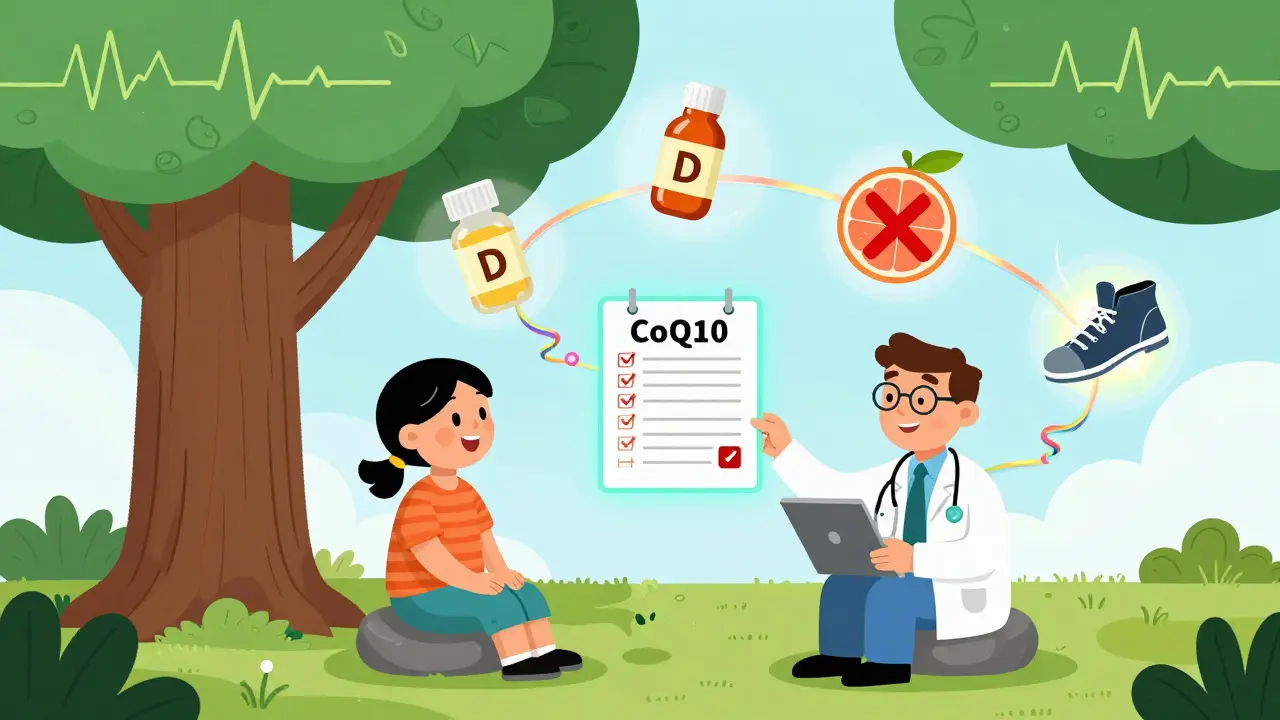
- Get a blood test for creatine kinase (CK). High levels mean your muscles are breaking down. Normal levels? The pain might be something else.
- Check your vitamin D and thyroid levels. Low levels can mimic statin side effects.
- Try lowering your dose. Sometimes 10 mg of atorvastatin gives you 80% of the benefit with 90% of the comfort.
- Switch to a different statin. Pravastatin or fluvastatin are good alternatives for people with muscle issues.
- Consider coenzyme Q10. Some people swear by it. The science isn’t rock-solid, but it’s safe to try. A 100-200 mg daily dose might help if your body’s making less of it due to statin use.
- Don’t skip exercise. Inactivity makes muscles weaker and more prone to pain. Light walking or swimming can help.
One patient I know switched from simvastatin to pravastatin after six months of leg cramps that made it hard to climb stairs. Within two weeks, the pain vanished. His LDL stayed at 1.8 mmol/L. He’s been on it for five years now.
Are Statins Worth It for You?
The answer depends on your risk. If you’ve had a heart attack, stroke, or bypass surgery-yes, statins are essential. If you have diabetes and high cholesterol-yes. If you’re over 50 with high LDL and a family history of early heart disease-yes.
But if you’re young, healthy, and just a little above the “normal” cholesterol range? The math changes. For someone with low risk, the chance of avoiding a heart attack over 10 years might be 1% or 2%. The chance of muscle pain? 5-10%. That’s a tough trade-off.
That’s why guidelines now stress shared decision-making. Your doctor shouldn’t just hand you a script. They should show you your risk numbers. They should ask how you feel. They should give you options.
There are alternatives-ezetimibe, PCSK9 inhibitors, lifestyle changes-but none match statins for cost, effectiveness, and proven outcomes. For most people at risk, statins are still the best tool we have.
Real Stories, Real Choices
On forums like Reddit, you’ll find people who say statins ruined their lives. And you’ll find others who say they saved them.
One man in Sydney, 68, had a mild heart attack at 62. His LDL was 4.8. After starting atorvastatin, it dropped to 1.6. He had no muscle pain. He says, “I’d take this pill every day for the rest of my life if I had to.”
Another woman, 54, took rosuvastatin for two years. She developed constant calf cramps that woke her up at night. Her CK was normal. Her doctor switched her to pravastatin. The cramps disappeared in ten days. Her LDL stayed low. She didn’t have to choose between her heart and her comfort.
These aren’t outliers. They’re common stories. Statins work. But they’re not magic. They’re tools. And like any tool, they need to be used right.
What’s Next for Statins?
Researchers are working on smarter versions. Some are testing statins that target the liver more precisely, so they don’t affect muscles as much. Others are looking at genetic tests to predict who’s likely to have side effects-like a variant in the SLCO1B1 gene that makes simvastatin riskier.
For now, the message is simple: don’t fear statins. But don’t ignore your body, either. If something feels off, speak up. Your doctor isn’t trying to force you into a pill. They’re trying to keep you alive-and healthy.
Statin therapy isn’t about taking a pill and hoping for the best. It’s about working with your body, not against it. And that’s a partnership worth having.
Do statins really reduce heart attacks?
Yes. Multiple large studies, including the 4S and HPS trials, show statins reduce major heart events by about 30% on average. For every 1 mmol/L drop in LDL cholesterol, your risk of a heart attack or stroke falls by 22%. The benefit is strongest in people with existing heart disease or high risk factors like diabetes or high blood pressure.
Is muscle pain from statins dangerous?
Usually not. Most muscle aches are mild and don’t cause damage. But in rare cases (fewer than 0.1% of users), statins can cause rhabdomyolysis-a serious condition where muscle tissue breaks down and can damage the kidneys. Signs include dark urine, severe weakness, or unexplained pain. If you have these, stop the statin and call your doctor immediately. Blood tests for creatine kinase (CK) can confirm if muscle damage is happening.
Can I take statins if I have muscle pain?
Maybe. Many people with mild muscle discomfort can stay on statins by switching to a different type (like pravastatin or fluvastatin), lowering the dose, or taking them every other day. Never stop without talking to your doctor. Muscle pain doesn’t always mean the statin is the cause-vitamin D deficiency, thyroid issues, or overexertion can mimic it. Blood tests help sort it out.
Are there natural alternatives to statins?
Lifestyle changes-like eating more fiber, exercising, losing weight, and cutting saturated fats-can lower LDL by 10-20%. Supplements like plant sterols or red yeast rice (which contains a natural statin) may help a bit. But none match the 30-60% LDL reduction of prescription statins. For high-risk people, lifestyle alone isn’t enough. For low-risk people, it might be a good first step-but always discuss options with your doctor.
Why do some people tolerate statins and others don’t?
Genetics play a big role. A variant in the SLCO1B1 gene affects how your body processes certain statins like simvastatin, increasing the risk of muscle side effects. Age, kidney or liver function, other medications (like antibiotics or antifungals), and even grapefruit juice can change how statins are metabolized. Some people’s muscles are simply more sensitive to the drug’s effects. There’s no one-size-fits-all answer.
Should I take CoQ10 with my statin?
It’s safe to try. Statins reduce levels of coenzyme Q10, which your muscles need for energy. Some studies show CoQ10 supplements (100-200 mg daily) may reduce muscle pain in people on statins, though results aren’t consistent. It’s not a guaranteed fix, but since it’s low-risk and inexpensive, many doctors recommend it as part of a trial approach if muscle symptoms appear.
Final Thoughts: Don’t Fear the Pill, Understand It
Statins are one of the most studied drugs in history. They’ve saved millions of lives. But they’re not perfect. Muscle pain is real. It’s common enough that you should expect it. But it’s not inevitable. And it’s rarely life-threatening.
The key isn’t avoiding statins. It’s finding the right one, at the right dose, for your body. If you’re on a statin and feel off, don’t assume it’s the pill. Don’t assume it’s nothing. Ask questions. Get tested. Try alternatives. Work with your doctor-not against them.
Your heart doesn’t need a miracle. It needs consistency. And for most people, that means taking a statin-not because it’s trendy, but because it works.
siva lingam
January 24, 2026statins are just big pharma’s way of turning healthy people into pill-popping zombies
next they’ll make us take vitamins to prevent breathing
Shelby Marcel
January 24, 2026i took rosuvastatin for 3 months and my legs felt like concrete bricks at night
swiched to pravastatin and boom-no more cramps
also i spell wrong sometimes but this is real
Phil Maxwell
January 25, 2026my dad’s been on atorvastatin for 12 years. no muscle pain, no issues. his cholesterol’s stable. he says it’s just part of his morning coffee routine now.
weird how some people act like it’s a cult when it’s just medicine
Alexandra Enns
January 26, 2026OH MY GOD YOU GUYS THIS IS THE MOST MISLEADING BLOG I’VE EVER READ
statins don’t ‘reprogram’ your liver-your liver doesn’t have a brain, it’s an organ, not a sentient AI
and that ‘22% risk reduction’? That’s relative risk, you morons-absolute risk is like 0.8% over 10 years for low-risk people
and don’t even get me started on CoQ10-some guy on Reddit says it works so it’s science now??
the real problem is doctors prescribing statins like they’re candy to people with LDL of 140 and zero other risk factors
you’re not saving lives-you’re creating hypochondriacs who think their hamstrings are failing because of a pill
and don’t even mention grapefruit. I drank grapefruit juice for 20 years and never turned into a human smoothie
also-why is everyone acting like this is a revolutionary discovery? I’ve been reading this exact article since 2014
Marie-Pier D.
January 28, 2026to anyone feeling muscle pain: i feel you 💔
it’s not ‘all in your head’-your body is talking
but please don’t quit cold turkey
talk to your doc, get your vit D checked, try a different statin
i switched from simva to prava and it was like waking up from a 3-year nap
you’re not weak for needing help-you’re smart for listening
and yes, coq10 helped me too 🙏
Patrick Gornik
January 28, 2026the real tragedy isn’t statin myopathy-it’s the epistemological collapse of modern medicine
we’ve reduced the human organism to a lipid spreadsheet, a cholesterol ledger, a metabolic balance sheet
statins don’t cure disease-they mediate the symptomatology of late-stage capitalism’s nutritional collapse
we’ve outsourced agency to a pill because we’re too busy scrolling to chew kale
and yet-we’re told to trust the algorithm, the RCT, the meta-analysis
but where’s the soul in this calculus?
where’s the embodied wisdom of ancestral movement, of fasting, of sunlight on skin?
we’ve turned the heart into a pump, the muscle into a sensor, the doctor into a prescriber
and we wonder why we feel hollow
maybe the statin isn’t the poison
maybe the poison is the belief that a molecule can fix a civilization
Juan Reibelo
January 29, 2026Okay, I’ve been on atorvastatin 20mg for 7 years-no issues. But I also: walk 8k steps daily, don’t eat fried food, sleep 7 hours, and drink water like it’s my job. Statins work better when you’re not a human dumpster fire. Also, if you’re taking simvastatin and eating grapefruit, you’re basically playing Russian roulette with your hamstrings. Just saying. 🤷♂️
Luke Davidson
January 29, 2026my cousin took simvastatin and couldn’t walk up stairs-she cried every night
switched to pravastatin and now she hikes every weekend
she says it’s like getting her body back
and yeah, her LDL’s still perfect
so if you’re suffering-don’t suffer in silence
there’s a version of this pill that might not suck
you’re not broken-you just haven’t found your fit yet 💪
asa MNG
January 30, 2026statins are literally the reason my thighs feel like they’re full of wet sand 😭
i took coq10 and it helped a lil but not enough
then i tried every other statin and finally found fluvastatin
now i’m back to dancing in my kitchen at 2am
also i’m not mad at big pharma
i’m mad at my doctor for not listening
they just handed me a script like i was a vending machine
ps: i miss my legs 😭🙏
Josh McEvoy
January 31, 2026they say statins save lives
but no one says they steal your ability to squat
my legs are now just… sad pillars
no more running
no more climbing
just… existing
like a human statue
with a prescription
and a silent scream
Heather McCubbin
February 2, 2026you people are so naive
statins are designed to keep you docile and dependent
they don’t care if you’re in pain
they care if you keep buying pills
your ‘heart health’ is just a marketing slogan
the real goal? Make you believe you need them forever
and if you question it? You’re ‘non-compliant’
they’ve turned medicine into a religion
and you’re the congregation
wake up
it’s not about cholesterol
it’s about control
Tommy Sandri
February 2, 2026Thank you for this comprehensive and evidence-based overview. The distinction between relative and absolute risk reduction is critical for informed decision-making, and the emphasis on individualized therapy-particularly the role of genetic polymorphisms like SLCO1B1-is both clinically sound and patient-centered. The data on alternative statins and adjunctive CoQ10 supplementation are appropriately contextualized. This is precisely the kind of nuanced, non-sensationalist communication that improves health literacy and reduces unnecessary discontinuation. Well done.