

21 Jan 2026
- 10 Comments
Athlete’s foot isn’t just a gym locker problem-it’s a common fungal infection that affects 1 in 5 people worldwide. If you’ve ever had itchy, cracked skin between your toes or flaky soles that won’t go away, you’re not alone. The good news? Most cases can be treated safely and effectively with over-the-counter (OTC) antifungals-if you use them right.
What’s Really Causing Your Itchy Feet?
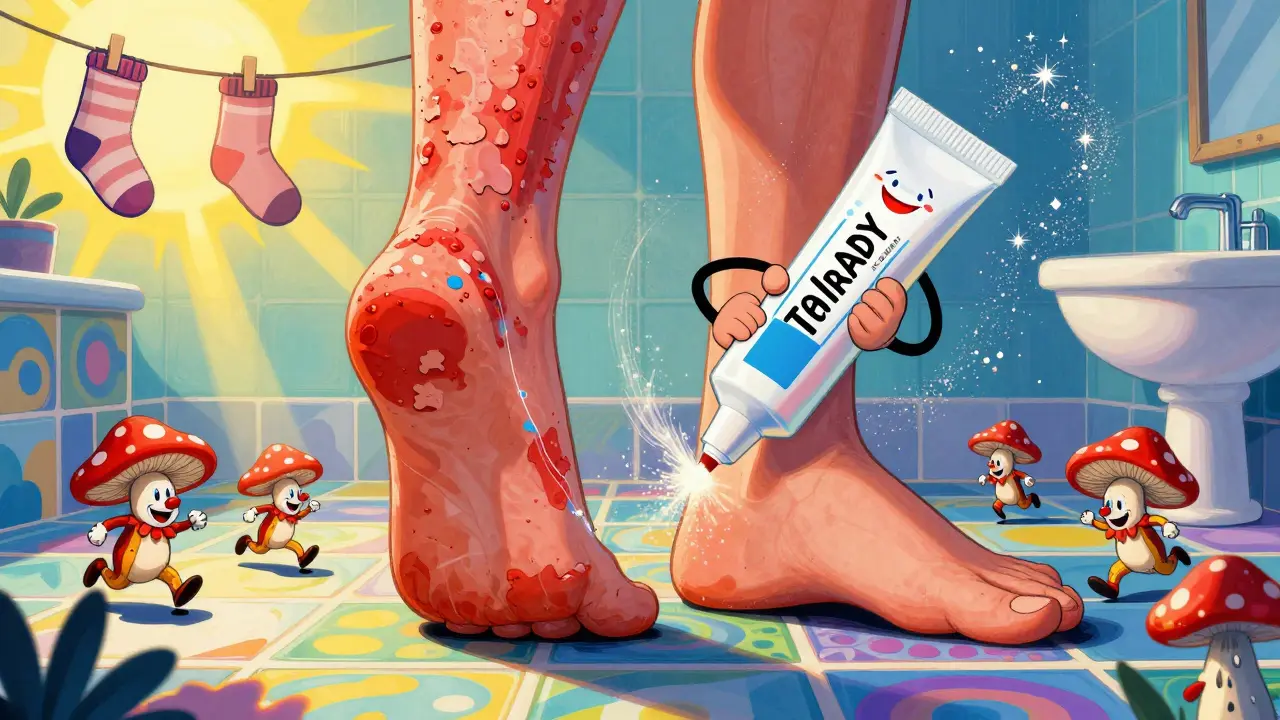
Athlete’s foot, or tinea pedis, is caused by fungi called dermatophytes. These bugs thrive in warm, damp places: inside sweaty sneakers, around public showers, or on damp towels. They don’t care if you’re an athlete or not. Anyone who walks barefoot in locker rooms, shares shoes, or wears tight, non-breathable socks is at risk. The infection usually starts between the toes, where moisture builds up. From there, it can spread to the soles, sides, or even nails. You might notice redness, peeling, burning, or blistering. Sometimes, it just feels like dry skin that won’t heal. But if you ignore it, it can get worse-and spread to your hands or other family members.Which OTC Antifungals Actually Work?
Not all OTC creams and sprays are created equal. There are five main active ingredients you’ll find on shelves, and their effectiveness varies.- Terbinafine (Lamisil AT): This is the top performer. It kills the fungus, not just slows it down. Studies show it cures 83% of cases within 1-2 weeks with just one daily application. It works fast-often clearing itching in 2-3 days.
- Clotrimazole (Lotrimin): A classic choice. It stops fungus from growing but doesn’t kill it outright. You need to apply it twice a day for 2-4 weeks. Works well for mixed infections (like when yeast joins the party).
- Miconazole (Micatin): Similar to clotrimazole. Twice-daily use. Good for sensitive skin.
- Tolnaftate (Tinactin): Older and cheaper. It’s okay for mild cases between the toes but struggles with thick, sole infections. Only about 65% effective.
- Undecylenic acid: Found in powders. Helps dry out skin and mildly fights fungus. Best as a helper, not a main treatment.
Price-wise, generic tolnaftate starts at $6, while branded terbinafine runs $20-$25. But spending more isn’t always better-terbinafine’s higher cost is worth it because you use less of it and finish faster.
How to Use These Treatments Right
Using the right product is only half the battle. How you use it makes all the difference.- Wash and dry thoroughly. Use soap and water. Then, dry your feet completely-especially between your toes. A hairdryer on cool or low heat works better than a towel.
- Apply a thin layer. Put the cream, spray, or gel on the infected area AND a 1-inch border around it. Don’t smear it thick. Too much doesn’t help-it just makes a mess.
- Apply to both feet. Even if only one foot looks bad, fungi are probably on both. Treating just one side is why so many people get it back.
- Keep going after it looks better. Most people stop when the itching stops. Big mistake. Fungi hide deep in skin layers. Continue treatment for at least 1 week after symptoms disappear. For terbinafine, that’s 1-2 weeks total. For clotrimazole, 2-4 weeks.
- Don’t skip days. One missed application can set you back days. Consistency beats intensity.
Podiatrists report that 63% of treatment failures happen because people quit too early. If you stop when it feels better, you’re just giving the fungus a chance to come back stronger.
Formulations: Creams, Sprays, Powders-Which One?
The form you choose matters based on your infection type and lifestyle.- Creams (65% of users): Best for dry, scaly skin on the soles or sides. Easy to spread, stays put.
- Sprays (20%): Great for hard-to-reach areas, athletes, or people who hate sticky fingers. Convenient, but make sure you cover the whole area.
- Powders (10%): Ideal for sweaty feet or moist infections between toes. Use daily in socks and shoes. Tolnaftate powder is the cheapest preventive option at under $9 for a 30g container.
- Gels and liquids (5%): Used for nail involvement or stubborn cases. Less common in OTC.
Surveys show 78% of users prefer sprays for daily use because they’re quick and clean. But if you have arthritis or shaky hands, once-daily terbinafine cream is easier than twice-daily clotrimazole.
Stop the Spread: Prevention Is Half the Cure
Treating the infection is important-but stopping it from coming back? That’s where most people fail.- Change socks twice a day. Cotton or moisture-wicking socks are best. No synthetic blends.
- Rotate your shoes. Let each pair sit for 24-48 hours to dry out. Fungi can live in shoes for months.
- Use antifungal powder in shoes daily. Even after the infection is gone. This cuts recurrence by 63%.
- Wear flip-flops in public showers, pools, and gyms. The CDC says this reduces transmission by 85%.
- Use a separate towel for your feet. Don’t share towels. Wash them in hot water after each use.
- Keep feet dry. If you’re sweaty, use foot powder or antifungal spray before putting on socks.
People who stop prevention after the itch is gone are 70% more likely to get it back within a year. Prevention isn’t optional-it’s part of the treatment.

When to See a Doctor
OTC treatments work for 85% of cases. But if you’re in the other 15%, you need help. See a doctor if:- Nothing improves after 2 weeks of consistent use.
- Your foot is swollen, oozing pus, or very painful-that’s a bacterial infection.
- The rash spreads to your nails, hands, or groin.
- You have diabetes, poor circulation, or a weak immune system.
Diabetics are at high risk for serious foot complications. Even a small crack can turn into a dangerous infection. If you’re diabetic and suspect athlete’s foot, don’t wait-see a podiatrist right away.
Doctors can prescribe stronger options: oral terbinafine (250mg daily for 2 weeks), itraconazole, or prescription topical ciclopirox. These work when OTC fails-and they’re often cheaper than you think. With a GoodRx coupon, oral terbinafine costs under $19.
What Not to Do
Here are the most common mistakes people make:- Using steroid creams (like hydrocortisone) to stop itching-this makes the fungus grow faster.
- Wearing the same socks or shoes every day.
- Washing feet but not drying between toes.
- Trying home remedies like vinegar soaks or tea tree oil without evidence-they might help a little, but they won’t cure it.
- Sharing towels, shoes, or nail clippers.
There’s no magic fix. Athlete’s foot isn’t a sign of poor hygiene-it’s a sign you’ve been exposed to fungi. The key is treating it properly and staying consistent.
What’s Next for Treatment?
New OTC products are coming. Some now combine antifungals with dimethicone to create a moisture barrier that keeps fungi out. In clinical trials, nanoemulsion sprays are cutting treatment time from 2 weeks to just 3-5 days. But for now, proven is better than new.One worrying trend: fungal resistance. Terbinafine resistance has risen from 0.2% in 2010 to 1.7% in 2023. That’s still low-but it means we can’t take these treatments for granted. Use them correctly, finish the course, and don’t overuse them.
For most people, athlete’s foot is a nuisance-not a crisis. With the right product, the right routine, and a little patience, it clears up fast. And once it’s gone, the habits you build will keep it from coming back.
Can I use athlete’s foot cream on other parts of my body?
Most OTC athlete’s foot creams are safe for other fungal skin infections like jock itch or ringworm, since they’re caused by the same fungi. But don’t use them on your face, eyes, or genitals unless the label says it’s okay. Always check the active ingredient and follow instructions.
How long does athlete’s foot take to go away?
With terbinafine, most people see improvement in 3-5 days and full clearance in 1-2 weeks. For clotrimazole or tolnaftate, it takes 2-4 weeks. Symptoms like itching fade faster than the fungus itself. Always finish the full course-even if your skin looks normal.
Is athlete’s foot contagious?
Yes. You can spread it through direct skin contact or by walking barefoot where someone else with the infection has been. Sharing towels, shoes, or socks also spreads it. Keep your feet covered in public showers, wash your hands after applying treatment, and don’t share personal items.
Can I wear socks and shoes while using antifungal cream?
Yes, but wait 10-15 minutes after applying the cream so it absorbs. Wear clean, dry socks made of cotton or moisture-wicking fabric. Avoid tight or synthetic shoes. If your feet get sweaty, change socks midday. Using antifungal powder inside shoes helps prevent reinfection.
Why does my athlete’s foot keep coming back?
Most recurrences happen because people stop treatment too soon or skip prevention. Fungi live in shoes, towels, and floors. If you don’t treat both feet, change socks daily, or dry shoes between wears, the fungus comes back. Use antifungal powder in shoes even after the infection clears. Prevention is the real cure.
Are natural remedies like tea tree oil effective?
Some studies show tea tree oil has mild antifungal properties, but it’s not strong enough to cure athlete’s foot on its own. It might help with itching or as a backup, but don’t rely on it. Stick to FDA-approved OTC antifungals with proven cure rates. Natural doesn’t mean effective.
Malik Ronquillo
January 21, 2026Terbinafine is the only thing that works. I used every other cream for months. Nothing. Then I tried Lamisil AT for 10 days and my feet looked like a baby’s butt. No joke. Stop wasting your money on crap.
Also, dry between your toes with a hairdryer. It’s not that hard. I know you’re lazy. But your feet aren’t.
And no, tea tree oil won’t save you. Stop Googling ‘natural remedies’ and just buy the damn cream.
Lana Kabulova
January 22, 2026Wait so you’re telling me I need to keep using the cream for a week after it stops itching??? But it doesn’t itch anymore!!! Why do I have to keep putting this gross sticky stuff on my feet??
Also why does every single source say ‘apply to a 1 inch border’ but none of the packaging says that??
And who even measures an inch on their foot??
Also why is everyone so obsessed with terbinafine?? I’ve been using tolnaftate for 3 weeks and my skin is fine??
Also why do I need to rotate shoes?? I only have two pairs!!
Also I wear sandals all summer so why am I even worried??
Also why is this so complicated?? I just want my feet to stop being weird
arun mehta
January 24, 2026Thank you for this comprehensive guide 🙏
As someone from India where humidity is relentless, I can confirm that athlete’s foot is not a ‘gym problem’-it’s a way of life. The real challenge isn’t the cream-it’s keeping your feet dry in monsoon season.
Pro tip: Use cotton socks, even in heat. Synthetic fibers are the enemy. And yes, antifungal powder in shoes daily-even after cure-is non-negotiable. I’ve seen friends relapse because they thought ‘no itch = no fungus.’ Big mistake.
Terbinafine is indeed the gold standard. But if cost is an issue, tolnaftate powder + strict hygiene still works. Just don’t skip the drying step. A hairdryer on low is your best friend.
And please, for the love of all that is holy-don’t share towels. Not even with your spouse. 🤦♂️
Prevention > cure. Always.
Chiraghuddin Qureshi
January 24, 2026Bro in India we call this ‘jungle foot’ 😂
My uncle used to rub neem leaves on his toes. Thought it was a cure. It wasn’t. He ended up with a fungal nail infection.
Terbinafine saved him. Now he carries a tiny tin of tolnaftate powder everywhere. Even to weddings. He says, ‘Better than dancing barefoot on temple floors.’
Also-flip flops in public showers? Non-negotiable. Even if you’re a ‘I’m clean’ person. Fungi don’t care about your hygiene standards. They just want warm, wet skin.
And yes, your socks matter. Cotton. Always. No exceptions.
One more thing: wash your feet with soap, not just water. Soap breaks the biofilm. Water alone? Useless.
Stay dry. Stay sane. 🙏
Oren Prettyman
January 25, 2026It is, of course, entirely unsurprising that the most effective treatment-terbinafine-is also the most expensive, thereby creating a structural disincentive for adherence among lower-income populations, which ironically correlates with higher rates of fungal exposure due to inadequate footwear and communal hygiene infrastructure. The pharmaceutical industry, in its infinite wisdom, has commodified fungal eradication, pricing out the very demographics most vulnerable to the condition, thereby perpetuating a cycle of recurrence and public health neglect. Furthermore, the recommendation to use antifungal powder in shoes indefinitely suggests an implicit assumption that the individual possesses the economic and spatial luxury to maintain multiple pairs of footwear and a dedicated storage regimen-an assumption that is, in many cases, patently false. One must ask: is this truly a medical solution, or merely a consumerist performance of cleanliness?
Tatiana Bandurina
January 27, 2026So you’re saying I need to treat both feet even if only one looks infected? But what if I only have one foot with the problem? That’s not logical. Why punish the healthy foot?
Also, why do you assume everyone has a hairdryer? What if I live in a dorm? Or a studio apartment? Or I’m a student with no money?
And who has time to apply cream twice a day? I work two jobs. I don’t have a ‘routine.’
Also, why is everyone so obsessed with terbinafine? Maybe I don’t want to use chemicals on my skin. Maybe I prefer ‘natural’ methods.
And what if I’m allergic to something? You don’t mention patch testing.
Also, why no mention of probiotics? Gut health affects skin. You’re ignoring the whole picture.
And what about my cat? Could she have given it to me? Do I need to treat her too?
This guide feels like it was written by someone who has never had to do laundry, let alone manage a real life.
Philip House
January 27, 2026Look, I’ve been to 12 countries. I’ve walked through every locker room from Tokyo to Tbilisi. Let me tell you something: fungus doesn’t care about your nationality, your income, or your ‘OTC guide.’
Terbinafine works? Cool. But in the Middle East, they use garlic. In Brazil, they use aloe. In rural China, they use ash. And guess what? It works. Not as fast. But it works.
You think America has the monopoly on science? Nah. We just market it better.
And don’t get me started on ‘dry between your toes.’ Who’s checking? You? Your partner? Your therapist?
Also, flip-flops in gyms? That’s not hygiene. That’s fear. You’re not a germaphobe. You’re just scared of your own feet.
Bottom line: fungus is everywhere. You can’t win. You can only delay. So chill. Wash your feet. Wear clean socks. And if it comes back? So what. You’re still alive. That’s the real win.
Sarvesh CK
January 29, 2026The philosophical underpinning of this guide reveals a deeper tension between modern biomedical reductionism and holistic human experience. While the efficacy of terbinafine is empirically validated, the social and psychological dimensions of chronic fungal infection-shame, stigma, isolation-are rarely addressed. The insistence on daily powder application, shoe rotation, and hairdryer use, while medically sound, imposes a ritualistic burden that may alienate those with limited autonomy over their environment. In cultures where communal living is the norm, the directive to ‘use a separate towel’ may be not only impractical but culturally incongruent. One must therefore ask: is the cure being prescribed for the disease, or for the idealized, isolated, hyper-individualized subject of Western medicine? Perhaps true healing lies not only in eradicating the fungus, but in reimagining the conditions under which it thrives-socially, economically, and spiritually.
Hilary Miller
January 30, 2026I used to have this bad and now I don’t. Just use terbinafine. Dry feet. Don’t share towels. Done.
Brenda King
January 31, 2026Thank you for writing this. I’m a nurse and I see so many people come in with foot infections because they stopped the cream too soon. Or they used hydrocortisone to ‘calm it down’ and made it worse.
One thing I always tell my patients: if your skin looks normal but still feels a little weird? Keep going. Fungus is sneaky.
And yes, your shoes are the problem. I had a patient who wore the same sneakers for 3 years. Same pair. Even after treatment. Of course it came back.
Use the powder. Even if you think you’re ‘fine.’ It’s like brushing your teeth after you’ve had a cavity filled.
You got this. And you’re not alone. So many of us have been there.
And if you’re diabetic? Please, please, please see your doctor. Don’t wait.
Love you all. Stay dry.
💙