
30 Dec 2025
- 12 Comments
When a generic drug hits the shelf, you might assume it’s just a cheaper copy of the brand-name version. But behind that simple label is a rigorous scientific process designed to prove it works exactly the same way in your body. That process is called a bioequivalence study. These aren’t just lab tests-they’re controlled clinical trials with strict rules, precise measurements, and statistical standards that ensure safety and effectiveness. If you’ve ever wondered how regulators know a generic pill delivers the same result as the original, here’s how it actually works.
Why Bioequivalence Studies Exist
Before 1984, every generic drug needed its own full clinical trial to prove it worked. That meant long delays, high costs, and fewer options for patients. The U.S. Hatch-Waxman Act changed that by introducing the Abbreviated New Drug Application (ANDA). Now, manufacturers don’t need to repeat expensive clinical trials. Instead, they must prove bioequivalence: that their version releases the same amount of active ingredient into the bloodstream at the same speed as the brand-name drug. The same standard applies in Europe, Japan, Canada, and other major markets. The goal? Safe, affordable access without sacrificing quality. According to the FDA, generic drugs saved the U.S. healthcare system over $1.68 trillion between 2010 and 2019.The Core Design: Crossover Studies
Most bioequivalence studies use a two-period, two-sequence crossover design. That means 24 to 32 healthy volunteers (sometimes up to 100, depending on the drug) each take both the generic (test) and brand-name (reference) versions. But not at the same time. One group gets the generic first, then the brand after a break. The other group gets the brand first, then the generic. This design cancels out individual differences-like metabolism speed or body weight-because each person serves as their own control. The break between doses? A washout period. It must be long enough for the drug to fully leave the body. That’s usually five times the drug’s elimination half-life. For a drug cleared in 12 hours, that’s 60 hours. For something slower, like a long-acting injectable, it could be weeks. Getting this wrong is one of the most common mistakes-45% of failed studies have inadequate washout periods, according to FDA data.How the Drug Is Measured
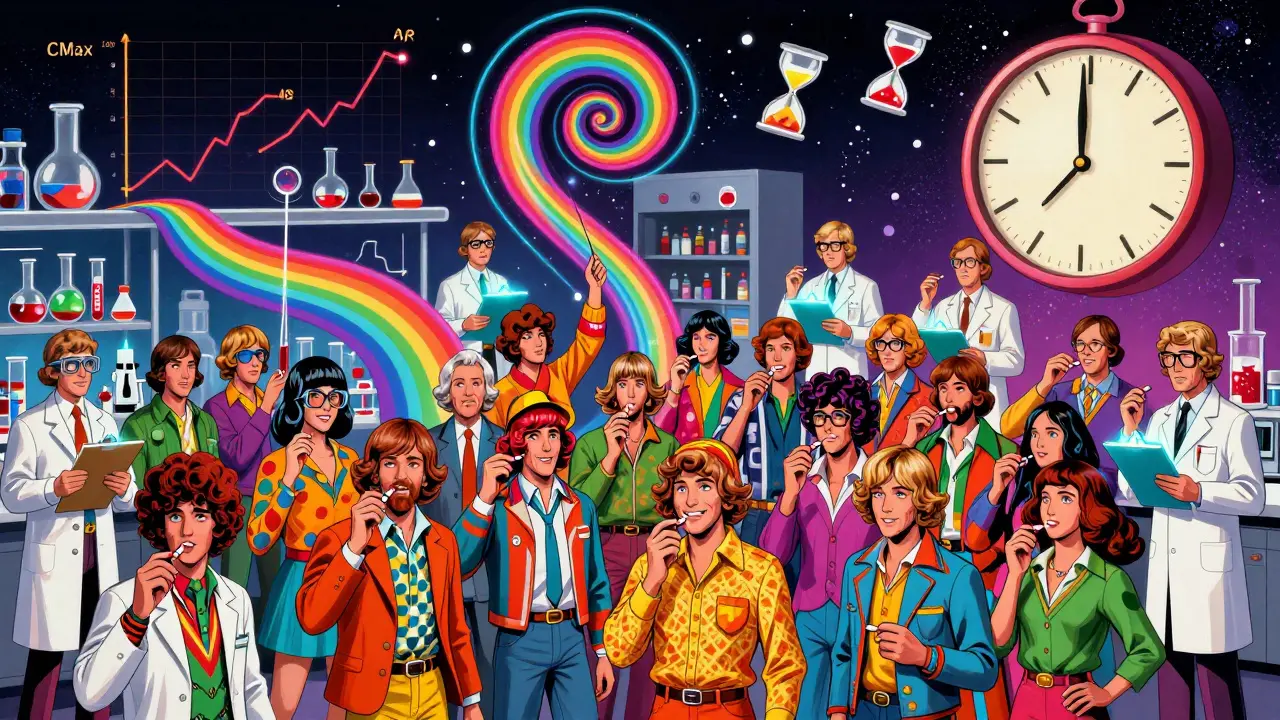
After each dose, blood samples are taken at specific times. You can’t just grab one sample and call it a day. You need a full picture of how the drug moves through the body. The standard requires at least seven time points: before dosing (zero), one point before the peak concentration (Cmax), two points around the peak, and three during the elimination phase. Sampling continues until the area under the curve (AUC) captures at least 80% of the total exposure (AUC∞). That usually means collecting samples for 3 to 5 half-lives. The blood is processed into plasma or serum, then analyzed using validated methods-most often liquid chromatography with tandem mass spectrometry (LC-MS/MS). These methods must be precise: results within ±15% of the true value, or ±20% at very low concentrations. If the lab’s method isn’t properly validated, the whole study can be rejected. One white paper found that 22% of bioequivalence studies face delays because of analytical issues, costing an average of $187,000 per delay.The Key Numbers: Cmax and AUC
Two metrics matter most: Cmax and AUC. Cmax is the highest concentration of the drug in the blood. AUC (area under the curve) measures total exposure over time. Think of Cmax as how fast the drug hits, and AUC as how much it delivers overall. Both must be measured for every subject after each dose. The data is then transformed using logarithms to normalize the distribution. Statistical analysis uses ANOVA (analysis of variance) to compare the test and reference products. The result? A 90% confidence interval for the geometric mean ratio of test to reference. For most drugs, this interval must fall between 80.00% and 125.00% for both Cmax and AUC. That means the generic’s exposure can’t be more than 25% higher or 20% lower than the brand. If it’s outside that range, the drug is not approved.
Special Cases: Highly Variable and Narrow Therapeutic Index Drugs
Not all drugs are created equal. Some, like warfarin or digoxin, have a narrow therapeutic index-meaning tiny differences in blood levels can cause toxicity or lack of effect. For these, the acceptance range tightens to 90.00%-111.11%. Other drugs, like certain antiepileptics or statins, show high variability between people. For those, regulators allow different approaches. The EMA requires replicate crossover designs (four periods, multiple doses) with 50-100 subjects. The FDA may use reference-scaled average bioequivalence, which adjusts the acceptance range based on how variable the reference drug is. These methods prevent overly strict standards from blocking good generics.Dissolution Testing: The In Vitro Backup
Even before human studies, the drug’s physical behavior is tested. Dissolution testing compares how quickly the generic and brand dissolve in lab conditions mimicking the stomach and intestines (pH 1.2 to 6.8). At least 12 units of each product are tested. The similarity between the two dissolution profiles is measured using the f2 factor. If f2 is above 50, the profiles are considered similar. For some simple drugs-those classified as BCS Class I (highly soluble and highly permeable)-this test alone can qualify for a waiver, meaning no human study is needed. In 2022, 27% of approved generics used this biowaiver path.What Happens If It Fails?
Failure isn’t rare. Pilot studies help avoid it. Experts like Dr. Jennifer Bright (former FDA Office of Generic Drugs director) say pilot studies reduce failure rates from 35% to under 10%. A pilot study is a small-scale version of the main trial. It helps fine-tune sampling times, confirm washout periods, and check if the analytical method works. One Reddit user shared how underestimating a 72-hour half-life led to a $250,000 redo and a three-month delay. Common reasons for rejection include poor sampling schedules, statistical errors, or inconsistent Cmax values. Alembic Pharmaceuticals’ 2022 rejection of a generic version of Trulicity (dulaglutide) was due to inconsistent peak concentrations across multiple studies. On the flip side, Teva got Januvio approved in one successful study with just 36 subjects because their design was flawless.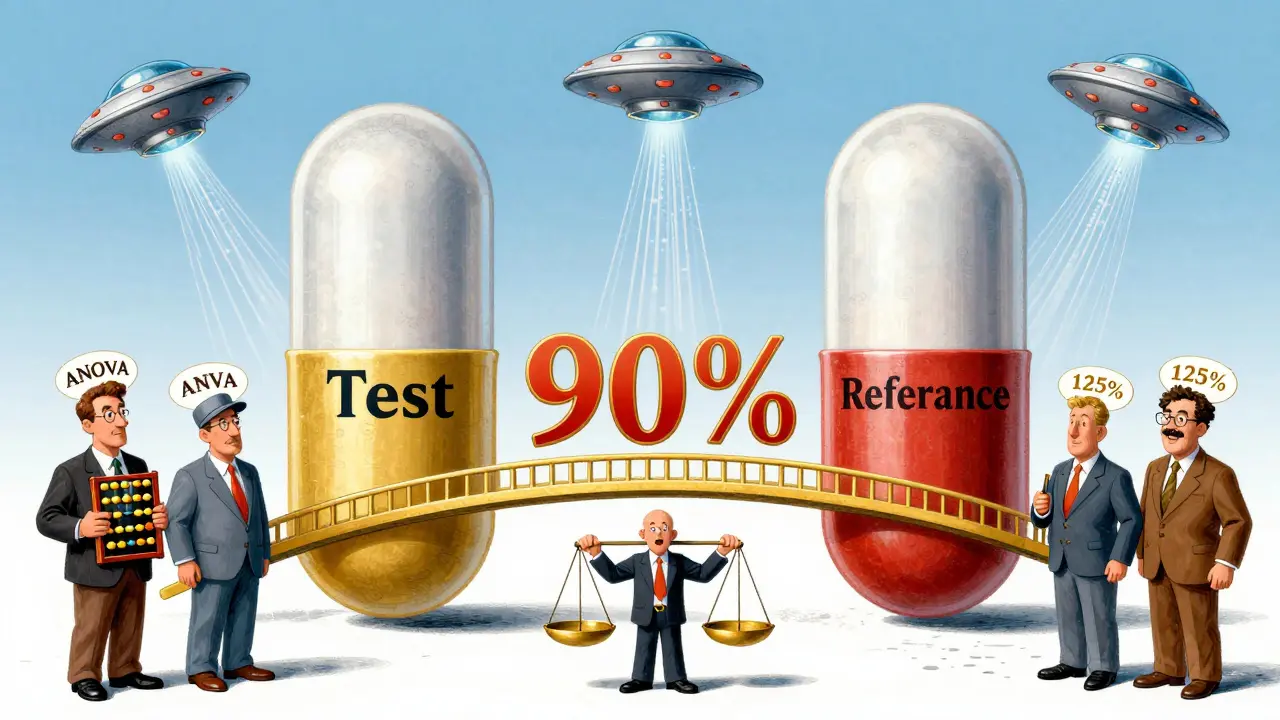
Joy Nickles
December 31, 2025okay so i just read this and i’m like… why does it take 10 months to approve a generic?? i mean, like… it’s the same damn pill?? and the lab stuff?? LC-MS/MS?? i don’t even know what that is but it sounds like a spaceship engine??
Emma Hooper
January 2, 2026love this breakdown!! it’s wild how much science is hiding behind that $5 bottle of ibuprofen. i used to think generics were just ‘close enough’-turns out they’re basically clones with a PhD in pharmacokinetics. the 80-125% range? genius. it’s like saying ‘you can be 20% taller or 25% shorter than your twin and still be identical.’ mind blown 🤯
Harriet Hollingsworth
January 4, 2026This is exactly why we need to stop trusting big pharma. They let these CROs run studies with underpaid volunteers and call it ‘science.’ The FDA approves this nonsense and then acts like it’s a miracle. People are dying because of inconsistent Cmax values and no one’s问责!
Deepika D
January 5, 2026As someone from India where generics save lives daily, this article made me tear up a little. We have millions who rely on these studies to get their heart meds, diabetes drugs, even HIV treatments at prices they can afford. The dissolution testing? The washout periods? The f2 factor? These aren’t just numbers-they’re lifelines. And yes, the 80-125% range is science, not guesswork. It’s based on decades of clinical outcomes. When people say ‘generic = bad,’ they’re not just wrong-they’re dangerous. Let’s celebrate the quiet heroes: the bioanalytical scientists, the CRO staff, the volunteers who give blood for $50 a day so you can pay $3 for your statin. 🙏
Chandreson Chandreas
January 5, 2026bioequivalence is basically the universe’s way of saying ‘trust the math, not the brand.’ 🧮💊
we’re all just molecules floating in a sea of chemistry, and somehow, we built a system that says: ‘if your curve looks like theirs, you’re family.’ beautiful, really.
Darren Pearson
January 6, 2026While the article is commendably detailed, it lacks critical context regarding the ethical implications of using healthy volunteers as pharmacokinetic proxies. The practice, though legally sanctioned, commodifies human physiology in a manner inconsistent with the Hippocratic Oath. Furthermore, the reliance on CROs introduces a profound conflict of interest-firms incentivized to produce favorable outcomes rather than scientific truth. One must question whether the $1.68 trillion in savings justifies the erosion of clinical integrity.
Stewart Smith
January 7, 2026so let me get this straight… we spend $187k because a lab’s LC-MS/MS was off by 16%? and we call this ‘science’? 🤡
also, 36 subjects and it’s approved? i’d trust that more than my ex’s ‘i’m fine’ text.
Retha Dungga
January 9, 2026life is just a curve man… AUC… Cmax… we’re all just trying to find our peak before we fade out 🌅
maybe the real generic is our souls… same ingredients… different packaging
Urvi Patel
January 10, 2026Who even needs brand names? If the math says it’s the same then it’s the same. Why do Americans pay $200 for a drug that costs $3 here? You’re being robbed. This system is rigged for profit. The FDA is a puppet. Wake up.
anggit marga
January 12, 2026Why is everyone acting like this is some American innovation? We’ve been doing this in Nigeria since the 90s with local labs and zero funding. You think LC-MS/MS is magic? We use UV spectrophotometers and prayer. Your ‘rigorous standards’ are just colonial leftovers. We make generics that work better than your brand-name crap.
Marilyn Ferrera
January 12, 202680-125% isn’t arbitrary-it’s based on clinical equivalence thresholds validated across 30+ years. The washout period? Non-negotiable. The f2 factor? Critical. This isn’t guesswork. It’s precision.
Bennett Ryynanen
January 13, 2026yo i just read this and i’m like… these people are basically doing drug yoga. they sit there, take pills, get poked, and then math makes it all equal. i’m so proud of science. also… if i take my generic at 8am vs 8pm… does the curve still look the same? 🤔