
27 Mar 2026
- 10 Comments
FDA Black Box Warning Navigator
Understand Your Medication Risks
Select a medication category from our database to see the specific safety alert and generated discussion points.
Required Action:
Discussion Guide for Your Doctor
Use these questions (based on the STEPS framework) during your consultation.
What You See on the Label Matters
When you pick up a new prescription, the packaging includes more than just a name and dosage. Sometimes, there is a bold black border around a specific section of the text. This isn't just design; it signals that FDA Black Box Warnings represent the most serious safety advisory mandated by regulators. These alerts tell you immediately that a medication carries risks severe enough to cause death or serious harm.
You might wonder why a drug gets this distinction. It usually means the benefits still outweigh the risks for many people, but the danger is significant enough that you need special monitoring or strict usage rules. As of recent years, over 400 medications carry these warnings. That is a lot of drugs in circulation with high-risk profiles. Understanding this system helps you talk to your doctor about whether a specific treatment is right for you.
The Hierarchy of Drug Safety Alerts
Not every side effect gets equal space on a label. There are milder warnings listed under "Side Effects" or "Precautions." However, a boxed warning sits at the top of the safety pyramid. The U.S. Food and Drug Administration, often called the FDA, established this standard to ensure visibility. According to regulations like 21 CFR 201.56, these warnings must appear near the beginning of the package insert, enclosed in a distinct black border.
This formatting isn't arbitrary. It forces prescribers and patients to acknowledge the risk before starting therapy. Unlike minor side effects like drowsiness or dry mouth, risks listed here could involve organ failure, suicide risk, birth defects, or severe heart issues. The presence of a box changes the conversation from "are there any side effects?" to "is this risk acceptable for my specific health profile?"
Key Characteristics of Boxed Warnings:
- Placement: Always located at the start of the prescribing information.
- Visual: Surrounded by a solid black border for contrast.
- Severity: Reserved for life-threatening injuries or permanent harm.
- Audience: Targets both healthcare providers and patients directly.
How the FDA Decides to Add a Warning
Most people assume safety testing happens only before a drug hits the shelves. While clinical trials test effectiveness and basic safety, rare or long-term dangers often show up only after millions of people take the medicine. The FDA monitors this through a system called post-marketing surveillance. When patterns emerge suggesting a drug causes serious harm more often than expected, agency officials review the evidence.
They look at reports filed through the MedWatch program. Consumers and doctors submit these reports voluntarily. If the FDA sees a spike in severe events linked to a specific drug, they may mandate a boxed warning. For example, if a diabetes medication suddenly showed higher rates of heart attacks in patients compared to those taking placebo, the agency would step in. The goal isn't necessarily to ban the drug immediately but to manage the known danger.
Real-World Examples and Their Impact
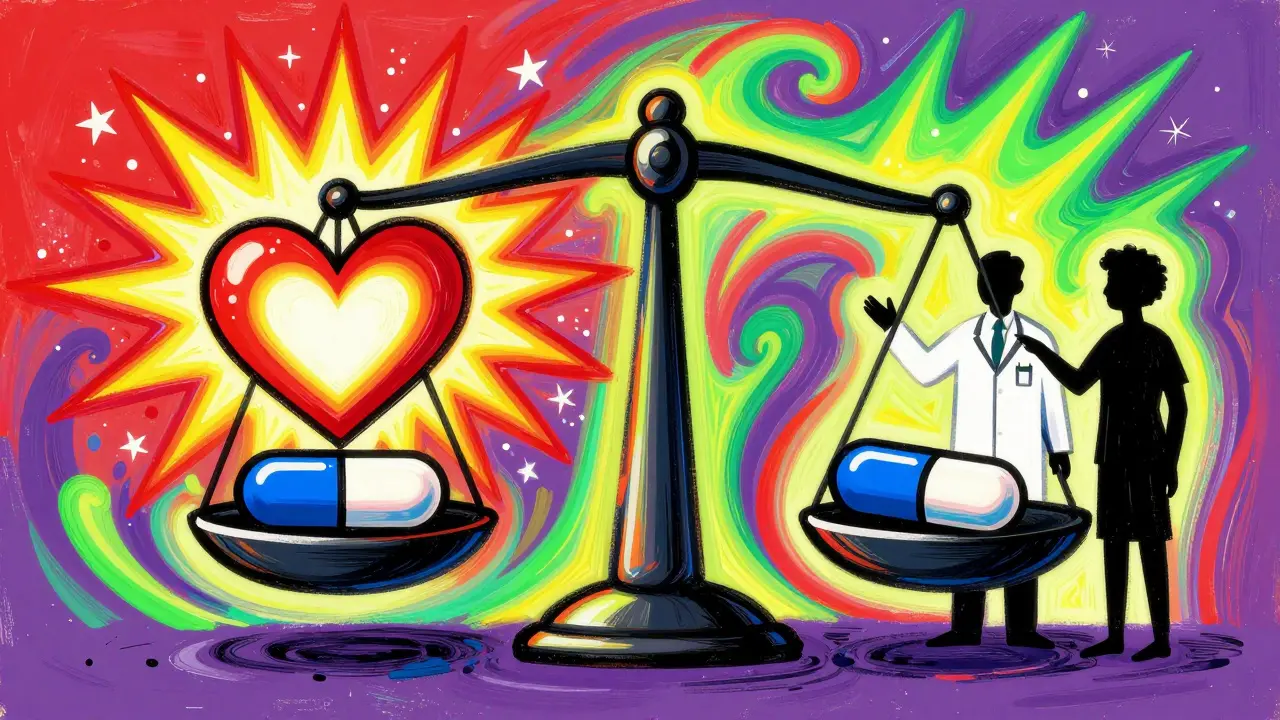
Abstract concepts become clearer when you look at specific medicines. A famous case involves rosiglitazone, sold under the brand name Avandia. Years after approval, studies suggested an increased risk of heart problems. Once the FDA placed a black box warning on Avandia, prescription rates dropped sharply-by roughly 70% according to some analyses. Yet, millions of patients continued using it because no perfect alternative existed for their condition.
| Medication Class | Typical Risk Highlighted | Monitoring Requirement |
|---|---|---|
| Clozapine | Agranulocytosis (severe blood cell drop) | Weekly blood counts initially |
| Statins | Muscle damage (Rhabdomyolysis) | Report symptoms immediately |
| Sulfonamides | Severe skin reactions | Discontinue at first sign of rash |
| Tylenol (Acetaminophen) | Liver failure at high doses | Limit daily intake strictly |
Notice how the warnings vary. Some require lab tests (like blood counts), while others just need vigilance (stopping if a rash appears). The FDA updates these lists continuously. In 2021, new guidance required even stricter placement within the electronic label to make sure computer systems flag the warning automatically when a doctor orders the drug.
Navigating Treatment Decisions Safely
If your doctor prescribes a drug with a black box warning, panic is rarely the answer. Many of these medicines treat life-saving conditions where no safer option exists. Experts recommend using a framework called STEPS: Safety, Tolerability, Effectiveness, Price, and Simplicity. Before agreeing to treatment, ask your provider:
- Why is this specific drug necessary?
- Are there alternatives without the boxed warning?
- What signs of trouble should I watch for?
- How often do we need to check labs or vitals?
For certain high-risk drugs, the FDA goes beyond a simple warning. They implement Risk Evaluation and Mitigation Strategies, known as REMS. This adds extra layers of control. Sometimes, a pharmacy cannot even dispense the drug unless the doctor certifies they know how to handle it, or unless you enroll in a specific patient registry. This ensures everyone involved understands the gravity of the situation.

Looking Ahead: The Future of Safety Alerts
The way we track drug safety is changing fast. In its strategic plan for 2023-2027, the FDA identified improving drug labeling as a top priority. One big shift involves pharmacogenomics-the study of how your genetics affect drug response. Instead of a blanket warning for everyone, future labels might warn only patients with specific genetic markers. This precision prevents healthy people from avoiding effective treatments unnecessarily.
Digital health records are also playing a bigger role. The Sentinel Initiative now scans data from hundreds of millions of Americans electronically. This allows regulators to spot risks much faster than waiting for voluntary paper reports. By mid-2026, many systems aim to provide dynamic risk information tailored to individual patient characteristics right at the point of prescribing.
Your Role in Monitoring Your Health
Even with advanced monitoring systems, you are the most important observer. You live with your body day-to-day. If you notice unusual symptoms after starting a new medication, report them. The FDA receives approximately 200,000 consumer reports annually. These individual stories often form the pattern that triggers a new safety investigation.
You have rights too. Physicians must review the risks and benefits of these medications with you. It is okay to ask for the patient information leaflet. If a warning seems vague, ask the pharmacist to explain what it means for your specific health history. Being informed protects you better than hoping the warning applies to someone else.
Does a black box warning mean I shouldn't take the drug?
Not necessarily. Doctors prescribe these drugs when the potential benefit outweighs the risk for your specific condition. The warning highlights serious dangers so you can manage them carefully rather than avoiding the medication entirely.
How often does the FDA update these warnings?
There is no fixed schedule. Updates happen when new data emerges from clinical studies or post-marketing surveillance showing significant risks. The agency reviews safety signals continuously throughout the year.
Can I see the warning on the physical pill bottle?
Usually, the full warning appears in the package insert (the detailed leaflet inside the box). The bottle itself often carries a summary label. Always read the full information provided by your pharmacist.
What happens if a drug gets a new warning?
Prescription rates often drop as doctors reconsider use. Sales figures typically decline by 25 to 40 percent in the first year following a new warning, though some patients continue if no alternatives exist.
Where can I find a list of all drugs with black box warnings?
The FDA provides a searchable database on its official Drugs@FDA website. Independent organizations like Consumer Reports Best Buy Drugs also maintain updated lists for public reference.
Monique Ball
March 28, 2026It is absolutely crucial! People really need to read those boxes! You can ignore minor side effects sometimes. But these black box warnings change everything. Your safety depends on understanding this data fully; it matters! Doctors often rush through this part. We must advocate for ourselves in clinic visits. The FDA does not always tell us enough upfront! Post-marketing surveillance catches hidden dangers eventually. However, patients get hurt before those studies finish. I want everyone to know their rights clearly! Reading the patient leaflet is non-negotiable for me. You deserve to know the risks completely. Never hesitate to ask your pharmacist for details. Safety always comes first in my book! 🙏💊
Tommy Nguyen
March 29, 2026This information helps everyone stay safe out there :)
gina macabuhay
March 30, 2026You sound like you enjoy lecturing strangers online excessively. Many people manage their health without reading every single paragraph available. Some individuals simply trust their physicians implicitly without questioning authority constantly. This culture of fear is unnecessary when treatment plans exist. Nobody wants panic mongering disguised as helpful advice frankly.
Richard Kubíček
April 1, 2026Trust is vital yet knowledge empowers choice significantly. Fear can be a tool or a barrier depending on perspective entirely. Perhaps balance lies in acknowledging danger while maintaining hope realistically. We navigate life through uncertainty always after all.
Philip Wynkoop
April 3, 2026Good info here guys thanks for sharing it all out there
i appreciate the breakdown of the labels specifically
Debra Brigman
April 5, 2026The symphony of pharmacology plays in our veins daily. Warning labels serve as cautionary whispers in a cacophonous marketplace of cures. We dance with fire when we consume synthetic compounds recklessly. Awareness illuminates the path toward holistic well-being uniquely.
Sarah Klingenberg
April 5, 2026That's a beautiful way to put the situation honestly. We all take meds sometimes for necessary reasons though. Just good to keep eyes open always 😊
Devon Riley
April 5, 2026I totally agree with your perspective on being observant. Taking charge of your own health journey feels empowering too. Keep shining bright on that wellness path 💪✨
Austin Oguche
April 7, 2026Regulatory compliance ensures public safety standards remain high globally. Information dissemination aids proper utilization of therapeutic agents effectively. Patient education remains paramount in modern medicine protocols
Monique Louise Hill
April 7, 2026Standards do not matter if patients ignore the facts provided. Responsibility falls on individuals ultimately 🤷♀️ You cannot shift blame easily.