
15 Jan 2026
- 10 Comments
Every year, hundreds of thousands of patients in the U.S. and Australia are harmed because their medication list gets lost, mixed up, or forgotten when they move from hospital to home, or from one doctor to another. These aren’t rare mistakes-they’re predictable, preventable, and happening far too often. In fact, medication reconciliation is the single most effective way to stop these errors before they hurt someone. Yet, only about 42% of hospitals do it well. If you’re a patient, a caregiver, or a healthcare worker, you need to know how this works-and how to make it work for you.
What Is Medication Reconciliation, and Why Does It Matter?
Medication reconciliation isn’t just checking a list. It’s a full process: getting the most accurate picture of what a patient is really taking, comparing it to what the care team thinks they’re taking, and fixing any mismatches. This happens at every handoff-admission, transfer between units, and especially discharge. Think about it: a 72-year-old woman with high blood pressure, diabetes, and atrial fibrillation comes into the hospital after falling. She’s on warfarin, metformin, lisinopril, and a daily aspirin. But when the nurse asks her what she takes, she says, “I take my pills in the morning.” She doesn’t remember names or doses. The doctor orders a new blood thinner because they don’t know she’s already on warfarin. That’s how a bleeding emergency starts. The Joint Commission has required medication reconciliation since 2005. The World Health Organization made it a top priority in their Medication Without Harm campaign. And the data backs it up: hospitals that do this right see 57% fewer medication errors after discharge and 38% fewer readmissions within 30 days.The Four Steps That Actually Work
There’s no magic tool or app that fixes this alone. It’s a process with four non-negotiable steps:- Get the best possible medication history-not from memory, not from a printout from last year. Talk to the patient, their family, their pharmacist, their GP. Call the community pharmacy. Check the state prescription drug monitoring program if available.
- Create the list of medications to be prescribed-this is what the hospital team plans to give during the stay and at discharge. Don’t assume. Write it down.
- Compare the two lists-side by side. Look for omissions, duplications, wrong doses, drug interactions. Is the patient still on a statin they stopped six months ago? Is there a new blood pressure pill that clashes with their kidney meds?
- Make clinical decisions and communicate them-if a medication is stopped, why? If a new one is added, explain it clearly. Document everything. Hand it off in writing and verbally.
Technology Helps-But Only If It’s Done Right
EHRs, CPOE systems, barcode scanning-they sound like the answer. And in some ways, they are. Studies show these tools can cut medication errors by nearly half in acute settings. But here’s the catch: when hospitals roll out new EHRs without training or workflow changes, medication discrepancies go up by 18% in the first six months. Why? Because the system doesn’t ask the right questions. It auto-populates old meds. It doesn’t flag a duplicate dose of metformin because the patient’s primary care doctor changed the dose two weeks ago. It doesn’t know that the patient stopped taking their diuretic because they couldn’t afford it. Barcodes help with administration, but they don’t fix the list. AI tools like MedWise Transition, cleared by the FDA in August 2024, are promising-they reduced discrepancies by 41% in a 12-hospital pilot. But they’re only as good as the data they’re fed. The real win? Combining tech with human judgment. A pharmacist who knows how to dig into a patient’s history, who can call a pharmacy and say, “I need to verify this list,” and who has the time to do it-that’s the gold standard.
Why Discharge Is the Most Dangerous Moment
Most medication errors happen when patients leave the hospital. Why? Because that’s when the handoff breaks down. The patient gets a discharge summary with a new list. But they don’t understand it. Their primary care doctor never gets it. Their pharmacy doesn’t have the updated list. The family doesn’t know what changed. One study found that 78% of transition errors come from communication gaps between providers. Another showed that only 28% of facilities consistently involve patients in reconciling their meds. And 72% of patients don’t even know why the list matters. Here’s what works:- Have a pharmacist meet with the patient before discharge. Not just hand them a paper. Sit down. Ask them to read the list back. Show them the pills. Use pictures if needed.
- Send the updated list to the patient’s primary care provider and pharmacy electronically-and follow up to confirm receipt.
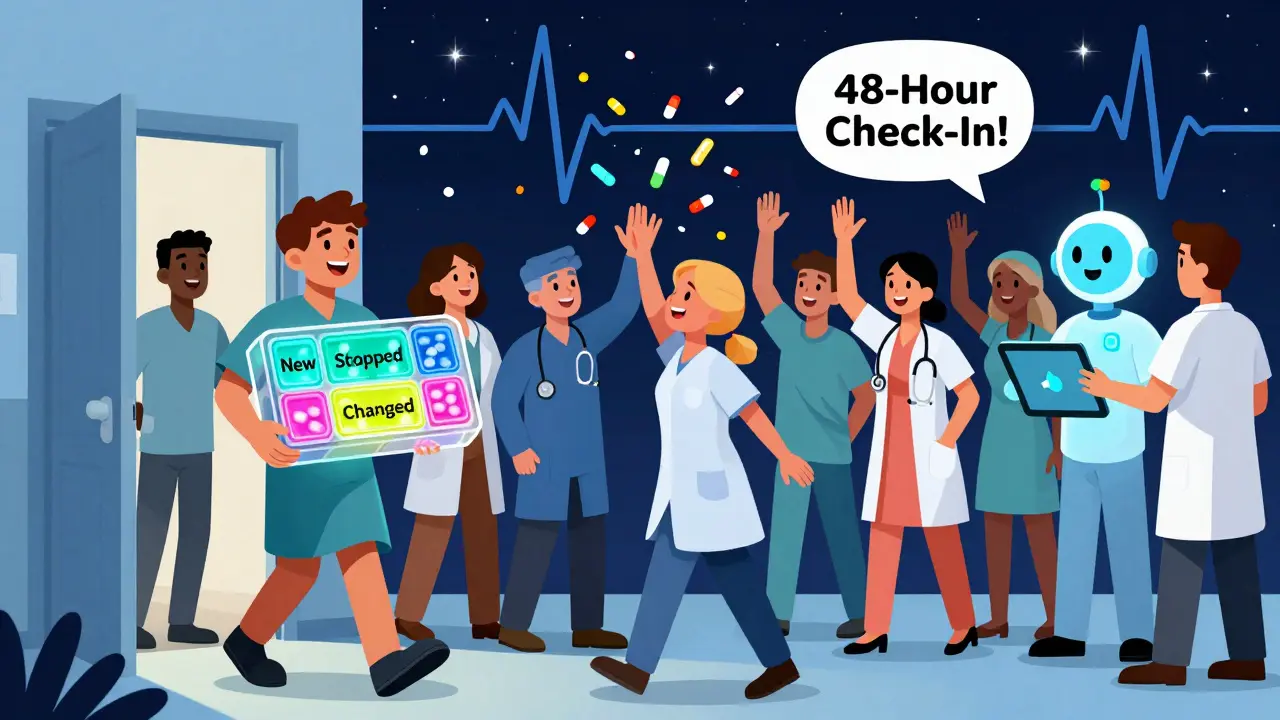
- Give the patient a printed copy with clear labels: “New,” “Stopped,” “Changed.”
- Call the patient 48 hours after discharge. Ask: “Are you taking all your meds as instructed? Any side effects?”
What Gets in the Way?
You’d think everyone agrees this is important. But here’s the reality:- Time-Doctors and nurses are overwhelmed. Reconciling meds takes 15-20 minutes per patient. Most hospitals give them 8-10. So they cut corners.
- Resistance-63% of hospitals report physician pushback. “I don’t have time to do this.” “The nurse should handle it.” “We’ve always done it this way.”
- Fragmented systems-Only 37% of U.S. hospitals can electronically share medication data with community pharmacies. That means pharmacists are still calling 10 different clinics just to get a list.
- Unclear roles-The MARQUIS study found that when staff were trained to take med histories but no one was assigned responsibility, harmful errors went up by 15%.
What’s Changing in 2025 and Beyond
The rules are tightening. The 2025 National Patient Safety Goals require verifying high-risk medications with at least two sources. The WHO’s Phase 2 of Medication Without Harm sets a target to cut harm in high-risk transitions by 30% by 2027. CMS is increasing penalties for hospitals with high readmission rates linked to medication errors. In Australia, the Safety and Quality Health Care Commission already requires reconciliation at every transition point. In Europe, the iPRI framework is doing the same. New tools are coming. AI assistants that flag interactions in real time. Apps that let patients upload their own med lists from home. Pharmacy-led discharge programs that follow patients for 30 days. But the biggest change? It’s cultural. Medication reconciliation isn’t an add-on. It’s core to safe care.What You Can Do-Whether You’re a Patient or a Provider
If you’re a patient or caregiver:- Keep your own list-meds, doses, times, reasons. Update it every time something changes.
- Bring it to every appointment. Don’t wait to be asked.
- Ask: “What changed? Why? What should I stop?”
- Call your pharmacy and ask them to confirm your list.
- If you’re discharged, make sure you get a written list and someone explains it to you.
- Start with the MATCH toolkit. Don’t just install an EHR module-change how you work.
- Assign a medication reconciliation lead. Usually a pharmacist.
- Build in time. Protect 15 minutes per patient. No exceptions.
- Connect with community pharmacies. Don’t assume they have your info.
- Train your team. Not just once. Every six months. Use real cases.
Final Thought: This Isn’t About Paperwork. It’s About Trust.
Medication errors during transitions don’t just cost money. They cost trust. A patient who gets sicker because their meds weren’t reviewed doesn’t just lose health-they lose faith in the system. But when it works? When a pharmacist catches a dangerous interaction before discharge, when a patient walks out knowing exactly what to take and why-that’s when care becomes safe. That’s when healing can actually happen. It’s not complicated. It just takes commitment. And time. And the courage to do it right-even when it’s hard.What is medication reconciliation and why is it important during discharge?
Medication reconciliation is the process of creating the most accurate list possible of a patient’s current medications and comparing it to new orders at each care transition-especially discharge. It’s critical because up to 60% of medication errors happen during these handoffs. Without reconciliation, patients can be discharged with duplicate drugs, missing medications, or dangerous interactions, leading to preventable hospital readmissions and serious harm.
Who is responsible for medication reconciliation in a hospital?
While everyone plays a role, the most effective programs assign responsibility to a pharmacist. Pharmacists have the training to identify drug interactions, dosing errors, and duplications. Nurses and physicians contribute by gathering patient history and reviewing orders, but the pharmacist leads the comparison and decision-making. Studies show hospitals with dedicated transition pharmacists reduce adverse drug events by 53%.
Can electronic health records (EHRs) prevent medication errors?
EHRs can help-when used correctly. Systems with clinical decision support and barcode scanning reduce errors by up to 48%. But if the system auto-fills old data without verification, it can increase discrepancies by 18% during rollout. The key isn’t the technology-it’s how it’s used. EHRs work best when paired with trained staff who verify information with patients and community providers.
Why do patients often not understand their discharge medication list?
Most discharge lists are written for clinicians, not patients. They use medical terms, lack context, and aren’t explained verbally. A 2024 Kaiser Family Foundation survey found 72% of patients don’t understand why the list matters. The fix? Use plain language, show the actual pills, ask the patient to repeat the instructions, and give them a printed copy with clear labels like “New,” “Stopped,” or “Changed.”
What’s the biggest barrier to preventing medication errors during transitions?
The biggest barrier is fragmented communication. Only 37% of U.S. hospitals can electronically share medication data with community pharmacies. That means staff waste hours calling clinics and pharmacies just to get a complete list. Without reliable information from outside providers, even the best reconciliation process is built on incomplete data.
How long does it take to implement a successful medication reconciliation program?
It typically takes 6 to 9 months to fully implement a program that works. The AHRQ MATCH toolkit recommends a 12-step process that includes staff training, workflow redesign, system integration, and ongoing evaluation. Quick fixes-like just turning on an EHR module-don’t work. Success requires changing how teams work together, not just adding technology.
Sarah Mailloux
January 16, 2026I work in ER and this is the #1 reason people come back within a week. Someone forgets to tell us they stopped their blood thinner last month because it made them dizzy. We give it to them again. Boom. Bleeding. No magic fix. Just talk to the patient. Listen. Simple.
Amy Ehinger
January 17, 2026I had my mom discharged last year and honestly it felt like they handed her a napkin with scribbles on it and said 'good luck'. She didn't know why half the pills were new or why some were gone. Took me three days to call her PCP, her pharmacy, and her old cardiologist to piece together what actually changed. And we're educated. Imagine someone who doesn't speak English well or has dementia. This isn't just a process-it's a lifeline.
Crystel Ann
January 17, 2026The part about pharmacists being the ones to lead reconciliation really hit home. My aunt’s hospital had a transition pharmacist who sat with her for 20 minutes, showed her each pill, and even drew little pictures of when to take them. She didn’t get readmitted. That’s the kind of care that doesn’t show up in stats-it shows up in people’s lives.
Haley Graves
January 18, 2026Stop treating this like a checklist. It’s not about ticking boxes in an EHR. It’s about protecting human beings. If your hospital is still letting nurses scramble to get med lists while they’re short-staffed and overworked, you’re not just cutting corners-you’re gambling with lives. Assign the pharmacist. Give them time. No excuses.
ellen adamina
January 19, 2026I’m curious-how many of those 57% fewer errors are actually from catching duplicate prescriptions versus missed ones? Because I’ve seen both happen, but the duplicates are way harder to spot when the patient says they take 'the blue pill' and the system has it listed as 'lisinopril 10mg' from 2021
Gloria Montero Puertas
January 20, 2026This whole 'medication reconciliation' movement is just another bureaucratic overreach disguised as patient safety. We used to trust doctors. Now we have flowcharts, checklists, and pharmacists playing detective because we’ve turned healthcare into a liability minefield. People used to just take their pills. Now we need a PowerPoint presentation just to leave the hospital.
Tom Doan
January 20, 2026Funny how they tout AI tools like MedWise Transition as the future, but the entire system still relies on a nurse calling a pharmacy at 3 PM on a Friday because the EHR auto-filled the wrong dose. Technology doesn't fix culture. People do. And right now, our culture is to move fast and break things-except when it’s a patient’s life.
Sohan Jindal
January 22, 2026This is why America is falling apart. We got a guy in a lab coat telling grandma what pills to take while the government pays for it. Meanwhile, real Americans are getting kicked out of hospitals because they can't afford their meds. Why not just give people the meds and shut up? Why all the paperwork? This is socialism with a stethoscope.
Frank Geurts
January 22, 2026In the Netherlands, we have a national electronic medication record accessible to all authorized providers, pharmacies, and patients via a secure portal. Every change is timestamped, verified, and auto-notified. We’ve reduced transition errors by 71% since 2018. The infrastructure exists. The will is the only thing missing. It is not a technological challenge. It is a governance imperative.
Mike Berrange
January 22, 2026I'm sorry, but I have to say this: the fact that we need a 159-step toolkit to stop people from dying because someone didn't ask what meds they're on says everything about how broken this system is. And yet, nobody gets fired for it. No one gets sued. No one even gets a slap on the wrist. It's just another silent epidemic.