
10 Dec 2025
- 15 Comments
Geriatric Medication Safety Checker
Check if a medication is potentially inappropriate for older adults according to the Beers Criteria - the gold standard for safe prescribing in geriatrics. Enter a medication name to see if it's listed as potentially inappropriate and what safer alternatives might exist.
Every year, over 1.3 million older adults in the U.S. end up in the hospital because of dangerous drug reactions. Most of these cases aren’t accidents-they’re preventable. The problem isn’t that doctors are careless. It’s that the body changes with age, and many medications prescribed for younger patients become risky-or even deadly-for seniors. This isn’t theoretical. It’s happening in emergency rooms, nursing homes, and living rooms across the country. The solution isn’t just stopping bad drugs. It’s replacing them with smarter, safer options-and doing it in a way that respects the person behind the prescription.
Why Older Adults Are at Higher Risk
As we age, our bodies don’t process drugs the same way. The liver slows down. The kidneys filter less efficiently. Fat increases, muscle mass decreases. That means a drug that was safe at 50 can build up to toxic levels by 75. Even a standard dose of a common painkiller or sleep aid can cause confusion, falls, or internal bleeding in someone over 65.And it’s not just one drug. Most older adults take five or more medications daily. This is called polypharmacy. It’s not always avoidable-managing diabetes, heart disease, arthritis, and depression often requires multiple drugs. But when those drugs interact, or when one drug masks the side effects of another, the risks multiply. A 2025 JAMA Network Open review found that seniors prescribed just one potentially inappropriate medication (PIM) were 26% more likely to suffer a serious drug reaction. With two or more PIMs, that risk jumps to over 50%.
The Beers Criteria: The Gold Standard for Safe Prescribing
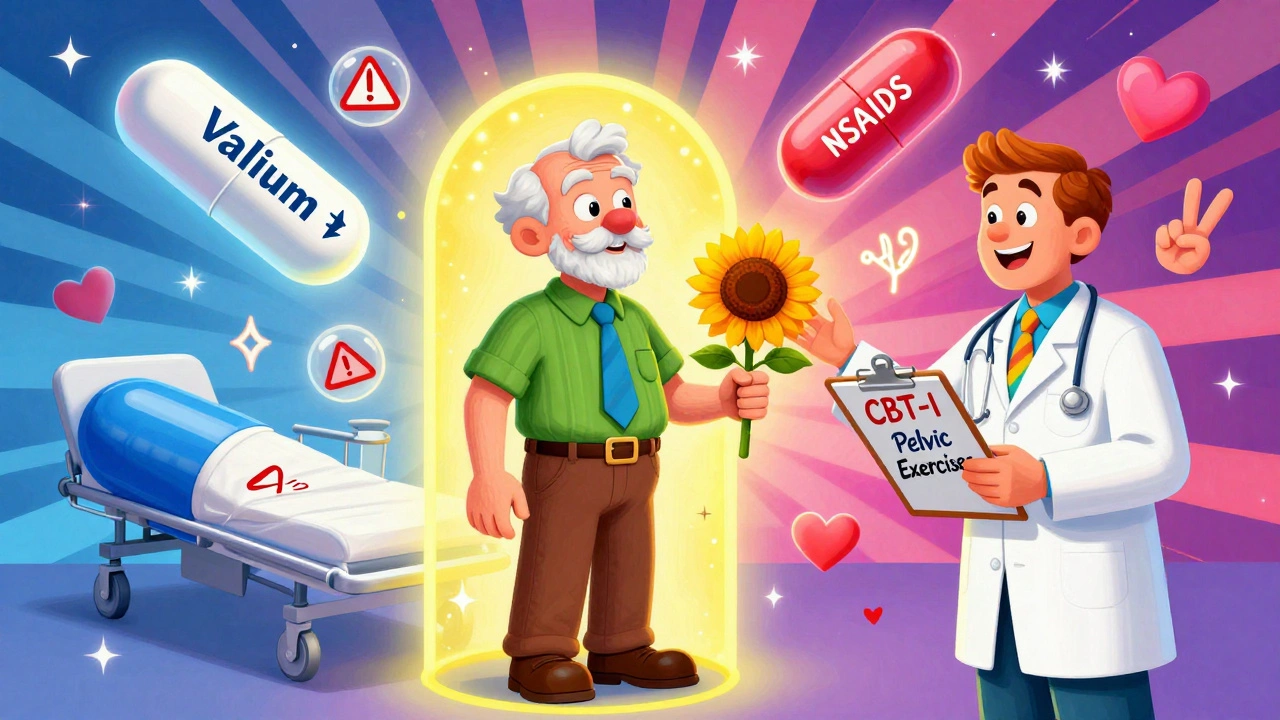
Since 1991, the American Geriatrics Society (AGS) has published the Beers Criteria®-a living list of medications that should be avoided or used with extreme caution in older adults. The latest version, released in 2023, identified 139 drugs or drug classes as potentially inappropriate. These aren’t random picks. Each was backed by clinical studies showing clear harm in older populations.Some examples? Benzodiazepines like diazepam (Valium) and lorazepam (Ativan). These are often prescribed for anxiety or insomnia, but they cause dizziness, memory loss, and increase fall risk by up to 60%. Anticholinergics like diphenhydramine (Benadryl) and oxybutynin (Ditropan) are linked to confusion and dementia-like symptoms. Even common NSAIDs like indomethacin and ketorolac can cause kidney failure or stomach bleeding in seniors.
The 2023 update added tramadol, a painkiller many assume is safe because it’s not an opioid. But tramadol can trigger dangerously low sodium levels (hyponatremia), especially when taken with antidepressants or diuretics. It also raised the aspirin warning age from 80 to 70-because even low-dose aspirin for heart protection can cause life-threatening bleeding in older adults, particularly men.
What makes the Beers Criteria powerful isn’t just the list-it’s how widely it’s used. Epic’s electronic health record system now flags these drugs in 87% of its geriatric installations. That means when a doctor types in a prescription for a 72-year-old, the system pops up a warning. But here’s the catch: alerts alone aren’t enough. A 2024 Health Affairs study showed that hospitals using Beers Criteria alerts alone reduced dangerous prescriptions by only 18%. When pharmacists joined the team, that number jumped to 35%.
The Missing Piece: What to Use Instead
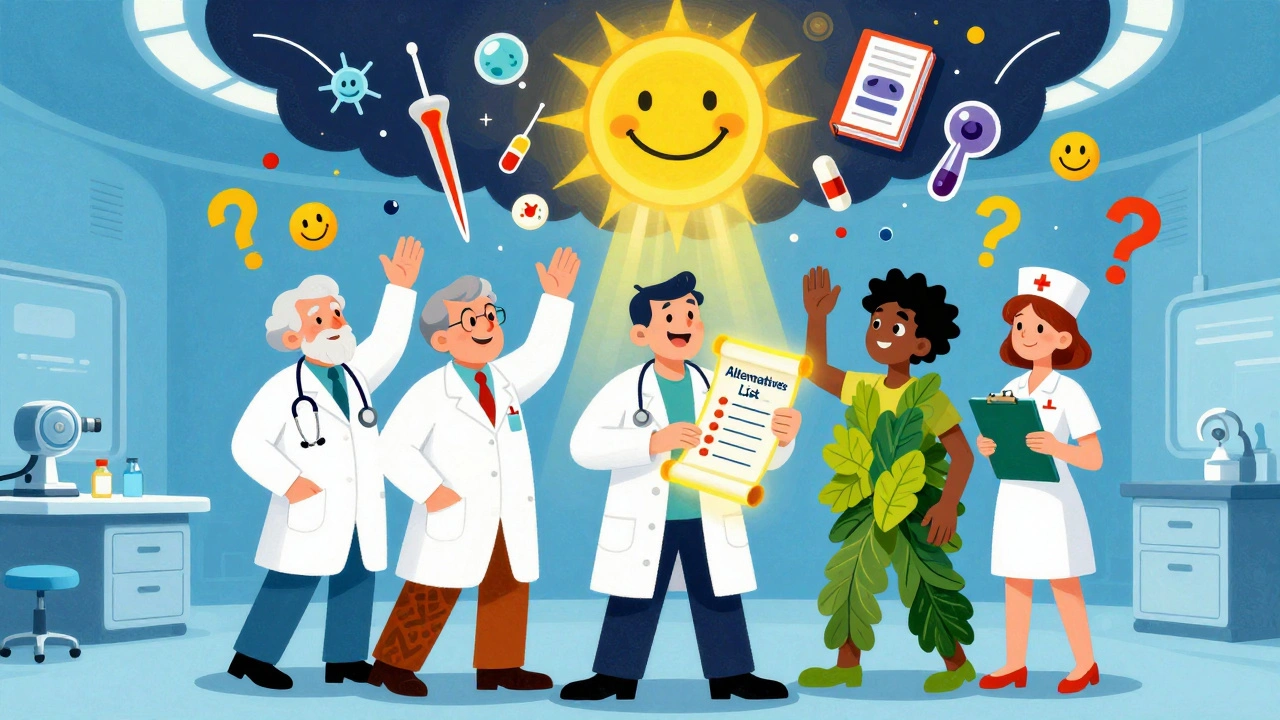
For years, doctors knew what drugs to avoid-but not what to prescribe instead. That’s why, on July 23, 2025, the AGS released something groundbreaking: the Beers Criteria® Alternatives List.This isn’t just a list of safer drugs. It’s a toolkit. For each of the 12 most common PIM categories, it offers 47 evidence-based alternatives. And here’s the key: 38% of those alternatives aren’t drugs at all.
Instead of prescribing a sleeping pill for insomnia, the Alternatives List suggests:
- Behavioral sleep therapy (CBT-I)
- Reducing evening caffeine
- Increasing morning sunlight exposure
- Establishing a consistent bedtime routine
For chronic pain? Replace NSAIDs with:
- Physical therapy
- Acupuncture
- Topical capsaicin or lidocaine patches
- Low-dose gabapentin (used cautiously)
For overactive bladder? Skip oxybutynin and try:
- Bladder training
- Timed voiding
- Weight management
- Pelvic floor exercises
This shift-from just stopping bad drugs to actively replacing them with better options-is what’s making the difference. A 2023 survey of 1,200 primary care doctors found that 68% struggled to find safe alternatives when trying to deprescribe. The Alternatives List gave them a roadmap.

How Emergency Rooms Are Leading the Change
Emergency departments are on the front lines. Seniors come in with falls, confusion, or stomach bleeding-and often, the root cause is a medication they’ve been taking for years. That’s why the Geriatric Emergency Medication Safety Recommendations (GEMS-Rx) were created in March 2024.GEMS-Rx focuses on just eight high-risk drug classes that are most likely to cause harm when prescribed at discharge: antipsychotics, benzodiazepines, anticholinergics, NSAIDs, opioids, certain diabetes drugs, proton pump inhibitors, and anticoagulants. It gives ED teams a simple checklist: Is this drug necessary? Is there a safer alternative? Has the patient been reviewed by a pharmacist?
Results speak for themselves. In a July 2025 Medscape survey of 850 ER doctors, 72% said GEMS-Rx reduced high-risk prescriptions by nearly 30%. At Mayo Clinic’s Rochester ED, a team of pharmacists, geriatricians, and ER physicians cut dangerous prescriptions by 38% in just six months. But it took 12 weeks of training and workflow changes to get there.
Not every hospital can afford a full geriatric team. But even small steps help. A simple pharmacist review before discharge, or a printed handout with alternative options, can make a difference. The GEDC Toolkit, developed by the Geriatric Emergency Department Collaborative, offers free resources like deprescribing scripts and STOPP/START quick-reference cards. Over 89% of early adopters called them “highly useful.”
The Real Challenge: Alert Fatigue and Overcorrection
Technology isn’t perfect. Many hospitals use EHR systems that trigger Beers Criteria alerts for every patient over 65-even when the drug is clearly appropriate. A warfarin prescription for atrial fibrillation? Alert. Low-dose aspirin for a patient with a history of heart attack? Alert. A beta-blocker for controlled hypertension? Alert.That’s called alert fatigue. When doctors see too many warnings, they start ignoring them. In one Epic-using hospital, 65% of Beers alerts were overridden-even when the drug was clinically necessary. Dr. Lisa Chen, an emergency physician, put it bluntly on a geriatric ED Facebook group: “We’re being trained to override, not to think.”
And there’s another danger: deprescribing too aggressively. Not every older adult needs every drug stopped. A frail 85-year-old with advanced dementia might not benefit from stopping a statin. But a 70-year-old with no heart disease, taking aspirin daily for “prevention,” might be better off without it.
That’s why experts like Dr. Joanne Schnur warn against rigid rules. The Beers Criteria are guides-not laws. The goal isn’t to eliminate all medications. It’s to match the right treatment to the right person, with their goals, values, and life expectancy in mind.
What Works in Real Life
The most successful programs don’t rely on software alone. They combine:- Pharmacists trained in geriatrics (Board Certified in Geriatric Pharmacy, or BCGP)
- Geriatricians who understand frailty and comorbidities
- ED teams trained in deprescribing conversations
- Clear documentation for CMS Measure 238
At the University of Alabama at Birmingham, a pharmacist-led medication reconciliation program cut 30-day readmissions for drug-related problems by 22%. At Mayo Clinic, they now require a pharmacist to review all discharges for patients over 70. At smaller rural hospitals, they use simplified GEMS-Rx checklists and train nurses to flag high-risk prescriptions.
It’s not easy. It takes time. It takes training. But the cost of doing nothing is higher. In 2025, medication-related hospitalizations for seniors cost the U.S. healthcare system $2.8 billion. And that number is rising as the population ages.
What’s Next
By 2026, CMS will expand Measure 238 to track not just dangerous prescriptions-but also deprescribing events. That means hospitals will be measured not just on how many bad drugs they avoid, but on how many they safely remove.The AGS is also working on “Beers Criteria Digital Integration Standards,” expected in early 2026. These will help EHR systems use AI to understand context-so alerts only fire when truly needed. For example, if a patient has atrial fibrillation and is on warfarin, the system should know that’s not a Beers Criteria violation.
The future of geriatric medication safety isn’t about more alerts. It’s about smarter care. It’s about asking: “Is this drug helping this person live better-or just prolonging a list of side effects?”
The answer isn’t always simple. But the question is worth asking-for every 70-year-old, every 85-year-old, every grandparent who deserves to take only what they truly need.
What are the most dangerous medications for seniors?
The most dangerous medications for older adults include benzodiazepines (like Valium and Ativan), anticholinergics (like Benadryl and oxybutynin), NSAIDs (like indomethacin), opioids (like meperidine), and certain diabetes drugs. The 2023 Beers Criteria also added tramadol due to risks of low sodium levels and increased bleeding risk from aspirin in those over 70. These drugs increase fall risk, confusion, kidney damage, and internal bleeding.
Can seniors stop taking all their medications at once?
No. Stopping multiple medications suddenly can be dangerous and cause withdrawal, rebound symptoms, or worsening of chronic conditions. Deprescribing should be done slowly, one drug at a time, under medical supervision. The goal is to reduce harm-not create new problems. A pharmacist or geriatrician can help prioritize which drugs to review first.
How can family members help with medication safety?
Family members can keep an updated list of all medications (including supplements and OTC drugs), bring it to every doctor visit, and ask: “Is this still necessary?” “Are there safer alternatives?” “What happens if we stop it?” They can also watch for signs of side effects-confusion, dizziness, falls, or changes in appetite-and report them immediately. Many seniors don’t mention side effects because they think it’s just “getting older.”
Is the Beers Criteria used in Australia?
While the Beers Criteria were developed in the U.S., many Australian clinicians use them as a reference because the physiological changes in aging are similar across populations. Australia has its own guidelines, like the Australian Medicines Handbook’s geriatric recommendations and the STOPP/START criteria, which are widely adopted in hospitals. The principles of avoiding inappropriate drugs and seeking alternatives are globally recognized.
What should I do if my elderly parent is on a drug flagged by Beers Criteria?
Don’t stop the medication yourself. Schedule a medication review with their doctor or a geriatric pharmacist. Ask for the Alternatives List to see what safer options exist. Bring a list of all current medications, including over-the-counter and supplements. Be prepared to discuss goals: Is the focus on comfort, longevity, or quality of life? The right answer depends on the person, not just the drug list.
Jack Appleby
December 12, 2025Let’s be brutally honest: the Beers Criteria are a godsend, but they’re still just a checklist. The real problem isn’t the drugs-it’s the systemic dehumanization of elderly care. Doctors are pressured to check boxes, not build relationships. A 78-year-old with dementia isn’t a ‘case’-she’s a woman who remembers singing Sinatra to her kids. If we’re not prescribing with her humanity in mind, we’re just pharmacological bureaucrats in lab coats.
And don’t get me started on EHR alerts. I’ve seen a cardiologist override a Beers warning for warfarin because the system didn’t know the patient had a mechanical valve. The algorithm doesn’t care about life-or-death nuance. It just screams.
What we need isn’t more alerts. It’s more time. More training. More reimbursement for geriatric consults. The system is rigged to reward volume, not wisdom.
And yes-non-pharmacological alternatives? Brilliant. But good CBT-I? Accessible to rural seniors? Ha. We need Medicaid to cover sleep therapy, not just pills.
This isn’t medicine. It’s triage with a thesaurus.
Rebecca Dong
December 13, 2025Y’all realize the Beers Criteria were created by Ivy League geriatricians who’ve never met a Medicare patient who still drives their own car, right? Meanwhile, my grandma takes Benadryl to sleep because the VA won’t approve her CBT-I referral. And now you want to take it away because some study says it’s ‘risky’? What’s riskier? A little drowsiness or watching your mother cry because she can’t sleep for the 47th night in a row?
This is just another way for big pharma to push their ‘safe’ alternatives-which are all expensive, unproven, and covered by insurance only if you have a platinum plan.
They’re not protecting seniors. They’re protecting liability.
Sarah Clifford
December 14, 2025My grandma was on like 12 meds. One day she just stopped taking them all because she got tired of the pill organizer. She didn’t die. She started sleeping better. Walked more. Laughed more. I’m not saying ditch all meds. But sometimes… the meds are the problem.
Regan Mears
December 16, 2025I’ve worked in geriatric ERs for 14 years. The Beers Criteria saved lives. But the real hero? The pharmacist who sits down with the family and says, ‘Let’s take this one off first-let’s see what happens.’ That’s not tech. That’s care.
One of my patients, 82, was on three anticholinergics. Confused, falling, incontinent. We swapped one for a patch, stopped another, started pelvic floor PT. Three months later, she was gardening again. No meds. Just dignity.
It’s not about rules. It’s about listening. And then acting.
And yes-family members? Bring the list. Write down the symptoms. Don’t say ‘she’s just getting old.’ Say ‘she’s not herself.’ That’s the key.
We’re not trying to take away comfort. We’re trying to give back life.
Stephanie Maillet
December 17, 2025There’s a quiet tragedy here: we treat aging as a disease to be managed, not a stage of life to be honored.
The Beers Criteria are a brilliant diagnostic tool-but they’re also a symptom of a medical system that equates intervention with virtue. We rush to fix what we don’t understand. We fear silence, so we fill it with pills.
But what if the answer isn’t another drug, another protocol, another algorithm? What if the answer is presence? A warm hand. A quiet room. A walk in the sun. A meal shared without the pressure to ‘do something’?
Deprescribing isn’t just about stopping drugs. It’s about stopping the assumption that every ache, every sleepless night, every moment of confusion must be ‘fixed.’
Sometimes, the most radical act of medicine is to do nothing-and simply be with someone as they are.
That’s not a guideline. That’s a philosophy.
And maybe, just maybe, it’s the only one that matters.
Queenie Chan
December 19, 2025Okay but let’s talk about tramadol. I’ve seen so many seniors on it because it’s ‘non-narcotic’-but it’s basically a sneaky opioid with a side of hyponatremia. My uncle was on it for years, got hospitalized for confusion, and no one connected the dots until his blood sodium was at 122.
And the aspirin thing? 70+? Yes. My aunt had a GI bleed from daily low-dose aspirin. She didn’t have heart disease. She was taking it because her friend said it ‘cleanses the blood.’
Doctors need to stop assuming ‘preventive’ means ‘safe.’ Prevention is only safe if it’s actually necessary.
Also-why is physical therapy still a luxury? Why can’t Medicare cover 12 sessions for chronic pain? We’d save billions.
And can we PLEASE stop calling it ‘polypharmacy’ like it’s a dirty word? Sometimes, people need five meds. The problem isn’t the number. It’s the lack of review.
David Palmer
December 20, 2025So you’re telling me I gotta tell my 80-year-old dad to stop taking his Benadryl for allergies because it might make him forget his own name? Cool. But what’s he supposed to do when his eyes are watering and he can’t breathe? Go to the ER every time? Nah. I’ll take the risk.
Also, who’s gonna pay for ‘pelvic floor exercises’? My dad’s got arthritis. He can’t even stand up to pee without help. You think he’s gonna do Kegels? Please.
This whole thing feels like rich people telling poor people how to live.
Raj Rsvpraj
December 21, 2025These ‘alternatives’ are laughable. CBT-I? In India, we have 1 geriatric psychiatrist per 1.2 million people. Who’s gonna do that? Acupuncture? My uncle tried it-got a needle in his ear and then a bill for $300. No insurance. No result.
And you think American guidelines apply here? We don’t have Epic. We don’t have pharmacists on staff. We have a 22-year-old intern scribbling prescriptions while his phone buzzes with WhatsApp messages.
You’re not solving anything. You’re just exporting your guilt.
And don’t get me started on ‘Beers Criteria Digital Integration Standards.’ We don’t even have electricity in half the villages. But sure-let’s AI our way out of this.
Stop lecturing. Start funding.
Paul Dixon
December 21, 2025My mom’s on a few of those flagged meds. I didn’t know until I read this. We sat down with her pharmacist last week. He took one look and said, ‘We can drop two of these tomorrow.’
She’s been sleeping better. Less dizzy. Even started cooking again.
It’s not about taking meds away. It’s about making sure they’re helping-not hurting.
Thanks for the push to ask the hard questions.
Vivian Amadi
December 22, 2025STOP THE PRESSES. The Beers Criteria are a socialist plot to eliminate senior autonomy! Who gave these doctors the right to decide what my grandmother can take?! She’s 83, not a lab rat! If she wants to take Valium and Benadryl and aspirin and tramadol, let her! It’s her body! It’s her choice! This is tyranny dressed in white coats!
And why are they pushing ‘sleep therapy’? What’s next? Mandatory yoga? No more naps? This is the woke medical industrial complex at work!
They’re coming for our pills next!
Jimmy Kärnfeldt
December 24, 2025I’ve seen this play out with my dad. He was on five meds. We cut two. He didn’t die. He got happier.
It’s not about being perfect. It’s about being thoughtful.
Every time we remove a drug, we’re not just reducing side effects-we’re giving back space. Space to breathe. To move. To be.
And that? That’s medicine.
Thank you for writing this. It’s the kind of thing that makes me believe we can do better.
Ariel Nichole
December 24, 2025I work in a small clinic. We started using the GEMS-Rx checklist last year. We didn’t have a geriatrician. Just a nurse and a pharmacist who stayed late.
We cut 17 dangerous prescriptions in six months.
One lady stopped her NSAID and started walking with her grandson. She said it felt like ‘getting her life back.’
It’s not glamorous. But it matters.
Keep doing this work.
Monica Evan
December 25, 2025my aunt was on benadryl for years because she said it helped her sleep… then she started hallucinating at night and thought her cat was talking to her. we took her off it and she’s been fine. no drama. no crisis. just… better.
also-why is it so hard to get a pharmacist to review meds? my insurance won’t cover it unless you’re in a nursing home. what even is this system??
and yes-physical therapy for pain? yes please. but my mom can’t get to a clinic. we need home visits. or telehealth PT. please??
and why do we still have so many doctors who think ‘older’ means ‘just accept the side effects’? that’s not care. that’s neglect.
Jim Irish
December 26, 2025The Beers Criteria are evidence-based. The alternatives are evidence-based. The problem is implementation. Not ideology.
Ben Greening
December 28, 2025One of the most overlooked factors is polypharmacy’s psychological impact. Seniors often feel like their identity is now a pill schedule. They’re not ‘John’ anymore-they’re ‘the guy on the six meds.’
Deprescribing isn’t just clinical. It’s existential.
When we remove a drug, we sometimes restore a person.
That’s worth more than any algorithm.